Famous Viking Symbols and Their Meanings: By Thor’s Hammer!
When it comes to Viking symbols, the one the modern world knows best is the bluetooth symbol (which actually is a combination of medieval Norse runes!). But there’s so many more significant Norse symbols from history that can tell us a lot about Viking history, religion, and culture. From stories about the gods to the makeup of the Norse universe to their runic writing system, there’s a lot to explore. So, let’s dive in and uncover the meanings of the most famous Viking symbols!
Viking Symbols From the Chief Norse God Odin
Before we talk about the different symbols related with him, let’s get to know the Norse god Odin a little bit. Known as the “Allfather” or king of the gods, Odin was the most important deity in the Norse religion. He is credited with, among other things, bringing runes to humanity and serving as the god of wisdom. Atop his many other duties, Norse mythology tells us that Odin traveled between the nine different worlds that made up the universe.1 So, as you can imagine, many of the most famous Viking symbols were associated with this powerful god.
Odin’s Raven Symbol

Amlaíb Cuarán
In Norse culture, ravens were a symbol for intelligence, cunning, and power.2 Modern science backs this up, as some studies have even found ravens to be as intelligent as great apes!3 Ravens’ obvious intelligence made them a natural companion for Odin, the god of wisdom.
In Norse mythology, Odin had two Ravens who helped him keep tabs on the world and would even act as scouts prior to battle.4 The ravens’ names were Huginn and Muninn, which translate from the Norse language as Thought and Memory, respectively.5 Their names show another connection to Odin’s intelligence and wisdom.
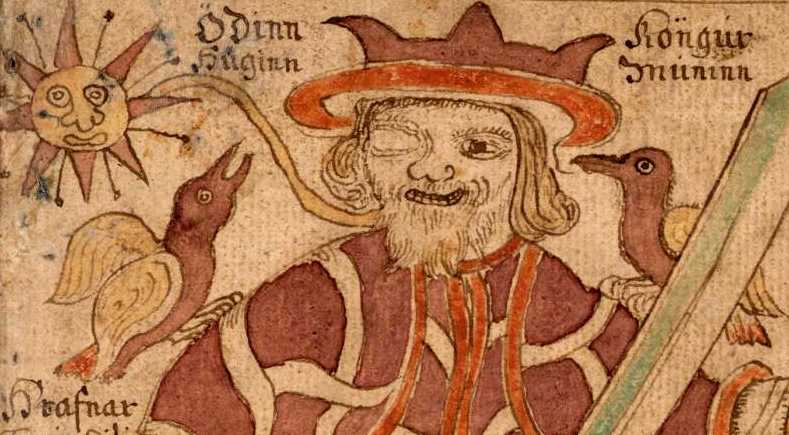
Much of what we know about Huggin and Muninn’s roles as Viking symbols comes from the medieval Icelandic writer Snorri Sturluson. In Sturluson’s work, Heimskringla (The Chronicle of the Kings of Norway), Odin had “two ravens, to whom he had taught the speech of man; and they flew far and wide through the land, and brought him the news.”6
Odin’s Spear
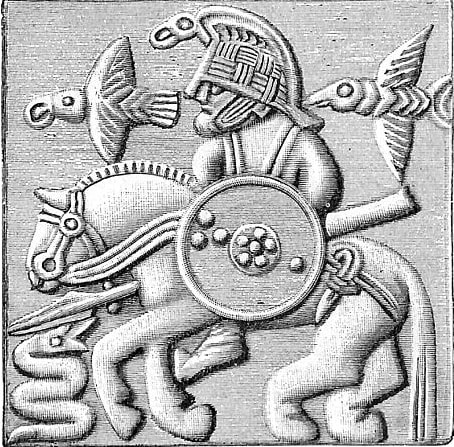
Odin’s spear, or gungnir in Old Norse, was one of the most powerful symbols in Norse mythology. Crafted by dwarves, the spear was Odin’s fearsome instrument of war. In Norse belief, Odin hurled gungnir over Vanaheim, one of the nine realms, to start the AEsir-Vanir war, a conflict between the gods.7 According to Norse legend, Odin lead his troops into battle in the AEsir-Vanir by proclaiming “Odin owns all of you!”, a phrase actual Viking warriors would shout at their enemies to put the fear of god (or Odin) into them.8
Due to gungnir’s association with the king of the gods, it was not uncommon for viking warriors to try to make their own version of this magical spear. In Viking lore, it was said that runes were carved into the tip of gungnir, which imbued it with magic. Whether for divine protection, better aim, bravery, or something else altogether, Viking warriors carved runes into their spears in an attempt to imitate gungnir.9
Odin’s Horse
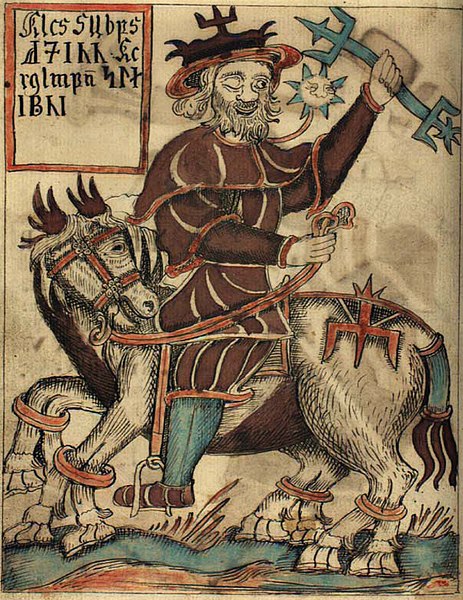
Odin’s horse, Sleipnir, has one of the more interesting (or weird, depending on your perspective) origin stories of any creature from Norse mythology. Sleipnir was conceived when the trickster god Loki transformed into a horse and mated with a giant’s horse. After he was born, Loki then gifted Sleipnir to Odin. This divine parentage gave Sleipnir magical abilities, namely incredible speed and the ability to travel between the worlds of the living and the dead.10 It was these abilities above everything else that made Sleipnir such an important Norse symbol.
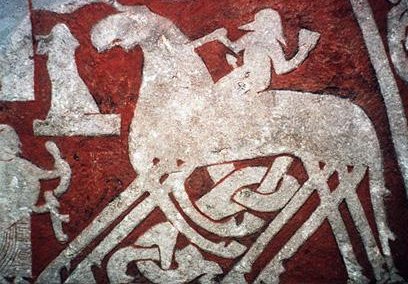
As the offspring of a Norse god, Sleipnir was no ordinary looking horse. Instead of four legs, he had eight. It was his eight legs that made Sleipnir so fast and allowed him and Odin to traverse the realms with great speed. Though Sleipnir didn’t appear in written records until the tenth century, archaeologists have found him and his distinctive eight legs in stone carvings that date back to the eighth century.11 And, when you think about the dedication it takes to carve anything into stone, especially with the tools available 1,300 years ago, Sleipnir must have been an important Viking symbol for some time before those carvings were made.
One of the theories on how the Norse people came up with the idea for an eight-legged horse ties directly into Sleipnir’s use as a symbol for the voyage between life and and death. Some historians argue that Sleipnir’s eight legs were inspired by funeral processions, when four men (two on each side) would carry a funeral bier with the body to its final resting place.12 Just as this procession helped a person go from the realm of the living and the dead, so too did Sleipnir transport the dead into the afterlife.
Vikings Symbols From Important Norse Gods
Like all pre-modern societies, the Norse drew some of their most important symbols from the stories they told about their gods. So, let’s get to two of the most important Norse gods and the symbols that Vikings associated with them.
Thor’s Hammer

In Norse mythology, Thor was one of the most powerful and important gods. The son of Odin (the Norse pantheon’s equivalent of Zeus), Thor protected the world of the gods, known as Asgard, and the human world, called Midgard, from their enemies. From this role of protector of both the gods and humanity, Thor evolved into the god of war and fertility within the Norse pantheon.13
What we remember most about the Norse god Thor (thanks in no small part to the Marvel movies) isn’t his role in safeguarding expecting mothers and Viking warriors. Instead, we think of Thor’s hammer, Mjollnir. Though experts aren’t exactly sure what Mjollnir meant in early and Medieval Norse, the current consensus is that it would translate to “lightning.” And this makes sense, as the Norse believed that thunder was the sound of Thor crashing his hammer into his enemies and that lightning struck when Thor sent Mjollnir crashing down to earth.14
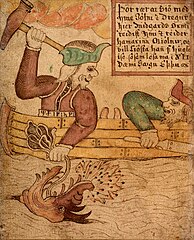
The stories of Mjollnir that come to use from Norse mythology show why Thor’s hammer became such an important Viking symbol. Forged by a dwarf named Sindir, Mjollnir made Thor invincible in battle. Anyone that Thor struck with his hammer was killed instantly. And, like the mythological version of an Apple Airtag, whenever Thor threw Mjollnir, whether he hit his target or not, the hammer would return to him. Interestingly, Mjollnir was so heavy that even Thor needed special gauntlets created by dwarves in order to lift it.15
Due to the role of Thor as a protector and the strength of Mjollnir itself, Thor’s hammer was perhaps the most important Viking symbol. Archaeologists have found evidence that wearing Thor’s hammer was a common practice throughout the VIking world. Necklace pendants in the shape of Thor’s hammer have been found as far apart as Scandinavia, Ireland, Iceland, and Russia.16 Interestingly enough, more Norse people began wearing Thor’s hammer as Christianity spread into Scandinavia as a way to demonstrate their belief in Thor and the old gods.17
Viking Ships and Skidbladner
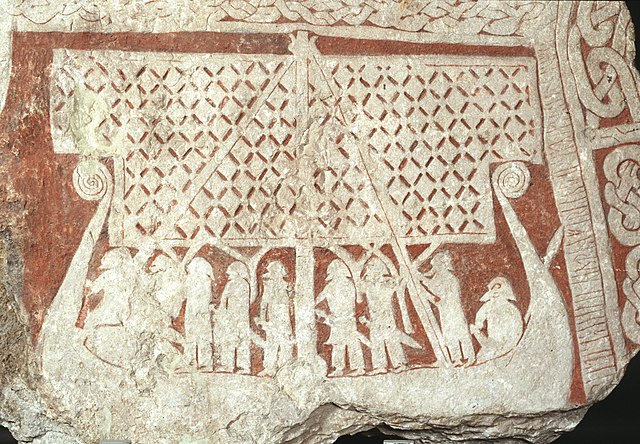
Ships were one of the most important aspects of Viking culture. Rivers and fjords dominated the unique landscape of their homeland, meaning water was the fastest and most efficient way of traveling within Scandinavia. And, without their amazing ships, Vikings could not have traveled across Europe and the Atlantic. Indeed, one historian has put it as succinctly as, no Viking ships “no Vikings and no Viking Age.”18
The importance of ships to everyday life in the Norse world made these vessels into one of the most important, and enduring, Viking symbols as well. Archaeologists have found images of ships carved into stone and etched into coins, and jewelry fashioned to look like a classic Viking ship. Scholars have even found evidence of a high-profile burial that used a 17 feet-long ship as a burial chamber. Excavated in Sandefjord, Norway around 1880, the ship, now called the Gokstad ships, is the best surviving example of a Viking Age vessel and has informed much of what we know about Norse seafaring.19
Just how critical ships were to Viking culture is underscored by their inclusion in mythology. Frey, the god of fertility and vitality in the Norse pantheon, had a ship fashioned for him by a dwarf. Frey’s ship was named Skidbladnir (pronounced Skithblathnir) and was said to be “the best of ships.” According to lore, Frey could use Skidbladnir to get anywhere in the world near instantaneously and, when he didn’t need to sail it, could fold the ship up and put it in his pocket.21
Frey’s role as the god of fertility and the ubiquity of ships and ship symbolism in the Viking world points to ships as an important Viking symbol of prosperity and abundance.
Boars, Frey, and Freya
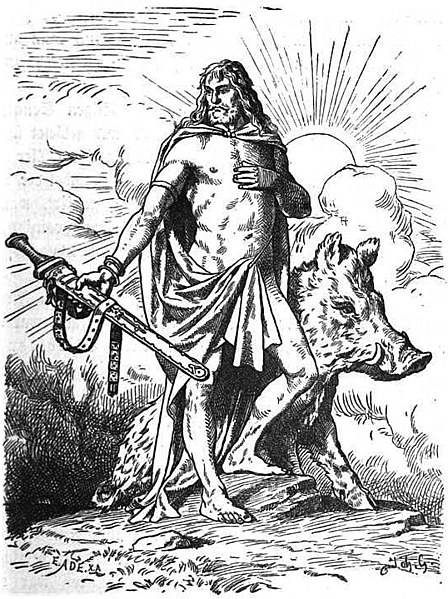
As we said above, Frey was one of the most important Norse gods. In fact, scholars often put him in the Viking “holy trinity” alongside Odin and Thor. What we didn’t mention above, however, is that Frey had a sister named Freyja. Considered the most revered of the Norse goddesses, Freyja was the goddess of battle, death, love, and fertility – she really covered the gamut!22 But, what does this have to do with boars? Well, each of these divine siblings had boars with golden bristles. Frey’s board was named Gullinbursti (Golden-maned) and Freyja’s was named Hildsvin (“battle swine”).23
Clearly, boars were important Viking symbols, since two of their most important deities had boar companions. Why, though? In the world of Norse mythology, boars served as symbols for both agriculture and fighting ability. According to Norse belief, boars brought the knowledge of farming to humanity, showing people how to plow the earth and sow seeds by using their tusks.24 Boars heads (sónarblót) were also served at Yule, the Norse celebration during the winter solstice. On one hand, just like Frey, boars were a sacred symbol of fertility.
On the other hand, boars were a powerful Viking symbol for war, bravery, and fighting ability. The Prose Edda describes how: “Rides… on a board with bristles of gold, battle-wise Frey[r] to the fortress of Odin’s son…”25
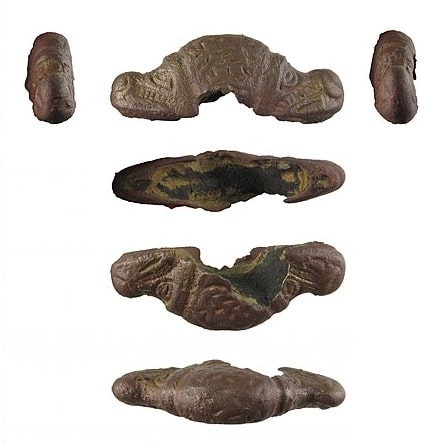
Just as Frey and Freyja rode Gullinbursti and Hildsvin to war, Viking warriors decorated their helmets and swords with boar imagery. It was believed that wearing a boar on your helmet would protect your life during battle. Presumably, having a boar on your sword would make you more formidable.26
Famous Viking Symbols From Norse Mythology
While the gods were clearly important to the development of Norse symbols, Vikings found symbolic meaning in other places, too. So, to truly understand Viking symbols and their meanings, we need to explore the world of Norse mythology.
Jörmungandr, or the Midgard Serpent
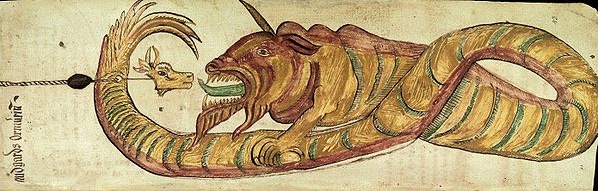
Jörmungandr, which translates to the Midgard Serpent or World Serpent, was another magical creature from Norse mythology who featured prominently in Norse symbols from the Viking Age.
The son Loki and the giantess Angrboða (or Angrotha) – anyone else notice Loki is a little freaky? – Jörmungandr was believed to be one of the three beings that would bring about the end of the world, Ragnarok. In Norse belief, Jörmungandr and his siblings Fenrir (a giant wolf) and Hel were imprisoned by Odin because of a prophecy that foretold their role in the defeat of the gods. Fenrir was trapped on a rocky island, Hel was sent to the underworld, and Jörmungandr was dropped into the ocean.27
Over time, Jörmungandr grew so large that he encircled the entire world and greeted at the bottom of the ocean with his own tail in his mouth. When Ragnorok came, the Vikings believed that Jörmungandr would rise from the ocean and join his siblings in an epic battle against the gods. IN this battle, Jörmungandr would be killed by a blow from Thor’s hammer, but not before delivering a poisonous bite to the mighty god that would kill him shortly after the battle.28
Because of his role in Ragnarok and the death of Thor, many historians view Jörmungandr as a Viking symbol of change and transformation. From the ashes of Ragnarok a new world would begin, just like a “new” serpent emerging from the old skin it left behind.29
Yggdrasil, the Tree of Life
Yggdrasil, which literally translate to “Odin’s gallows,” is a giant ash tree that holds the universe together. Sometimes called the Tree of Life or the World Tree, Yggdrasil functioned as the VIking symbol for the cosmos.
Though Norse mythology (or at least the myths that have survived) never tells us about all nine worlds that made up the universe, it does tell us that the Tree of Life held them all together. From written sources put together after the Viking Age, we know that Agard (the realm of the gods), Midgard (earth), Niflheim (the underworld), and Jotunheim (the realm of the giants) were all located somewhere within the great ash tree. Where exactly, however, depends on the source.30

One of the most famous stories about Yggdrasil tells that Odin hung himself from its branches for nine days in order to gain knowledge. In most iterations of this tale, Odin was specifically after knowledge of runes, which he eventually passed on to humanity. This tale is perhaps how this important tree got the name “Odin’s gallows.”31
The fact that the Norse used a tree to represent the cosmos tells that, much like the gods, they viewed the universe as temporary. The Vikings knew that all trees eventually fall and this had to have been on their mind with Yggdrasil – that, one day, the Tree of Life would die and the universe would end.32
Valknut, aka Odin’s Knot

The valknut, sometimes referred to as Odin’s knot, is an ancient symbol from the Viking world. Made up of three interlocking triangles, archaeologists have found the Valknut on stone motifs in Gotland, Sweden which date to sometime between the eighth and tenth centuries.33 A large Viking age ship has also been unearthed in Gotland, which had the valknut carved into its wood.34 Unfortunately, we don’t know what the Norse themselves called this symbol. Interestingly, the name valknut is from modern Norwegian and translates to “knot of the slain.”35
Even among Viking symbols, this is a pretty intense name. The valknut name earned this rather viking-esque nom-de-plume because it has only been found in burial sites. Additionally, the stone carvings that feature the valknut also show a figure who looks a lot like Odin. In Norse mythology, Odin shepherds the dead into the afterlife and leads armies of dead warriors into battle from his hall Valhalla. These powerful symbols of the afterlife from Viking culture have led experts to believe that the valknut was used to symbolize death in religious iconography. But, beyond that, its exact meaning remains unclear.36
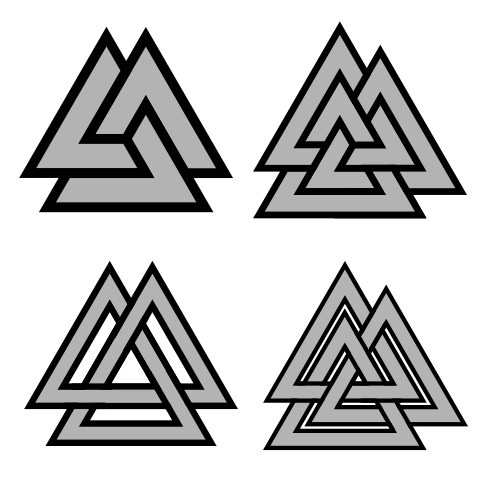
Another interesting interpretation of the valknut which lends more evidence to its association with death connects its knot-like appearance to the importance of weaving in Norse life and religion. In Norse mythology, weaving and spinning were used as representations for fate. The gods or the norns (three demi-god sisters who lived at the base of Yggdrasil) were believed to “spin the threads of fate.”37 A knot in these threads could easily symbolize death.
Viking Runes as Viking Symbols Important to Norse Culture
Today, when we think about Viking symbols, the runic alphabet isn’t far behind. Unlike other Norse symbols, however, runes were closer to pictograms than true symbols. But runes still held a special place in Norse belief and religious practice.
Runic Alphabet
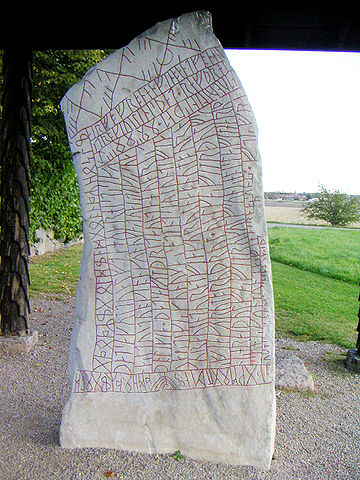
The history of the runic alphabet in Scandinavia goes all the way back to the second or third century AD.38 Though historians are not sure of how exactly writing came to the area, it seems likely that Germanic peoples who interacted with either the Etruscans or the Romans in northern Italy took their alphabet north, where it morphed into runes.
This pan-Germanic runic script has become known as elder futhark, because the first six of its 24 runic symbols represent the sounds “f”, “u”, “th”, “a”, “r”, and “k”.39 Almost sounds like a Danish cheerleading squad… Anyway, by the time of the Viking Age, the Norse version of the runic script had evolved to a runic script that contained 16 symbols and has thus been dubbed younger futhark.
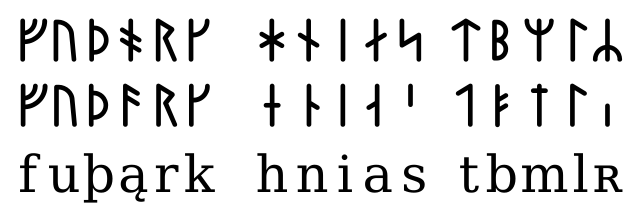
The Norse used younger futhark in a variety of ways. Some were fairly mundane, like marking one’s property. But the Norse people believed, too, that runes could hold magical properties.
This association with magic meant that runes were not written on paper, but carved into objects like bones, metal, or wood. This was thought to imbue the object with the runes’ magic.40 One example of this comes from the battlefield, where a viking warrior known as a berserker would carve the runic symbol for Tyr (the god of warriors) into their shield before battle. Whether or not this berserker symbol actually provided magical protection, it no doubt put fear into the hearts of the opposing enemies.41
One of the beliefs that evolved alongside the runic alphabet was that runes were given to humanity by Odin. Having acquired the knowledge of the runes after hanging himself from Yggdrasil, Odin gave this knowledge to mankind. The fact that they were given runes by the Allfather himself is one of the reasons the vikings believed in the power of these ancient symbols.42
Helm of Awe
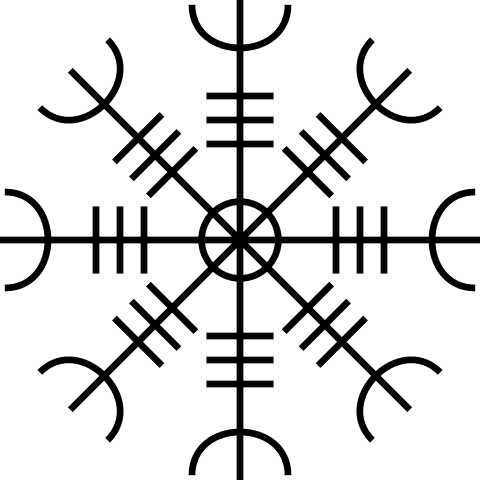
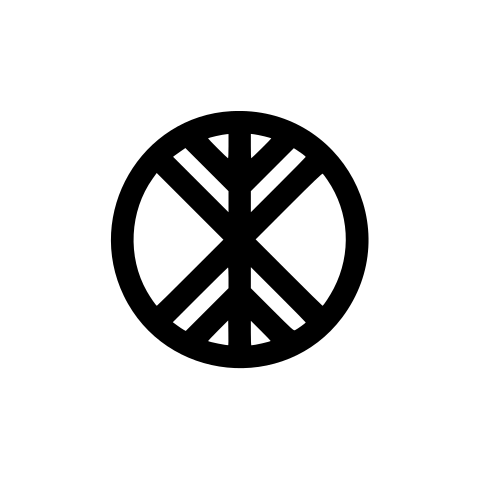
The Helm of Awe is made up of eight spokes that radiate out from a small circle. Each of these spokes has three perpendicular lines at their midpoints and are topped with a semi-circle so that they look like rounded tridents.

The spokes of this Viking symbol may come from Z-runes, which were used to provide protection against enemies.
The perpendicular lines on each spoke are derived from Isa runes, which translate from the Norse language as “ice.” While Isa runes are still not fully understood, scholars believe that Isa runes were used to steel oneself for an expected hardship.43
The Helm of Awe is one of the more enigmatic Viking symbols. The earliest record we have of the Helm of Awe comes from a seventeenth-century Icelandic manuscript that recorded a Norse legend from the thirteenth-century.44 This poem, called Fáfnismál, tells how the hero Sigurth found the dragon Fafnir. In the poem, Fafnir brags:45
The fear-helm I wore
to afright mankind,
While guarding my gold I lay;
Mightier seemed I | than any man,
For a fiercer never I found.
From this description, scholars have surmised that the Helm of Awe symbol would have been carved into a warrior’s helmet or armor for protection. Another later source tells us that a VIking would draw the Helm of Awe between his eyes and say a prayer in an attempt to ward off enemies.46
Though the Helm of Awe has never been found in a Viking Age archaeological site, the fact that it was described in a poem dating to the Middle Ages lends credence to the idea that this is an honest to Odin Norse symbol.
Modern Riffs on Viking Symbols
The fascination with Viking symbols has extended from the Middle Ages to the modern day. But that doesn’t mean everything that looks like a Norse symbol is genuine. A few popular iterations on these ancient symbols, in fact, have only been around since the mid-1800s or less.
Viking Compass
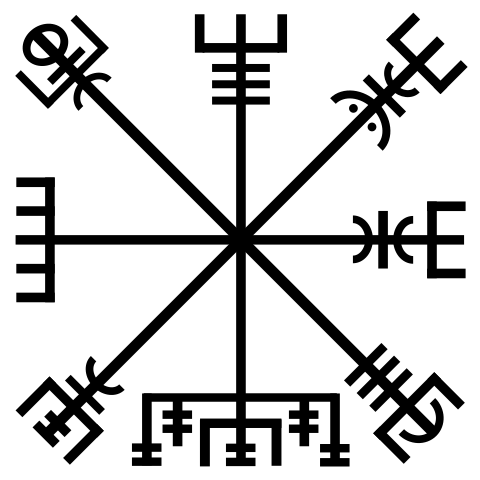
Even though the Viking Compass, also known as the Nordic compass or vegvísir in Icelandic, may look like legitimate Viking runes, it’s most likely 1,000 years younger than elder futhark.
The Viking Compass first appeared in the historical record in 1860 in the Huld Manuscript, a collection of Icelandic traditions of magic.47 Written by Geir Vigfússon, the Huld Manuscript says that if you “Carry this sign with you and you won’t get lost in storms or bad weather, even though in unfamiliar surrounds.”48 So, according to Vigfússon, this magical symbol would help you to not loose your way when traveling.
Unlike ancient and medieval Viking symbols, like Thor’s Hammer and the Valknut, the Viking Compass has never been found carved into rock, etched in metal, or shaped into jewelry. While it could still be waiting to be discovered, it seems most likely that the Nordic Compass was created well after the Viking Age.
Troll Cross
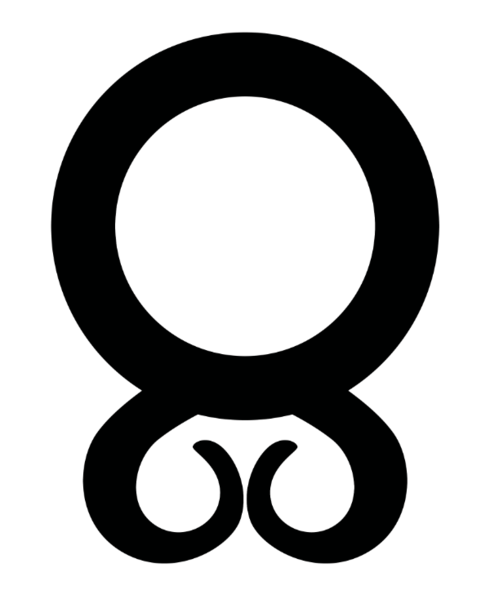
If you thought the Viking Compass was young, the Troll Cross might be a millennial! First introduced by fashion designer Kari Erlands, this symbol appears nowhere in the archaeological or historical record before 1990.49 Erlands certainly took inspiration from her Swedish heritage, however, and drew upon historical Viking symbols to create this symbol.
But, what if you don’t care? It still makes for a great looking necklace afterall. Well, the modern mythology has cropped up around this new age design says that it used to protect against trolls. Trolls were certainly some of the many mythical creatures from Viking era Norse mythology. While no written accounts from this era describe trolls, later Medieval works of Icelandic literature depict trolls as huge, ugly, and stupid, but nonetheless magical beings.50
Trolls definitely sound like creatures to keep at distance – so go get yourself a Troll Cross!
Sources on Viking Symbols and Their Meanings
- Tales of Heroes, Gods & Monsters: Norse Myths & Legends (London: Flame Tree Publishing, 2002), 391.
- “Hugin and Munin: Odin’s Ravens,” museum.ie
- “Are ravens as smart (or smarter) than us?” bbcearth.com
- “Hugin and Munin: Odin’s Ravens,” museum.ie
- James Graham-Cambpell, The Viking World, 155
- Snorri Sturluson, “The Ynglinga Saga, or the Story of Yngling Family From Odin to Halfdan the Black,” sacred-texts.com
- History Brought Alie, Norse Mythology Legends: Epic Stories, Quests, Myths & More from The Most Powerful Characters, Gods, Goddesses & Heroes of Norse & Viking Folklore, via google.com/books
- Daniel McCoy, “Gungnir,” norse-mythology.org
- Ibid
- Riley Winters, “The Ascension of Sleipnir: The Mythological Origins of Odin’s Steed,” ancient-origins.net
- Joshua J. Mark, “Sleipnir,” worldhistory.org
- H. Davidson, Gods and Myths of Northern Europe, via google.com/books
- Rachel Morgan, “Mjolnir’s Secrets: Thor’s Hammer Across the Viking World,” thecollector.com
- Daniel McCoy, “Thor’s Hammer,” norse-mythology.org/
- “Mjolnir,” kids.britannica.com
- Morgan, “Mjolnir’s Secrets.”
- McCoy, “Thor’s Hammer.”
- Daniel McCoy, “Viking Ships,” norse-mythology.org
- “Gokstad Ship,” penelope.uchicago.edu
- “Skidbladnir,” kids.britannica.com
- “Freya,” britannica.com
- Andrew Johnson, “The Wild Boar In Teutonic & Scandinavian Mythology (A Summary),” academia.edu/
- Ibid
- Thijs Porck, “Medieval piggyback rides: Riding boars in the Middle Ages,” leidenmedievalistsblog.nl
- Johnson, “The Wild Boar In Teutonic & Scandinavian Mythology (A Summary).”
- Joshua J. Mark, “Jörmungandr,” worldhistory.org
- “Jormungand,” kids.britannica.com
- Mark, “Jörmungandr,” worldhistory.org
- “Tree of Life,” britannica.com
- Peter Archer, The Book of Viking Myths: From the Voyages of Leif Erikson to the Deeds of Odin, the Storied History and Folklore of the Vikings (Avon, MA: Adams Media, 2017), 82.
- Daniel McCoy, “Yggdrasil,” norse-mythology.org
- “Saga Motifs on Gotland Picture Stones: The Case of Hildr Högnadóttir,” medievalists.net
- “Valknut,” britannica.com
- “Valknot,” adl.org
- Daniel McCoy, “The Valknut,” norse-mythology.org
- Project Runeberg, “Nornor,” runeberg.org
- Nicole Sanderson, “Runes Through Time,” pbs.org
- Ibid
- “Viking Runes and Runestones,” historyonthenet.com
- Sanderson, “Runes Through Time.”
- Archer, The Book of Viking Myths, 203.
- Daniel McCoy, “The Helm of Awe,” norse-mythology.org
- Mark Johnston, “What is the Helm of Awe? Runes, Symbols, and Viking Magic!” ancient-origins.net
- Snorri Sturluson, Poetic Edda, voluspa.org
- “The Helm of Awe,” worldhistory.org
- Jess Scott, “Vegvísir: The Truth of the ‘Viking Compass’,” lifeinnorway.net
- Justin Foster, “Huld Manuscript of Galdrastafir Witchcraft Magic Symbols and Runes – English Translation,” academia.edu
- Dani Rhys, “Troll Cross – Meaning and Origins, symbolsage.com
- Aðalheiður Guðmundsdóttir, “Behind the cloak, between the lines: Trolls and the symbolism of their clothing in Old Norse tradition,” degruyter.com