Inca Weapons: Instruments of Andean Empire
Inca weapons were the deadly force behind the most powerful indigenous empire South America ever knew. Beginning their expansion in the thirteenth-century, the Incas created an empire that stretched from from modern day Ecuador through Peru and Chile, with landscapes that included the Pacific shoreline, Andean mountains, and Amazonian rainforest.
Let’s explore the weapons that made this meteoric rise to empire possible.
Macana
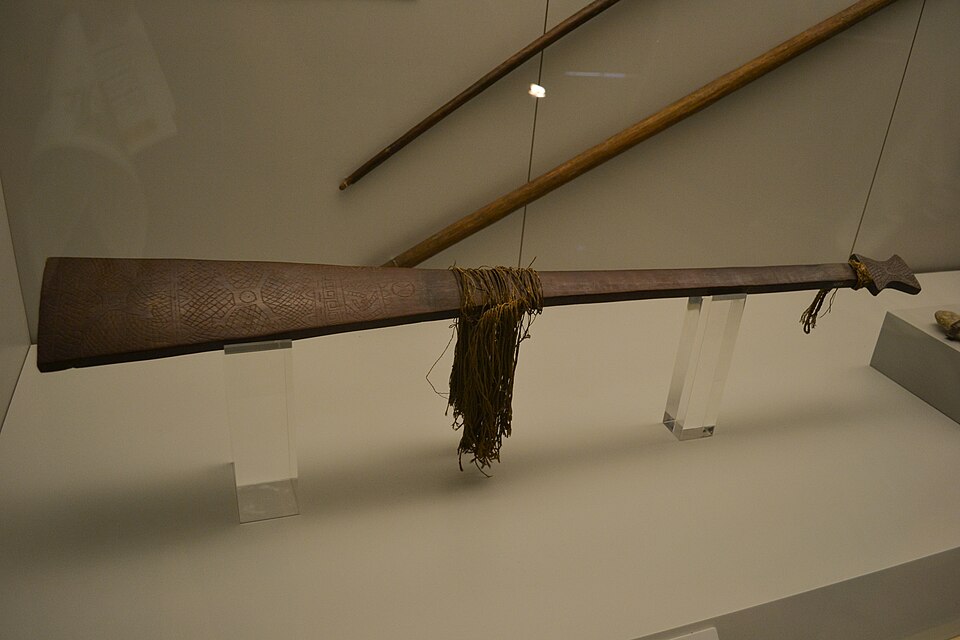
The word macana was originally derived from a Taino word used to describe wooden, club-like weapons. The Spanish adopted this term and used it to describe weapons cultures they encountered in the Americas. For example, conquistadores referred to the Aztec maquahuitl as a macana as well.
The Inca variety of the macana was an intimidating weapon indeed. About four feet long and 10 centimeters wide, the macana was sharpened at the edges and resembled a European broadsword. Like other varieties of sword, the macana was wielded with hands.1 Made from the chonta palms indigenous to the west coast of South America, these Inca weapons were hard, durable, and deadly.2
Contemporary accounts and archaeological finds make its effectiveness clear. The macana, when wielded by an expert warrior, could deliver so much force that it would fracture a skull.3 Not a pleasant way to go.
Champi
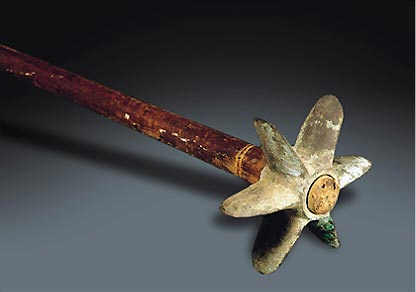
The champi is perhaps the most recognizable of all Inca weapons. Similar to a mace, the champi was made by attaching a star-shapped head (made of either stone or copper) to a wooden pole. These poles could be short or long, perhaps depending on the preferences of the individual warriors.4
The Spaniard Fernández de Oviedo wrote about seeing these bad boys in action on the battle field:
“First came men with slings and stones the size of eggs, carrying shields and wearing suits of quilted cotton to protect themselves against projectiles. Behind them marched soldiers with clubs and axes. The former carried the Andean… club with a sharp star-shaped stone fixed to the end, or clubs with hafted stones the thickness of a fist or sharp stone points.”5
As you can imagine, these were brutal weapons. When swung at full force, the star-shaped mace could easily fracture the bones of enemy combatants (or worse). If, like Oviedo, you saw a contingent of warriors holding these on the other side of the battle field, you undoubtedly thought of running.
Warak’a

Throughout history, the best armies have had an effective combination of hand-to-hand fighters and marksmen. The warak’a (sometimes spelled huaraca) was a sling made of rope that was used to hurl egg-sized stones at the enemy lines. Inca warriors that used the warak’a were highly trained and had excellent aim. In this way, the warak’a gave Inca armies the ability to pelt their enemies from distance before leading the battle charge.6
The synthesis of simplicity and efficiency, the warak’a were probably not difficult for the Inca to manufacture but had catastrophic consequences on the battlefield. When shot by an expert, the stone travelled fast enough to fracture skulls. Spanish accounts even attest that warak’a stones could snap their metal swords.7 This makes me wonder: how much damage did the warak’a do to Spanish armor? I’m guessing a decent amount.
Bolas
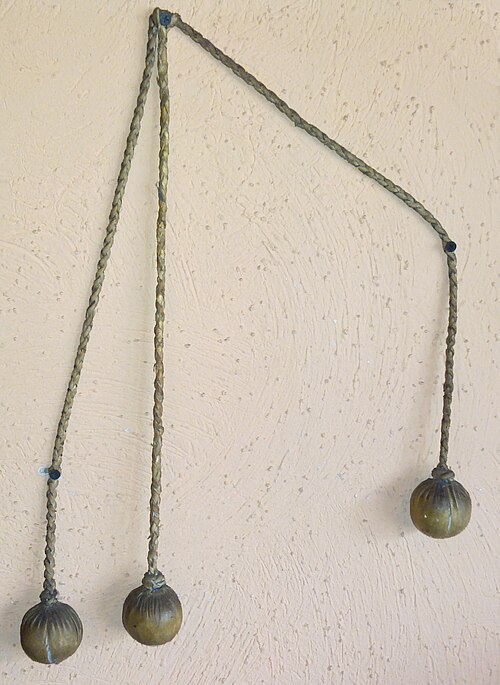
Bolas were one of the more ingenious Inca weapons. Like the macana, the word bolas is a Spanish word. The conquistadors didn’t get very imaginative with their naming, though, as bolas just means “balls.”8 The bolas was constructed by tying balls made of metal or stone to the ends of two or three chords, and then tying these chords together. The Inca warrior would then spin the bolas so that the chords rotated like helicopter propellers.
While the name that’s come down to us for this weapon is kind of boring, it was unbelievably effective on the battlefield. The bolas was used by throwing it at the feet of an oncoming enemy. It would then wrap itself around their legs, causing them to fall. This would make the individual extremely vulnerable. Plus, when whole units released their bolas at the same time, it could cause chaos on enemy lines by incapacitating the front lines.9
This Inca weapon proved especially useful against European forces during the Spanish conquest. Conquistadors often rode horses into battle, which presented a larger target for the bolas. And if you took down a mounted horse charging into battle, it was usually bad news for the rider and those around them.10
Cotton Armor and Shields
For soldiers in the Inca army, there were three main defensive Inca weapons: helmets, tunics, and shields.
Inca helmets were made from wood or animal skins and decorated with precious stones, mentals, or feathers depending on the soldier’s rank and area of origin.11 These helmets offered good protection from traditional South American weapons like the ones we’ve discussed in this article. During the Spanish conquest, though, wooden helmets proved less effective against the broadswords of the Spaniards.
Around their bodies, Inca soldiers tunics and quilted armor. The armor was made by wrapping layers of cloth around their body. This helped in absorbing blows from weapons or fists, or perhaps even saving them from an arrow. Over this armor, the Inca wore their finest tunics, similar to how they would have dressed for religious ceremonies or festivals.12 This tidbit gives us an interesting glimpse into Inca psychology around warfare. Did they wear these clothes so that if they died they would look their best? On the other side of the world, ancient Spartans bathed before battle for this very reason. Or, returning to the Inca, was Andean warfare more ceremonial than its Eurasian counterparts? Elsewhere in the Americas, the aim of war was to take prisoners rather than kill enemy armies into submission.
Finally, defensive Inca weapons were topped off by their shields. It seems that it was common for Inca warriors to go into battle with two shields. One was a smaller, round shield made from strips of palm wood and cotton woven together. Given that was worn on their back, this could have been devised as a means of protecting fighters from arrows and rocks slung from a warak’a. Their second shield was larger and rectangle, and would have been carried in from of the soldier to protect them from blows the champis, macanas, and clubs common in Andean warfare. These larger shields also had a piece of cloth hanging off the bottom, acting as a banner which symbolized the might and size of the Inca empire.13
Sources on Inca Weapons
- Gordon F. McEwan, The Incas: New Perspectives (New York: W.W. Norton & Company, 2006), 128-129
- Father Bernabe Cobo, Inca Religion and Customs (Austin: University of Texas Press, 2010), 218
- Maria Rostworowski de Diez Canseco, History of the Inca Realm (New York: University of Cambridge Press, 1999), 91-92
- Bernabe Cobo, Inca Religion and Customs, 218
- Rostworowski de Diez Canseco, History of the Inca Realm, 91-92
- “Inca sling (Huaraca),” digitalgems.contentdm.oclc.org
- Andrew Knighton, “10 Defining Features of Incan Warfare,” warhistoryonline.com
- “Bola,” britannica.com
- McEwan, The Incas, 128
- John Pemberton, Conquistadors, google.com/books
- Michael J. McGrath, “Incan Military History,” ebsco.com
- McEwan, The Incas, 128
- McEwan, The Incas, 129