Macuahuitl: The Wooden Sword of Aztec Warriors
Aztec warriors made up one of the most fearsome fighting forces of all time. In two centuries, they enabled the Aztecs’ imperial expansion, driving the accumulation of fabulous wealth and achievements in their capital city of Tenochtitlan. But what made these soldiers so effective? One thing was certainly the most powerful of their shock weapons: the macuahuitl.
What Was a Macuahuitl, Exactly?

The preferred weapon of choice among the elite Aztec warriors, the macuahuitl was a formidable force on the battlefield.
Despite its appearance, which may not convey the strength of an iron sword from the Old World, Spanish conquistadors consistently documented the macuahuitl’s remarkable ability to cut through the whole neck of a horse, taking the horse’s head clean off. Yikes!
Crafted from resilient materials like oak, these Aztec swords, armed with razor-sharp obsidian blades, often outperformed their European counterparts, inflicting considerable damage on their opponents.
The macuahuitl came in two variations: a compact one-handed version measuring approximately 3 to 4 inches in width and a little over 3 feet in length, and a larger two handed sword, about 4 inches wide and as tall as a man. Mastering the use of the two-handed macuahuitl required exceptional skill.
Artisans meticulously constructed these lethal weapons by fashioning the sword’s body from robust wood, typically oak, and carving grooves along the outer edge. The body of the macuahuitl resembled a modern cricket bat – it was long a flat, with a handle at the bottom for the user to grip. Within the grooves along the side, Aztec artisans would insert stone knives or blades made from obsidian.
The obsidian blades, made from volcanic glass, were strategically placed either tightly adjacent or with deliberate gaps. This created a surface that was either smooth and consistent or serrated. This blade design makes the macuahuitl look like an obsidian chainsaw! To secure these blades, artisans employed bitumen and adhesive made from turtle dung.
The macuahuitl’s efficacy in battle was so impressive that even Spanish soldiers conceded its superiority over European swords. Despite their best efforts, the Spaniards found it nearly impossible to break the obsidian blades, a rare admission of inferiority from the conquistadors.
Unfortunately, no original macuahuitls have survived to the present day. More than one artist has, however, made a modern recreation of these powerful weapons.
Who Used the Macuahuitl in Aztec Warfare?
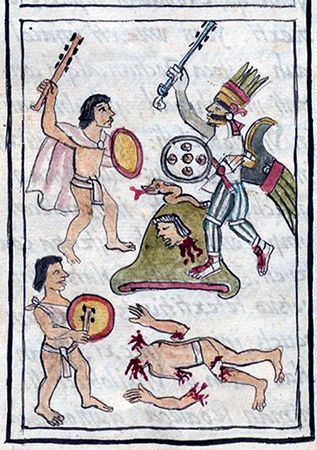
The Aztec Empire was a highly hierarchical place, so it makes sense that their military was no different. But whether the use of certain weapons, like the macuahuitl, was sanctioned based on a soldier’s rank in the army is unknown. What we do know about the macuahuitl’s use comes from diaries kept by conquistadors during the Spanish conquest, and codices compiled by Spaniards and Aztecs alike in the years following the conquest.
The codices give us some pictorial evidence for who may have used the macuahuitl in battle. In these books, we find images of Aztec and Mesoamerican nobles, including kings, wielding the macuahuitl in battle. These volumes also have depictions of the elite squadrons of the Aztec army carrying their wooden sword into battle.
A highly effective weapon for hand-to-hand combat, it would have made sense for the elite warriors to carry the macuahuitl into battle. The way to subdue an enemy in Mesoamerican warfare was not to kill as many opposing soldiers as you could before they surrendered (though people certainly died in battle). Rather, the way to win battles and conquer territory was to capture enemy soldiers. This role fell largely to the most highly skilled members of the army, such as the jaguar warriors and eagle warriors.
Some Spanish accounts that describe the enormous stockpile of macuahuitls in the Aztecs’ royal armory raise the possibility that this weapon was used those outside of the upper ranks.
“Montezuma had two houses stocked with every sort of weapon… There were shields large and small, and a sort of broadsword, and two-handed swords set with flint blades that cut much better than our swords”
Were these stockpiles to keep the elite warriors well-armed or were even common soldiers given the chance to swing the macuahuitl in battle?
Why the Aztecs Used Obsidian
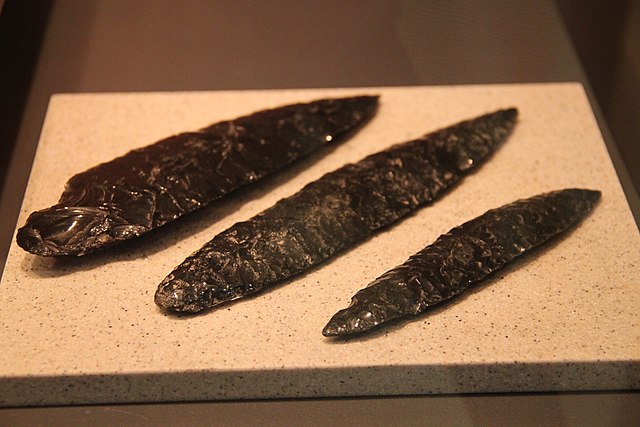
The Aztecs used obsidian in the macuahuitl because it was sharp! Expertly crafted obsidian blades are sharper than any other tool in either the ancient or modern world. They’re even sharper than a surgeon’s scalpel.
It also helped that obsidian was readily available. Found in the highland areas of central Mexico, obsidian is a type of volcanic glass that is formed when liquid lava quickly cools. Like other forms of volcanic glass, obsidian is rather brittle. Obsidian’s fragile nature turned out to be a double-edged sword for the Aztecs (see what I did there?).
Since obsidian blades can be easily made by chipping them off from larger pieces of the black glass, Aztec craftsmen had access to plenty of material to make macuahuitls with. But, it also made the sword’s blades fragile in battle.
How We Know About the Aztec Wooden Sword
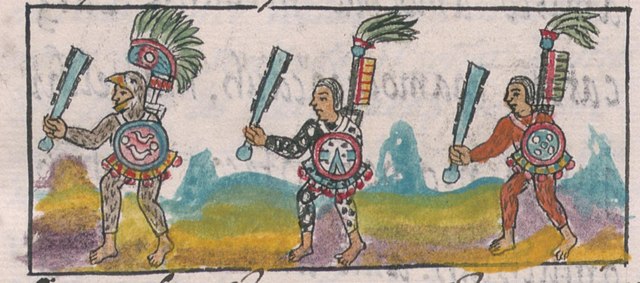
So, I mentioned earlier that there are no macuahuitls left from the Aztec period. This begs the question: how do we know about them then?
A number of folio type books, known collectively as codices, contain Aztec pictographs and European illustrations of what they saw when they arrived in Mexico – including macuahuitls.
The most famous examples include the Florentine Codex and the Codex Mendoza – both of which have been digitized and provided images for this article!
Both of these well-known codices were created in the years that followed the fall of the Aztec Empire. The Florentine Codex was written by Bernardino de Sahagún, a Franciscan friar who arrived in Mexico eight years after the Aztec Empire’s fall. This has become a highly valuable form of information about the Aztecs and their way of life.
Likewise, the Codex Mendoza contains numerous images of Aztec warriors carrying macuahuitls into battle. Though we don’t know how authored the work, it tells the history of the Aztec Empire and gives descriptions of their daily lives – information which has become invaluable.
Sources on the Macuahuitl
- Marco Antonio Cervera Obregón, “Mexica Weaponry,” mexicolore.co.uk
- “Codex Ixtlilxochitl, Folios 105 (verso) and 106 (recto),” metmuseum.org
- Paul Wilding, “Maquahuitl,” mexicolore.co.uk
- Michael E. Smith, The Aztecs (Cambridge, MA: Blackwell, 1996), 86
- “Obsidian,” britannica.com
- “General History of the Things of New Spain by Fray Bernardino de Sahagún: The Florentine Codex. Book IX: The Merchants,” loc.gov
- “Codex Mendoza (1542),” publicdomainreview.org