Valknut Symbol and Its Meaning in Norse Mythology
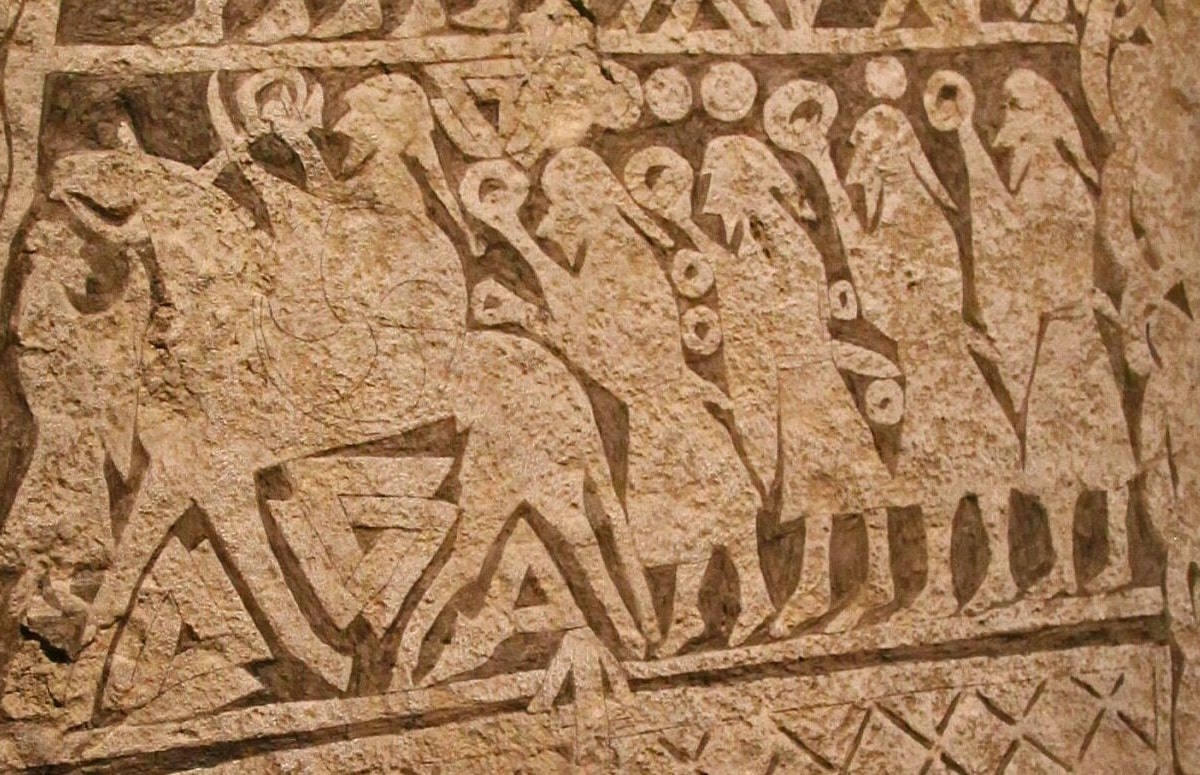
A mysterious symbol made up of three interlocking triangles, the valknut has sparked debate for decades. Its origins are so clouded that even the term valknut is a modern Norwegian word that means “knot of those fallen in battle.”1 Let’s dive into the history and meaning of the valknut symbol and see if we can’t untangle the meaning of these intertwined triangles.
A Brief History of the Valknut Symbol
The history of the valknut symbol is pretty murky. So much so, that some historians contest the valknut was not a true Viking age symbol. For the sake of this article, however, let’s ignore those pesky naysayers and explore the medieval evidence we have of the valknut’s meaning and history.
Author’s note: Several sources claim that the valknut has been found on a wooden bed post and a partially preserved tapestry found in the Oseberg ship burial. I have not been able to find any pictorial evidence of this, and have thus decided to omit this bit of the narrative from the article.
Stora Hammars Picture Stone
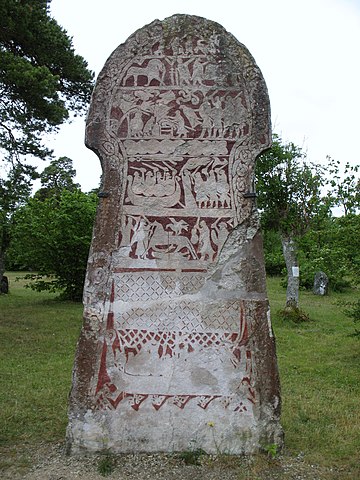
Found in 1855 on Gotland, a Swedish island located 56 miles off the Baltic coast, the Stora Hammars pictures stone is one of the best pieces of archaeological evidence for the valknut.2 Originally carved sometime between the eighth- and tenth-century, the Stora Hammars stone depicts a Viking Age battle.3 Historians have argued that the battle etched into the stone is from Norse lore, specifically the legend of Hildr.
According to this legend, Hildr is a valkyrie, or a spirit who collected souls from the battlefield for the chief Norse god Odin, who was captured by a king. Her father, obviously upset, went to war to get her back. After the first day of battle, rather than taking souls of fallen warriors to the afterlife, Hildr resurrects them to fight the next day. Then, after another day of fighting, she does again. By the end of the tale, we learn that Hildr plans to keep this battle going until the end of time.4
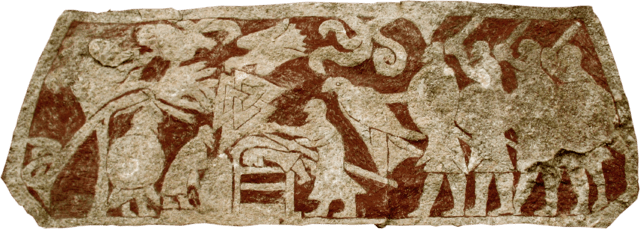
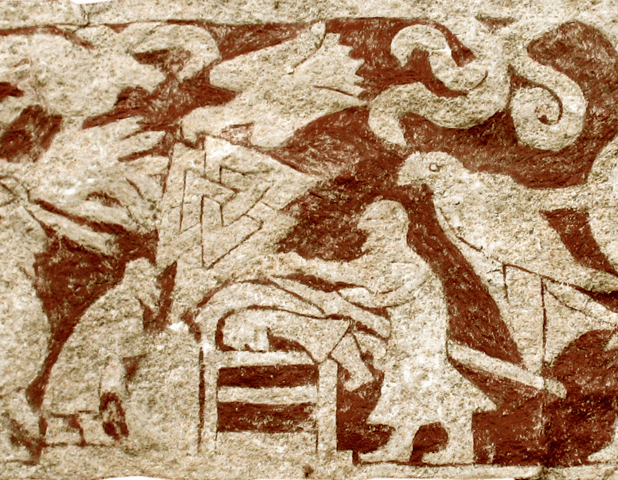
The Stora Hammars stone tells this story through six scenes that stretch from the top to the bottom of the large monolith. The third panel, which shows a man, with an army at his back and two birds overhead, making a sacrifice, is the one that concerns us. In this image, the man conducts the sacrifice by wielding a valknut against the sacrificial victim.5
Tängelgårda Stone
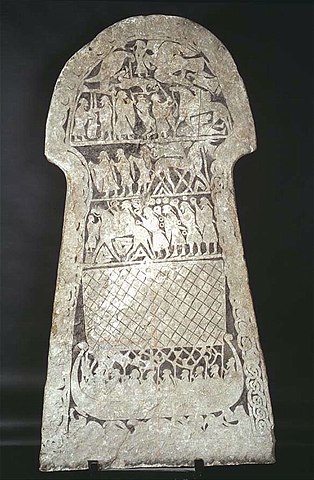
Created between 800-1100, the Tängelgårda stone also depicts a scene from Norse belief systems. Much like the Stora Hammars stone, the creators of the Tängelgårda stone divided the story up into four sections.6
The top section of the stone shows a great battle, with carrion birds, possibly ravens, flying around the slain warriors. The second section shows a funeral procession, with men carrying their swords pointed downward in a show of respect for the dead. It also seems that Odin and his eight legged horse Sleipnir are accompanying the procession, possibly to help usher the fallen warriors into the afterlife.

The third section shows the dead men, one on horseback, arriving at Odin’s hall, each carrying an oath ring to show their loyalty to the god. It’s this section where the valknut appears prominently. Under the gaps in the horses legs, the artists drew three different sets of interlocking triangles. Finally, in the last section, a ship full of people is shown sailing on open waters, potentially ferrying the fallen warriors into the afterlife.7
The Tängelgårda stone’s depiction of a warrior’s journey into the afterlife and Odin’s hall, Valhalla, has led some historians to posit that the valknut is somehow related to the worship of Odin.8
Nene River Ring
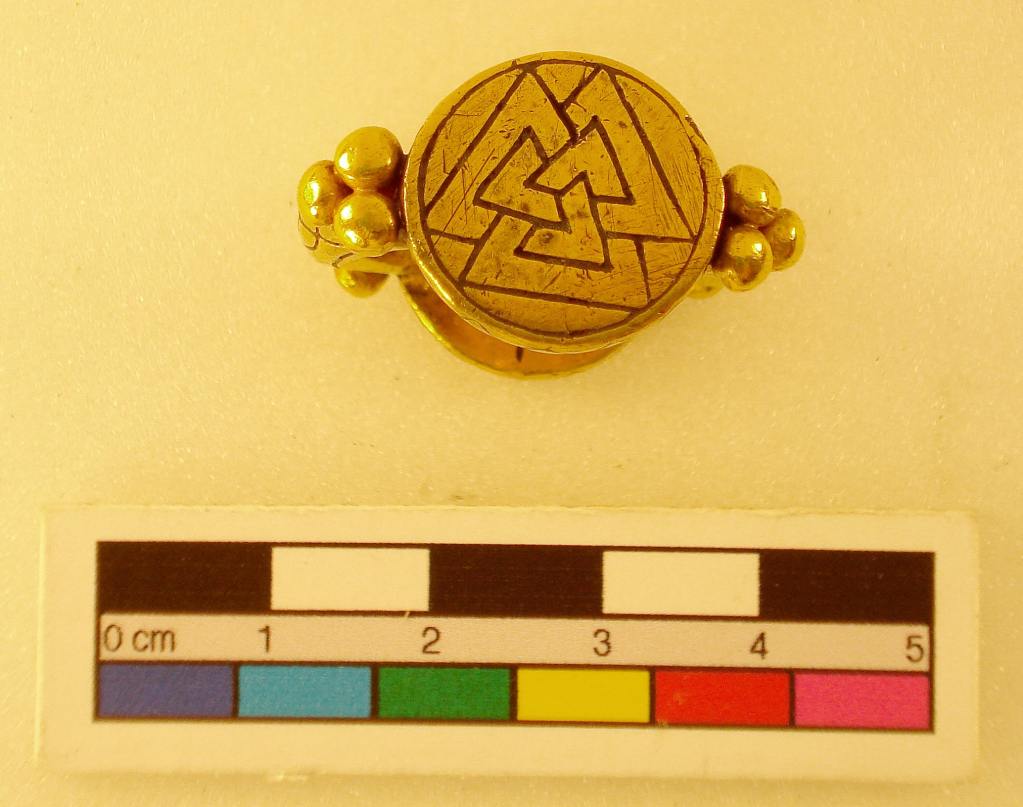
So, this one’s a little different. Instead of Gotland, this ring emblazoned with the valknut was found in the River Nene near Peterborough, England. Dating to the eighth- to ninth-century, the Nene River ring comes from the Viking Age, but it was made by a different culture.9
During this era, England was ruled by various Anglo-Saxon kingdoms. A Germanic people closely related to the Norse, when the Anglo Saxons arrived in England they had similar religious beliefs to the Vikings. The fact that the same symbol appears in both England and Sweden could point to an ancient history for this history in Northern Europe, potentially old enough to date to a time before the Norse went north and Anglo-Saxons sailed to England. This, however, is just conjecture.
Prose Edda Manuscript
Written by Snorri Sturluson during the early thirteenth-century, the Prose Edda is a collection of Norse and Icelandic folklore that dates back to the Viking Age (and possibly beyond). A lot of what we know about Viking lore comes from this and other manuscripts written by Sturluson.
In the second section of Prose Edda, called Skaldskaparmal (Language of Poetry) Sturluson recorded how gods and heroes were discussed in Old Norse poetry.10 In the Skaldskaparmal, Sturluson recounts the story of how the god Thor went to the realm of the giants, Jötenheim, and met with the strongest giant of them all, Hrungnir. When describing this giant, Sturluson noted “Hrungnir had the heart which is notorious, of hard stone and spiked with three corners, even as the written character is since formed, which men call Hrungnir’s Heart.”11
From this description of Hrungnir’s heart as being “spiked with three corners,” some have taken this to be an allusion to the valknut. Due to this connection, the valknut is sometimes called Hrungnir’s heart.12 Sturluson did not provide a visual to go alongside this description, so we’re left to read into it what we will.
Valknut Symbol in Nordic Religion
While the Vikings themselves did not leave any written explanation behind the valknut’s meaning, modern scholars have theorized that it served as a religious symbol associated with Odin. The chief of the Norse gods, and sometimes referred to as the Allfather, Odin was one of the most important deities in everyday worship. As such, he played many roles within the Norse pantheon, serving as the god of war, death, wisdom, and magic.13
The Stora Hammars and Tängelgårda picture stones both depict scenes of war and death, linking these stones (and the valknut) to the worship of Odin. In the Stora Hammars stone, the valknut itself is being wielded as a weapon, possibly by the Allfather himself. But there’s more than the etchings of warriors with swords aloft that connects the valknut to Odin.
To help him in his duties as the god of death and war, Odin enlisted the help of valkyries, often depicted as women, who scoured the battlefield the dead warriors worthy of joining the chief god in Valhalla.14 In Norse mythology, Odin also had two ravens, Huginn and Muninn, who were also known to ferry the souls of dead warriors to the afterlife. In both the Stora Hammars and Tängelgårda, valkyries and ravens make an appearance in the scenes that depict deadly warfare.
The shape of the valknut, too, could be a clue to its link with Odin. According to Norse mythology, as the god of war, Odin had the ability to create knots in peoples’ minds during battle so they became useful on the battlefield. But, he could also loosen their tensions and fears through “battle-madness, intoxication, and inspiration.”15 This ability to knot and unknot the minds of warriors could be why the valknut took on its distinctive shape.
Modern Use of the Symbol
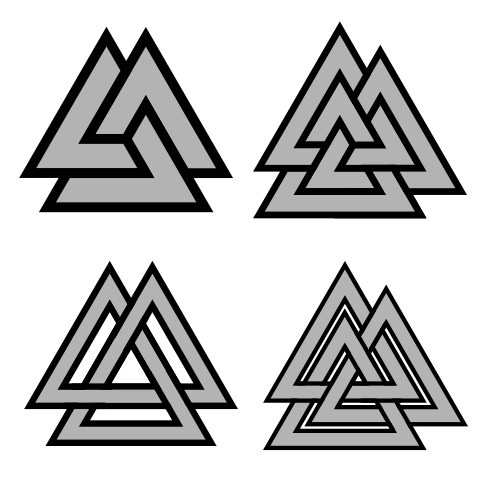
Like other ancient Norse symbols, such as the Helm of Awe, the valknut has been picked up by modern groups.
Some of these modern uses are completely innocent. For example, those that practice the Asatru religion, a branch of contemporary paganism in modern Scandinavia, use the symbol to connect with the beliefs of their ancestors.16 And some companies, like the American engineering firm RedViking, have adopted a logo inspired by the valknut.
Unfortunately, the valknut has also been used by white supremacists and far-right conspiracy groups who use the symbol in propaganda.
Sources on the Valknut
- “Valknut,” britannica.com
- Ibid
- Maria Herlin Karnell (ed.), Gotland’s Picture Stones: Bearers of an Enigmatic Legacy, (Gotländskt Arkiv, 2012), uni.hi.is
- “Hildr,” pantheon.org
- “Stora Hammars I,” viking.archeurope.com
- “The Tängelgården stones,” samlingar.shm.se
- “Picture stone from Tängelgårda,” web.archive.org
- “Valknot,” adl.org
- “Finger-ring,” britishmuseum.org
- “Germanic religion and mythology,” britannica.com
- Snorri Sturluson, Skáldskaparmal: The Poesy of Skalds, sacred-texts.com
- Martyn Whittock, American Vikings: How the Norse Sailed Into the Lands and Imaginations of America (New York: Simon & Schuster, 2023), via google.com/books
- Rachel Lockett, “Odin: The Shapeshifting Norse God of Wisdom,” historycooperative.org
- Joshua J. Mark, “Valkyrie,” worldhistory.org
- Daniel McCDoy, “The Valknut,” norse-mythology.org
- Whittock, American Vikings