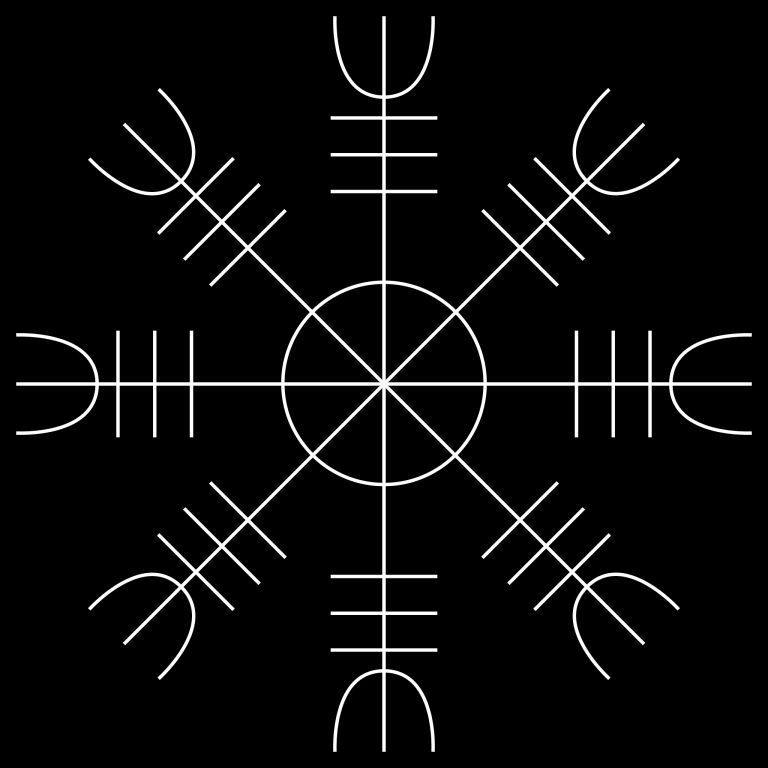
Gungnir, Spear of Odin: Gungho for Gungnir
Gungnir (pronounced like GUNG neer), was Odin’s spear and his primary weapon when in battle. The spear was an important symbol in Norse mythology with a deep history in Viking lands. Here’s what you need to know!
A Quick Intro to Odin

Before we dive into Gungnir’s mythology and symbolism, let’s get to know Odin, the man (or god) behind the spear.
Odin was the chief Norse god, who also acted as the god of war, wisdom, and poetry. Often called the “All-father” for his role as the head of the gods, Odin was a fascinating character. As the god of war, Odin himself was a fierce and cunning fighter, able to outwit and outduel any opponent. It was said that at the end of time, called Ragnarok, Odin would lead an army of gods and the slain warriors against the forces of evil. To build up this force, Odin sent supernatural beings called Valkyries to collect the souls of fallen warriors and bring them to his hall, Valhalla, in the realm of the gods – a place called Asgard.1
As the god of wisdom, Odin had an insatiable thirst for knowledge. So much so, in fact, that he tortured himself to gain true wisdom. According to Norse mythology, Odin sacrificed an eye, stabbed himself with his spear, and hung himself from the tree at the center of the universe, Yggdrasil, for nine days and nights.2
Odin had many animal companions. His ravens, Hugginn and Munnin, flew around the worlds of gods and men each day and informed Odin on what they saw. He rode an eight-legged horse named Sleipnir (“Slippery One”) who could travel between all the realms that made up the universe. And, it was not uncommon for Odin to be flanked by his two wolves, Geri and Freki – though scholars still debate the roles these wolves played.
Okay, that’s the quick and dirty version of Odin’s role in Norse mythology. Now on to Odin’s spear, Gungnir.
What Norse Mythology Says About Gungnir
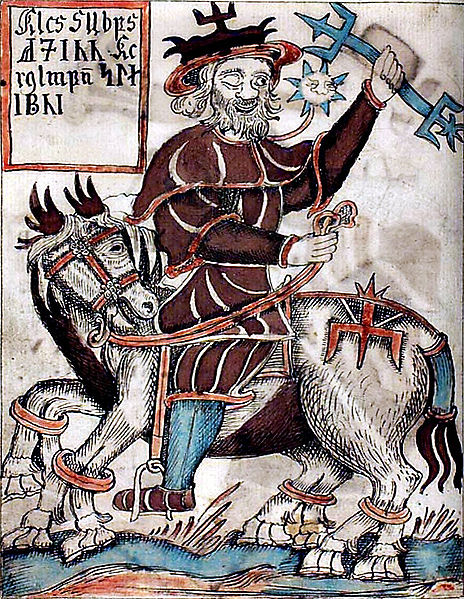
In Norse mythology, Gungnir was no ordinary spear. Forged by dwarves, it was the finest spear and one of the mightest weapons in the Norse cosmos. When Odin hurled it, the spear would not stop until it hit its target. Almost like a heat-seeking missile in a summer blockbuster action movie, Gungnir made Odin quite the marksman. The Norse also believed that Gungnir had runic inscriptions carved into its blade.3 Interestingly, archaeology has shown that the historical Norse also carved runes into their spears, perhaps in an attempt to appease Odin and get a piece of Gungnir’s magic for themselves.4
In a battle between gods, it was believed that Odin threw Gungnir over the opposing army and shouted, “Odin owns all of you!” (or, “Óðinn á yðr alla!” in Old Norse). From this, the Norse came to believe that each enemy killed in battle was a gift to Odin and, with each gift they gave him, the more likely he would be to show them favor in battle.5
Gungnir, however, did more than help Odin win victory over his foes on the battlefield. When Odin sought out knowledge, and stabbed himself to get it, he used Gungnir.6 This shows an interesting duality in the Norse belief around Odin’s spear: it was both a deadly weapon and an instrument of knowledge.
Depictions of Gungnir Through the Ages
One of the most famous Viking symbols, Gungnir has had a long life. Imagery of this magical spear appears in the historical record before the Viking Age began and has continued on into the modern age thanks to our ongoing fascination with Vikings. Let’s examine the ancient and Medieval depictions of Gungir to learn more about its history.
Vendel Helmets
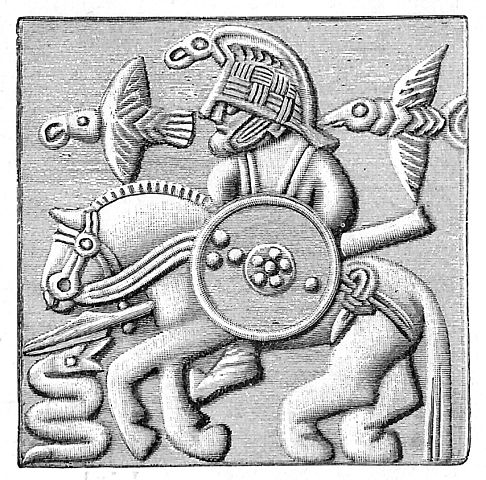
Though the Viking Age may have the introduction to Scandanavians for many Europeans, people have thrived in the region for nearly 12,000 years.7 In the period of Swedish history leading up to the Viking era, known as the Vendel period, we get one of the most well-preserved images of Odin.
Lasting from 550 AD to 800 AD, the Vendel period laid the groundwork for later Vikings. While they left no written records of their own, Vendel craftsmen made exquisite helmets.8 It’s from one of these helmets that the above image of Odin comes.
Made in the seventh-century, this depiction of Odin was pressed into a metal patch that was attached to a helmet.9 In the image, we see a warrior holding a spear while riding his horse, two birds flying along above him. Based on this image, we can tell that much of what we know later Norse peoples believed about Odin had ancient roots. Shown with this spear, Gungnir, it’s apparent that this Vendel-age Odin was a warrior.
Böksta Runestone
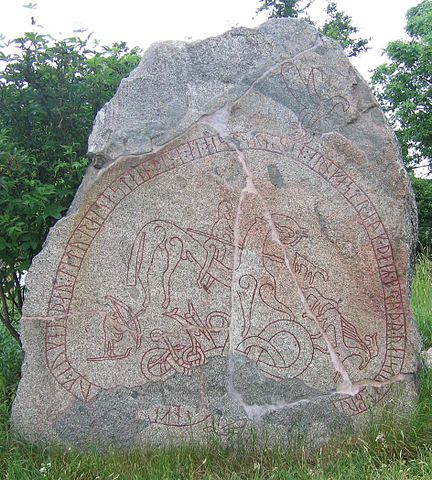
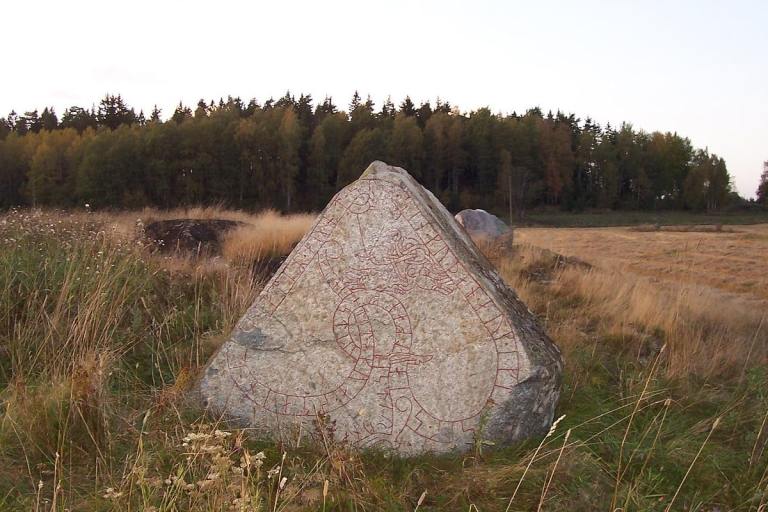
The Böksta runestone, one of nearly 1,700 Viking Age runestones in Sweden alone, is the more controversial bits of evidence we’ll discuss here. Originally carved sometime in the eleventh-century, it was, for some reason, broken into several pieces in the seventeenth-century. In 2004, the final missing piece was once again unearthed and the full runestone was re-created. This volatile history is why you’ll see giant fissures in the stone.
But, that’s not why it’s controversial among history nerds! The controversy is: does this stone depict Odin?
The Böksta runestone shows, what appears to be, a hunting scene. The largest figure is a man on horseback, wielding a large spear. Out in front of the man on horseback are what appear to be elk or a similar species. Behind the main figure, another man rides on skis, carrying a bow-and-arrow. Below all of these figures is a stylized design, though what exactly this design is meant to be is unclear as damage to the stone has obscured it.
The runic script that wraps around this scene says:
“Ingi-… and Jógerðr, they had this stone raised in memory of Eistr, their son; Ernfastr and his brothers raised in memory of their brother.”
While all of this makes it seem like that Böksta runestone portrays an everyday scene from the life of this Viking family, recent interpretations suggest that the man on horseback is in fact Odin, and the man on skis is Ullr, the god of siking, archery, and hunting.10 What makes this argument so compelling (at least for me) is the raven that hovers just above the runes on the upper-right side of the stone. Ravens were associated with Odin in Norse mythology and the All-father had two raven companions who helped him keep an eye on his realms.
Based on this reading of the Böksta runestone, this scene could well be Odin on a hunt with Ullr. This would that horse pictured is Odin’s steed, Sleipnir, and that his spear is in fact Gungnir. While this doesn’t tell us much about what the Vikings believed about Odin’s spear, it does point to the fact that Gungnir was not an invention of later Medieval Scandinavians, but did in fact exist in Viking Age portrayals of their chief god.
Skaldic Poet, Bragi Boddason
Skaldic poetry, a spoken form of poetry performed in the courts of nobility, flourished in Norway and Iceland from the ninth- to the thirteenth-centuries.11 Active around 850-870, Bragi Bodddason was one of the early greats of this new artform and was associated with three different Norwegian elites.12 Importantly for us, poetry that has come down to us from Boddasson is some of the earliest literary evidence for Odin and Gungnir.
In Boddasson’s poem known as “Egill Skallagrímsson, Fragment 1” (catchy, I know), Gungnir comes up twice:
- “Awry … the lips of Gungnir [i.e. spear blades] … of the wake of the longship … pierced.”13
- “It is there as men see the longship of the swinger of Gungnir.”14
In the first line, Gungnir is given human features when Boddasson calls the edges of the spear as “lips.” This suggests that Gungnir was more than just an inanimate object used by Odin. We also see a definitive reference to Gungn as a weapon of war, as it was used to pierce a longship.
In the second line, our new favorite poet Bragi Boddason referred to Odin as “the swinger of Gungnir.” This has also been translated as “Gungnir’s shaker.” This description of Gungnir as being shaken or swung by Odin illustrates that Gugnir was not just a symbol of might for Odin, but an instrument of war.
Poetic Edda and Prose Edda
Most of what we know about Gungnir’s role in Norse mythology comes from two works of Icelandic literature: the Poetic Edda and the Prose Edda. Compiled by Snorri Sturlosson in the thirteenth-century, these works are collections of the ancient and early Medieval beliefs that had survived as folk knowledge in Icelandic society. Despite Iceland’s conversion to Christianity well before Sturlosson’s time, a good deal of Viking Age mythology survived.
In the Poetic Edda, Sturlosson tells us that runes were carved “On Gungnir’s point.”15 Another poem from this collection describes how, when the gods went to war, “ On the host his spear | did Othin hurl / Then in the world | did war first come.”16
In the Prose Edda, we get more in-depth information on Odin’s spear. In one story, titled Skáldskaparmál, Sturlosson details how the trickster god “Loki went to those dwarves who are called Ívaldi’s Sons; and they made… the spear which became Odin’s possession, and was called Gungnir.” A few lines later, Sturlosson relates that “that the spear would never stop in its thrust.”17
Another story from the Prose Edda, known as Gylfaginning, tells the story of Ragnorok and how, in this final battle for the gods, “Odin rides first with the gold helmet and a fair birnie [senior warrior], and his spear, which is called Gungnir.”18
Sources on Gungnir
- “Odin,” kids.britannica.com
- “Odin – the one-eyed All-Father,” historiska.se
- History Brought Alive, Norse Mythology Legends: Epic Stories, Quests, Myths & More from The Most Powerful Characters, Gods, Goddesses & Heroes of Norse & Viking Folklore, via google.com/books
- Daniel McCoy, “Gungnir,” norse-mythology.org
- Ibid
- John Lindow, Norse Mythology: A Guide to the Gods, Heroes, Rituals, and Beliefs (New York: Oxford University Press, 2001), 155.
- Ingrid P. Nuse, “First Scandinavians came from north and south,” sciencenordic.com
- Wu Mingren, “Vendel Helmets: Spectacular Scandinavian Relics from the Vendel Period,” ancient-origins.net
- “7th century depiction of Odin on a Vendel helmet plate, found in Upplan,” medievalists.net
- Av Lars Silén, “Några reflektioner angående bilderna på Balingsta-stenen i Uppland,” Fornvännen: Journal of Swedish Antiquarian Research, no. 8 (1983): 88.
- “Skaldic Poetry,” britannica.com
- “Bragi inn gamli Boddason — Bragi,” skaldic.org
- Bragi Boddason, “Egill Skallagrímsson, Fragment 1,” skaldic.org
- Bragi Boddason, “Bragi inn gamli Boddason, Fragments 4,” skaldic.org
- Snorri Sturlosson, “Siggdrfiumol,” sacred-texts.com
- Snorri Sturlosson, “Voluspo,” sacred-texts.com
- Snorri Sturlosson, “Skáldskaparmál,” sacred-texts.com
- Snorri Sturlosson, “Gylfaginning,” sacred-texts.com