A (Not So) Brief Guide to the Viking Age
The Viking Age began when Norse peoples started venturing farther and farther afield from their home bases in Scandinavia. The nations we know today as Sweden, Norway, and Denmark gave rise to the fascinating fascinating culture of the Norse and the job description – as some scholars have labeled it – unique to them and their era: Vikings.
The Rise of the Viking Age
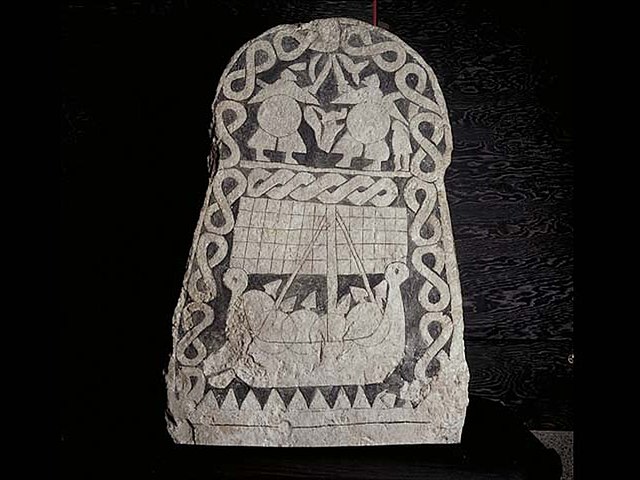
The expansion of Old Norse society out of Scandinavia was driven by a combination of exploration and economic motives. Their advanced longships, capable of navigating oceans, sea, and rivers, allowed Viking voyagers to reach distant lands. They established trade routes that connected them with the Baltic and Mediterranean Seas, Eastern Europe, and islands throughout the Atlantic Ocean, and even ventured as far as North America, some four centuries before Christopher Columbus.1
The earliest recorded event signaling the start of this era was the raid on the Lindisfarne Monastery in 793 CE.2 Located off the northeast coast of England, Lindisfarne was a highly revered Christian site, and its plunder by Viking raiders shocked Medieval Christendom. The descriptions of Viking raiders penned by the monks who survived has largely informed our perception of the Norse for a millenia: an image of bloodthirsty heathers who were bent on nothing other than plunder and killing. Or, in the words of the Anglo-Saxon Chronicle: “on 8 June [793] the raiding of heathen men miserably devastated God’s church in Lindisfarne island by looting and slaughter.”3
But how wrong this view of Norse society is!
The Viking Age was not solely about raiding. It was also a period of significant cultural exchange and settlement. Norsemen established colonies in places like Iceland and Greenland, where they created thriving communities. They also integrated with local populations across continental Europe, from Francia to Anglo-Saxon England to Constantinople, contributing to the rich tapestry of Medieval history.
As the Viking Age progressed, the influence of Norse culture became increasingly evident throughout Europe, shaping the political and social landscape of the time. The legacy of the Vikings is a testament to their enduring impact on history and culture.
What Did Viking Culture Look Like?
If the typical view of Norse culture as war obsessed, then what did their culture actually look like? Thought its impossible to cram an entire culture into a few paragraphs, here are the highlights.
For one, they had a rather complex social structure comprised of a hierarchical system including chieftains, freemen, and thralls (slaves). While chieftains wielded considerable power, free farmers and traders played vital roles in sustaining Viking society. Thralls performed essential labor, although – like many other ancient and Medieval societies – they could sometimes earn their freedom or gain status through loyalty and service.4
Daily life in Viking settlements was marked by a blend of practical and ceremonial activities. Longhouses served as both homes and communal spaces, fostering a strong sense of community. Farming, fishing, and animal husbandry were crucial for survival, complemented by crafts such as weaving and blacksmithing. The Vikings also engaged in extensive trade, exchanging goods with distant lands, including the Byzantine Empire and the Middle East.5
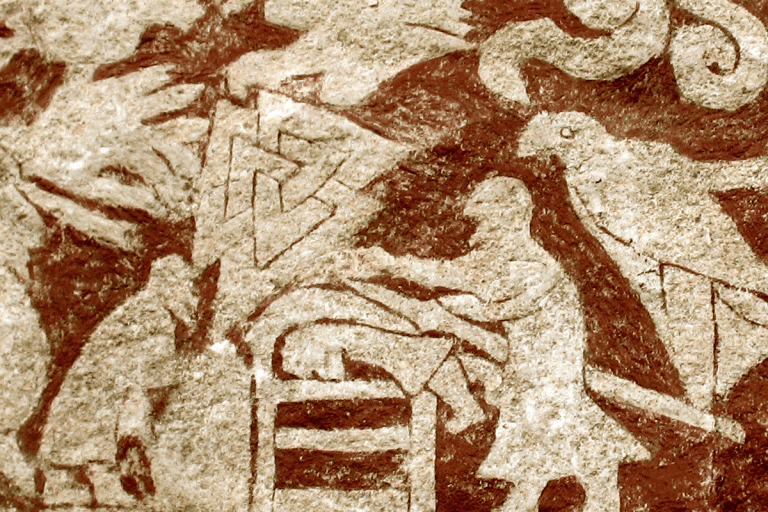
The pantheon of Norse gods and goddesses – the most important being Odin, Thor, and Freyja – was central to their belief system. These deities were associated with various aspects of life and nature, and their stories were preserved in epic sagas and poetry through a rich oral tradition. Norse art drew heavily from these beliefs and was characterized by intricate designs and runic inscriptions. Norse artisans adorned a wide range of items with the now famous Viking aesthetic, from personal items to grave markers. Symbols like the Mjolnir (Thor’s hammer), held both protective and cultural significance, reflecting the enduring influence of Viking beliefs and practices.6
Viking Ships, the Catalyst of the Viking Age
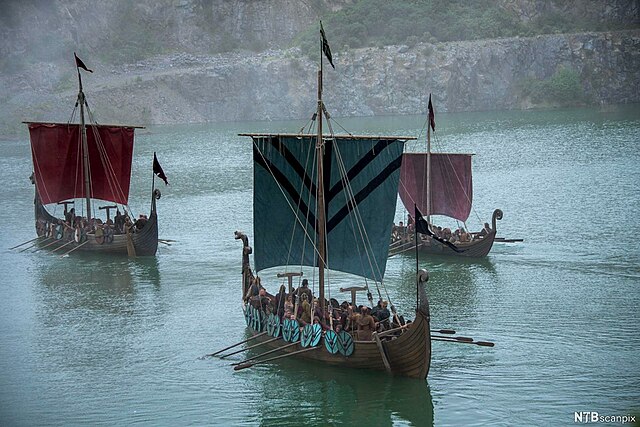
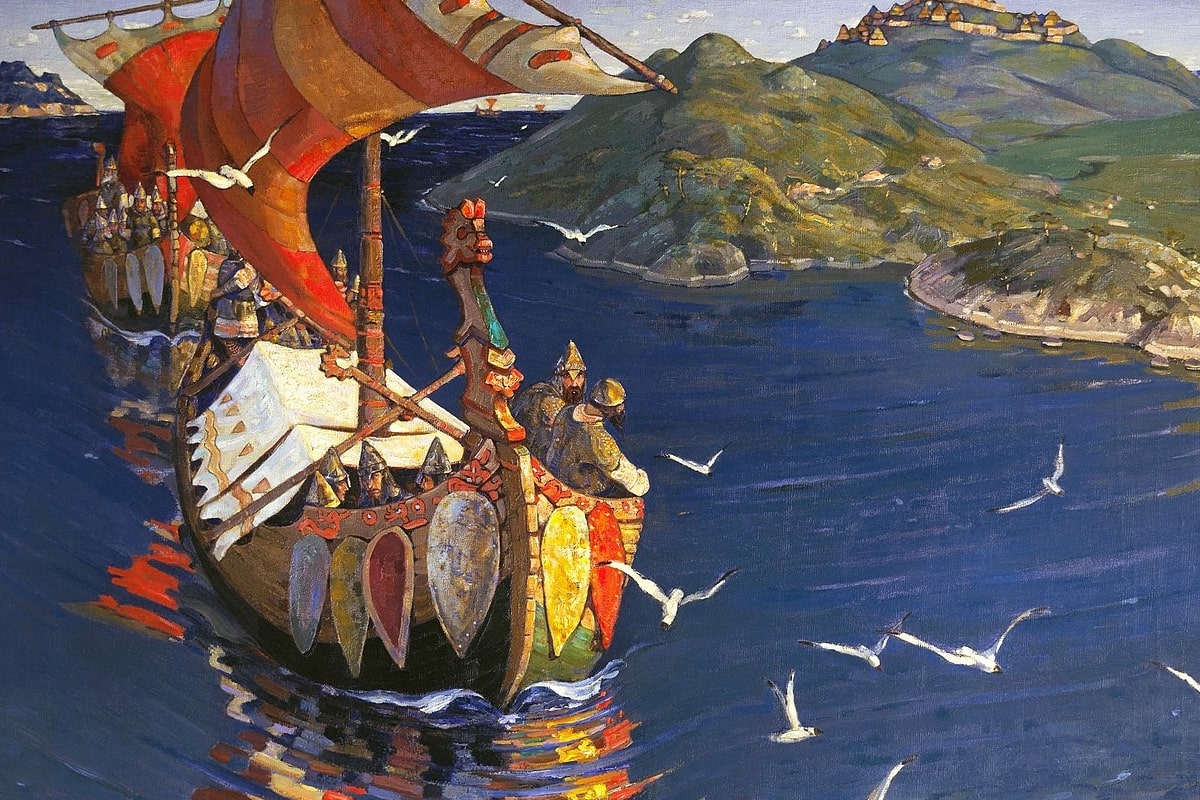
The Viking Age owes much of its success and far-reaching impact to the Norse’s advanced ship making. Designed for both speed and agility, Viking longships featured a sleek, narrow hull and a shallow draft, allowing them to navigate both open seas and shallow riverine environments.7
The flexibility of Viking longships made them ideal for raiding, trading, and exploration. With their ability to be beached easily, these ships could quickly launch attacks or establish new settlements along coastlines and riverbanks.
Longships were powered by both sails and oars. The combination of both wind and manpower allowed for effective navigation across the unpredictable waters of the North Atlantic. The use of a single square sail and a large crew of oarsmen allowed for speed and maneuverability, essential for swift raids and surprise attacks.8 This design also enabled Viking ships to undertake long voyages across vast distances, like, you know, crossing an ocean.
Another important type of Viking ship was the knarr, a cargo vessel with a broader, deeper hull designed for carrying goods and passengers. The knarr facilitated the Vikings’ extensive trade networks, linking the Baltic Sea with the Mediterranean and fostering the economic exchanges that were the raison d’être of their expansion.9
Viking Age ships were more than mere vessels; they were instruments of exploration and expansion, integral to the rise of the Viking Age and the far-reaching impact of Norse culture. Their design and functionality laid the groundwork for the Vikings’ legendary voyages and conquests, impacting the history of four continents.
Viking Raids and Settlements: From Russia (and Beyond!) With Love
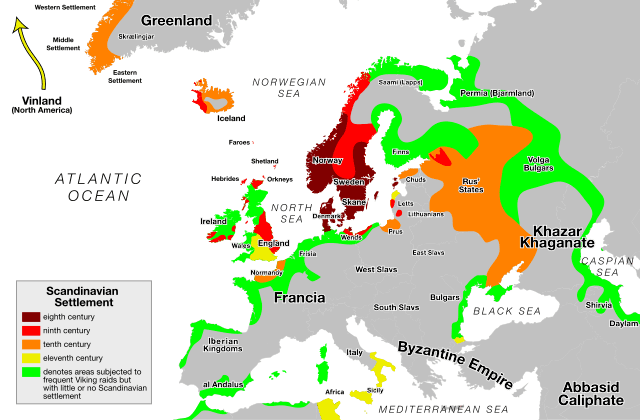
Fueled by their new ships, the Vikings did not stay contained to their Scandinavian kingdoms and earldoms for long. Soon, they expanded across Europe and even the Atlantic Ocean, beating Christopher Columbus and the trans-Atlantic empires his journey spawned by about five centuries.
Vikings in the British Isles
The Viking Age left an indelible mark on the British Isles, characterized by a series of dramatic raids and subsequent settlements that reshaped the region’s political and cultural landscape. Beginning in the late eighth-century, Norse seafarers launched a series of incursions that would profoundly impact England, Scotland, Ireland, and Wales.
The first notable Viking raid occurred in 793 CE, when Norse raiders attacked the Lindisfarne Monastery off the coast of Northumberland. This raid, targeting a wealthy Christian site, signaled the start of a period marked by widespread Viking activity. These early attacks were primarily focused on plundering monasteries and towns for their wealth. The Vikings’ advanced longships and tactical expertise allowed them to strike swiftly and with little warning, making their incursions particularly devastating.
By the early ninth-century, Viking raids intensified, and the Norse began establishing more permanent footholds. In 865 CE, a significant force known as the Great Heathen Army landed in the kingdom of East Anglia. This army, composed of various Norse factions, aimed to conquer and settle rather than merely raid. The conquest led to the establishment of the Danelaw, a region of England under Viking control, which included large parts of northern and eastern England.10
Viking settlements extended beyond England to other parts of the British Isles. In Scotland, Norse settlers established the Orkney and Shetland Islands as well as parts of the mainland, particularly in the Hebrides. In Ireland, Vikings founded Dublin, which grew into a major trading hub and cultural center.11 These settlements became integral to the local economy and culture, blending Norse and indigenous traditions.
The influence of Viking settlements is still visible today in place names, archaeological finds, and genetic markers. The Norse legacy in the British Isles is a testament to their profound impact on the history and development of the region.
Western Europe
The Viking Age extended far beyond the British Isles, reaching into continental Europe with significant raids and settlements in regions like France and Spain. From the late-eight to the tenth-centuries, Norse seafarers targeted these areas, leaving a lasting impact on the political and cultural landscapes of the time.
In France, the Vikings first appeared in the 820s, making their mark with raids along the Seine and Loire rivers.12 The strategic location of these rivers allowed the Norse to penetrate deep into French territory, targeting wealthy towns and monasteries. Paris, for example, suffered repeated attacks, with the most notable siege occurring in 845 CE when Viking leaders reportedly extracted a hefty ransom from the city. These raids were not merely destructive; they demonstrated the Vikings’ keen interest in controlling key trade routes and valuable resources.
By the mid-ninth century, the Viking presence in France evolved from raiding to settlement. In 911 CE, the Treaty of Saint-Clair-sur-Epte between the Frankish King Charles the Simple and Viking leader Rollo established the Duchy of Normandy. This agreement granted Rollo and his followers land in what is now northern France in exchange for their pledge of loyalty to the king and the promise to defend the region against other Viking raids.13 The Duchy of Normandy went on to become a powerful and influential state in its own right, which would conquer other areas of Medieval Europe.
Related Post: Viking Weapons and Their Role in Warfare
In Spain, Viking incursions were less frequent but still impactful. The Iberian Peninsula was targeted intermittently, with raids focusing on the northern regions and the coastal areas of modern-day Spain. The most notable Viking attack in Spain occurred in 859 CE, when Norse forces raided the city of Lisbon.14 These raids were part of a broader pattern of Norse expeditions across the Mediterranean, reflecting their extensive maritime capabilities and ambitions.
The influence of Viking raids and settlements in France and Spain highlights their far-reaching impact on continental Europe, contributing to the dynamic historical and cultural transformations of the era.
Eastern Europe
During the Viking Age, the Norsemen extended their influence far beyond Western Europe, venturing into Eastern Europe and establishing significant connections with regions such as Russia, Ukraine, and the Byzantine Empire. These expeditions profoundly impacted the development of the region, shaping its political and economic landscape.
In the ninth and tenth centuries, Viking traders and warriors, known as the Varangians, made their way into Eastern Europe via river routes. They traveled along the Dnieper, Volga, and other waterways, establishing crucial trade networks that connected the Baltic Sea to the Black Sea and the Caspian Sea. In modern-day Ukraine, Viking influence is notably evident in the early history of Kyiv. The Varangians, led by figures such as Rurik, played a pivotal role in founding the Kievan Rus, a federation of Slavic tribes. The Rurik dynasty, established by Rurik in 862 CE, laid the groundwork for the development of medieval Russia and Ukraine. The Viking presence in this region was characterized by both trade and military activity, contributing to the economic growth and political consolidation of the Kievan Rus.15
The Varangians also had a significant impact on the Byzantine Empire, engaging in both raiding and mercenary service. The Vikings, known as the Varangian Guard, were elite mercenaries who served as personal bodyguards to Byzantine emperors. Their martial skills and loyalty earned them a prestigious position within the Byzantine military. Raids on Byzantine territories, while less frequent than those in Western Europe, demonstrated the Vikings’ extensive reach and their role in the complex geopolitical dynamics of the period.16
The interactions between the Vikings and these Eastern regions facilitated cultural exchanges and trade, enriching both Norse and Eastern European societies. The influence of the Vikings in Russia, Ukraine, and the Byzantine Empire is a testament to their far-reaching impact on the history of Eastern Europe.
Iceland and Greenland
During the Viking Age, Norse explorers established notable colonies in the North Atlantic, with Iceland and Greenland serving as key outposts in their maritime expansion. These colonies represent some of the most remarkable achievements of Viking exploration and settlement.
Iceland was among the earliest and most significant Viking colonies. Norsemen, led by explorers like Ingólfr Arnarson, began settling in Iceland around 874 CE.17 The island, located midway between Europe and North America, offered fertile lands and abundant resources. The settlers established a unique societal structure with the Althing, one of the world’s oldest parliaments, founded around 930 CE.18 Icelandic society was characterized by a blend of Norse customs and local adaptations, creating a distinctive culture that thrived in the harsh northern environment. The sagas, which chronicle the lives and adventures of early Icelandic settlers, provide valuable insights into this period and reveal how Norse traditions adapted to their new surroundings.
Greenland, another ambitious Viking settlement, was established around 986 CE when Erik the Redled a group of Norse settlers to Greenland, seeking new land after being exiled from Iceland.19 The Norse established two main settlements: the Eastern Settlement, near present-day Qaqortoq, and the Western Settlement, near Nuuk. Despite Greenland’s challenging conditions, the Norse managed to establish a thriving colony for several centuries. They engaged in trade with Europe, exporting walrus ivory and other goods. However, Greenland’s colonies faced harsh environmental conditions, including the Little Ice Age, which contributed to their eventual decline in the fifteenth century.20
The Norse presence in Iceland and Greenland underscores the Vikings’ remarkable navigational skills and their ability to adapt to diverse environments. These colonies were not only significant for their immediate impact but also for their contributions to the broader history of exploration and settlement in the North Atlantic.
North America
Viking Age settlements extended beyond Europe into the New World, with Norse explorers reaching the shores of North America around the year 1000 CE. This remarkable chapter in Viking history is best represented by the sagas and archaeological evidence that shed light on their ventures across the Atlantic.
The most well-known Viking site in North America is L’Anse aux Meadows, located on the northern tip of Newfoundland in present-day Canada. Discovered in 1960, this site is the only confirmed Norse settlement in North America and is believed to have been established by Leif Erikson, son of Erik the Red. L’Anse aux Meadows consists of a series of Norse-style sod houses, artifacts, and ironwork that attest to a brief but very real Norse presence.21 The settlement dates to around 1000 CE, aligning with the timeframe of Viking sagas that recount voyages to a land known as Vinland.22
The sagas, particularly the Vinland Saga, describe how Leif Erikson sailed west from Greenland and landed in Vinland, a region noted for its rich resources and favorable climate. The exact location of Vinland remains a subject of scholarly debate, with some theories suggesting that it encompassed parts of Newfoundland and the Gulf of St. Lawrence.
Despite their impressive maritime skills, the Norse settlements in North America faced numerous challenges. The harsh climate, limited resources, and the fact that people already lived there likely contributed to the decline of their presence. By the early eleventh-century, Norse exploration in North America had largely ceased, and the colonies eventually disappeared from historical records.
The Viking ventures into North America highlight their remarkable navigational prowess and adventurous spirit. Although their presence was fleeting, the Norse exploration of the continent provides an early glimpse into European exploration of the New World, centuries before Columbus’s voyages.
The End of the Viking Age
The Viking Age, spanning from approximately 800 to 1050 CE, marked an era of intense exploration, raiding, and settlement. However, by the mid-eleventh-century, this dynamic period came to an end, driven by a combination of internal and external factors.
One significant factor in the decline of the Viking Age was the gradual conversion of Scandinavian societies to Christianity. As Viking leaders and their communities adopted Christianity, their focus shifted from raiding and colonizing to integrating with broader Christianized European society. This religious transformation played a crucial role in altering the nature of Norse society, moving away from the exploration and expansionism that characterized earlier centuries.23
Additionally, the consolidation of political power in Scandinavia contributed to the end of the Viking Age. In Norway, King Harald Fairhair’s unification of the country in the late ninth- and early tenth-centuries led to the formation of a more centralized monarchy.24 Similarly, in Denmark, King Gorm the Old and his successors strengthened royal authority and curtailed the influence of local chieftains.25 The consolidation of power reduced the incentive for local leaders to engage in raiding expeditions, as internal stability and centralized control became priorities.
Finally, external pressures, including resistance from the Frankish and English kingdoms, increasingly thwarted Viking raids. Improvements in fortified towns and defensive strategies made it more challenging for Norse raiders to achieve their objectives.26
By the mid-eleventh century, the combination of religious conversion, political centralization, economic shifts, and strengthened defenses culminated in the decline of Viking raiding and expansion. This transition marked the end of the Viking Age and the beginning of a new chapter in Scandinavian history, characterized by integration into medieval Europe.
Sources on the Viking Age
- “Viking: People,” britannica.com
- “The Viking Raid on Lindisfarne,” english-heritage.org.uk
- “Lindisfarne: Anglo-Saxon Chronicles,” penelope.uchicago.edu
- “Viking Societies,” sea.museum
- “Environment and Trade: Viking Age,” khanacademy.org
- Andrea C. Snow, “Art of the Viking Age,” smarthistory.org
- “Viking Ships,” rmg.co.uk
- Ibid
- Ed. John Block Friedman, Kristen Mossler Figg, Routledge Revivals: Trade, Travel and Exploration in the Middle Ages (New York: Routledge, 2000)
- Josh Butler, “The Great Heathen Army,” historic-uk.com
- Maeve Sikora, “The City of Dublin,” vikingeskibsmuseet.dk
- Joshua J. Marks, “Viking Raids on Paris,” worldhistory.org
- “The Founding of Normandy,” viking.archeurope.com
- Ann Christys, “Vikings in al-Andalus and the Maghreb,” alandalusylahistoria.com
- “Varangians,” newworldencyclopedia.org
- Ibid
- “History of Iceland,” britannica.com
- “Althing,” britannica.com
- Jesse Greenspan, “Why Did the Vikings Disappear From Greenland?” history.com
- Ibid
- “L’Anse aux Meadows National Historic Site,” whc.unesco.org
- “L’Anse aux Meadows,” britannica.com
- “The Transition to Christianity,” en.natmus.dk
- “Harald I, King of Norway,” britannica.com
- “Gorm the Old, Harald Bluetooth and Svein Forkbeard,” en.natmus.dk
- “The Carolingian empire and France,” britannica.com