Aztec Art and What it Tells Us About Aztec History
Aztec art consists of some of the most breathtaking pieces ever created. Aztec artists mastered many forms of expression, from sculpture to feather working. As their empire rose in prominence and power, the beauty and scale Aztec artists were able to achieve also grew.
By exploring the world of Aztec art, we can begin to get a better understanding of not only the Aztec Empire, but what it meant to be Mexica (the word the Aztecs used to describe themselves).
Influence of Other Mesoamerican Cultures
The Aztec civilization was a relative late comer to the central basin of Mexico where they established their capital, Tenochtitlan. The Aztec arrived in the central basin in the mid-1300s. By this time, this area of Mexico had already seen the rise and fall of several dominant cultures, including the Olmec and Toltec.
As the Aztecs took root in their new home, some of the cultural traditions of the area rubbed off on them. And in the century that followed, from the mid-1300s to the mid-1400s, the Aztec expanded their empire and reach. This constant expansion meant coming into contact with other Mesoamerican cultures, which gave the Aztec Empire 2,000 years of artistic expression and know-how to tap into.
This is not to say that the Aztecs had no art of their own, but merely that they were the next in line in a grand tradition of Mesoamerican art and science that stretched back millenia.
Perhaps the most powerful influence on the Aztec was Teotihuacan. A powerful city-state north of where the Aztec would settle, Teotihuaca thrived between the first- and seventh-centuries AD. The city’s most prominent buildings were the Temple of Quetzalcoatl as well as the Temple of the Sun and Moon.
The Temple of Quetzalcoatl, in particular, heavily influenced the Aztecs, as Quetzalcoatl became one of the most important deities in their pantheon. Teotihuacan was such an important site for the Aztecs that the word Teotihuacan is, in fact, a Nahuatal word (the language of the Aztecs). In Nahuatl, Teotihuacan means “the place where the gods were created.”
And, much like at Teotihuacan, images of the Feathered Serpent came to dominate Aztec art.
Most Important Types of Aztec Art
Aztec art took many forms. From huge statues to intricate pieces of made from feathers, the Aztecs produced artworks for use in all aspects of life. Unfortunately, much of what the Aztec created was destroyed by Spanish conquistadors during the conquest of Mexico. What has survived, however, is extraordinary.
Aztec Sculpture and Carvings

Owing to the fact that they were made from stone, Aztec sculptures are the most abundant form of Aztec art that still exists. Though many were destroyed by the Spanish after their conquest of the Aztec Empire, the remaining sculptures can still tell us quite a bit about Aztec life and religion.
Ranging in size from massive monoliths to small household items, Aztec sculpture depicted humans, animals, and plants – often with lifelike precision – as well as the gods.
Unlike Europeans of the time, whose religion forbade dissections of cadavers, the Aztecs had an extensive knowledge of the human anatomy. They used this knowledge to great effect in their sculpture, portraying all aspects of the body with precision. Archaeologists have found sculptures of people with gaps in their teeth, hunched backs, wrinkles, and more.
Much like their sculptures of humans, Aztec sculptures of the natural world around them were exquisite. Two particular favorite subjects of these sculptors were jaguars and eagles. Two of the most important Aztec symbols, the jaguar represented ferocity, stealth, and cunning, all key traits for an expanding empire. The eagle was associated with the god Huitziliopotchli, who was believed to have taken the form of an eagle and landed on a cactus in the middle of Lake Texcoco to show the Aztecs where to settle and build their capital city. These animals, and many others, where depicted in both standalone sculptures, as well as carvings on the sides of temples, pyramids, and palaces.
Many Aztec sculptures also held religious significance. Made to adorn private altars, stand on their own, or decorate temples, sculptures of gods were omnipresent in the lives of every Aztec. But more on the gods later (so keep scrolling)!
Aztec Architecture
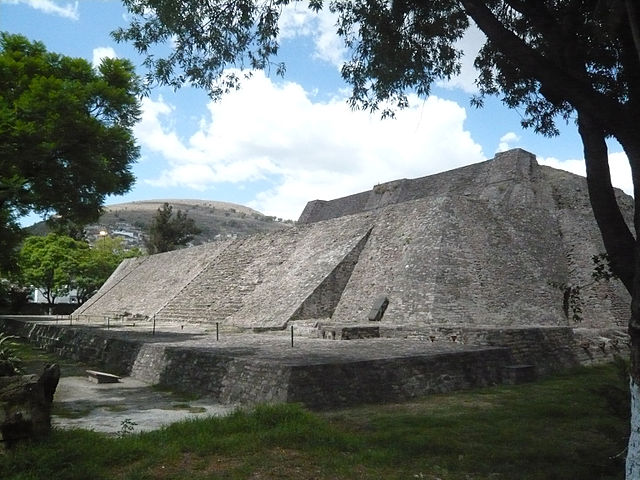
The Aztecs were masters of architecture and engineering. Their capital city, Tenochtitlan, was built in the middle of a lake on reclaimed land. They constructed aqueducts to bring fresh water to the city. When it came to building, there wasn’t much they couldn’t do. But, this is a post about Aztec art – so let’s examine the aesthetic side of their building prowess.
When it comes to architecture, the Aztecs are perhaps most famous for their pyramid-temples. These structures were built to represent mountains, which had extreme importance for Aztec religious beliefs. The Aztec believed that the souls of their ancestors lived in the mountains and that, as mountains were a source of water, they were a source of fertility.
Pyramids, or teocalli in Nahuatl, were constructed with other Aztec symbols in mind, however. Each pyramid consisted of four platforms, or steps, that were stacked on top of each other. The Aztecs then built a large, double staircase that ascended to the top of the pyramid. Historians believe this building technique was used to align with the cardinal directions. The pyramids were always located in the eastern part of the city center, and the staircase faced west, the direction in which sun set (or, in Aztec cosmology, descended into the underworld).
Each pyramid was also decorated with elaborate carvings of Aztec symbols, like eagles, jaguars, serpents, and conch shells. The inside walls, too, would have been covered in paint and carvings that communicated the religious importance of the site.
Aztec Pottery
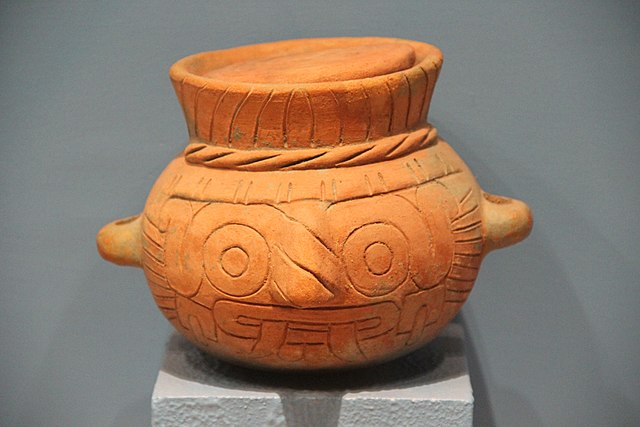
While the Aztecs are not known for their pottery, a distinctive ceramic style emerged among Aztec craftsmen. Known as “black-on-orange” ceramics, this unique Aztec pottery style involved clay firing to achieve a vibrant orange hue, followed by the application of intricate designs using black dyes.
Sold mainly in major urban hubs, black-on-orange pottery became a staple for Aztec people across all social strata. With time, Aztec artisans honed their craft, establishing significant production hubs that churned out standardized black-on-orange wares.
However, for the elite echelons of Aztec society, even this prized black-on-orange pottery fell short. The wealthiest among them opted for pottery imported from the neighboring city of Cholula, renowned across Mesoamerica for its superior quality and great talent of its potters. Contrasting the Aztec style, Cholula pottery showcased a kaleidoscope of colors and intricate motifs, including stylized feathers and representations of revered deities.
Bernal Díaz del Castillo, one of the Spanish conquistadors chronicling the Aztec Empire’s conquest, lauded the pottery of Cholula, describing it as “very good pottery… of red and black and white clay painted in various designs, and they supply Mexico and all neighboring provinces with it, as Talavera or Placencia do in Castile.”
Undoubtedly, the pinnacle of Aztec pottery hailed from Cholula, showcasing an unparalleled diversity and sophistication that surpassed the renowned black-on-orange style. In the world of Aztec art, pottery from Cholula held a special place.
Feather Workers
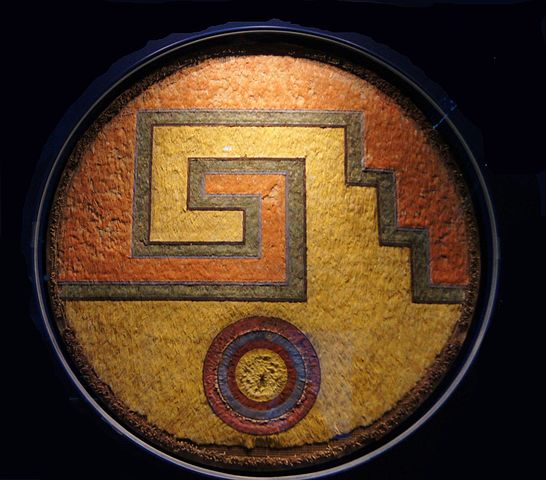
The Aztecs themselves considered feather working to be one of the highest artforms. As such, the mosaics that feather workers produced were used to adorn symbols of aristocracy, like ceremonial headdresses, decorative shields (like the one above), and clothing for the elite.
And while the results were so clearly beautiful, feather art was a painstaking process. To make these wonderful creations, artists began with a base. They then carefully placed brightly colored feathers, one by one, onto the base until they had created an intricate design. To create one piece of feather art tools weeks!
Feathers were so highly prized by the Aztecs because of their association with divinity. It was believed that birds could travel between the earthly and divine realms, and act as messengers for the gods. No wonder they held such an important place in Aztec art!
The Gods in Aztec Art
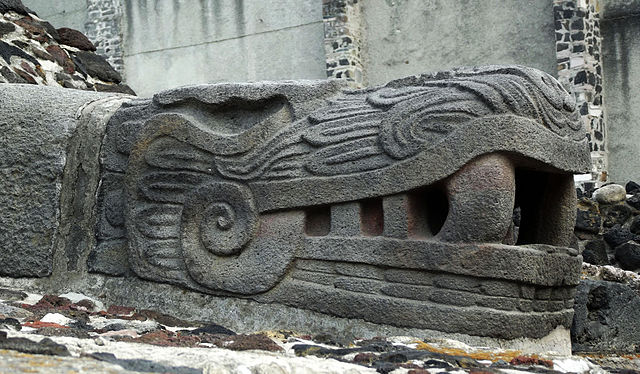
Aztec gods were a mainstay in any and all types of Aztec art. Like all peoples prior to the modern era, religion was one of the main ways the Aztecs tried to decode the mysteries of the world. So it’s no surprise that the most important deities of their pantheon were carved into buildings, featured on feather shields, and more.
But, the Aztec pantheon is pretty extensive. So, let’s explore two of the most well-known Aztec gods, Quetzalcoatl and Huitzilopochtli, and how they were represented in Aztec art.
Quetzalcoatl
Portrayed commonly as a feathered serpent, Quetzalcoatl held a pivotal position as both a deity and a symbol within Aztec art. The symbolic depictions of this god offer a captivating glimpse into Aztec culture.
Historical records first trace Quetzalcoatl’s existence back to the Olmecs, an ancient Mesoamerican culture flourishing between 1200 BCE and 400 BCE. This deity subsequently emerged as a significant religious symbol in the succeeding Mesoamerican civilizations. Indeed, archaeologists have found numerous sculptures of the feathered serpent aborning temples throughout the region.
While Quetzalcoatl played diverse roles across various Mesoamerican civilizations, for the Aztecs, he held the esteemed position of one of the creators of the world. Beyond this, his contributions extended considerably; he was revered as the bestower of maize, books, and calendars to humanity. This association with agricultural cycles and timekeeping led to his evolution into an Aztec symbol representing death and resurrection.
Quetzalcoatl remains a figure of immense intrigue, particularly to contemporary audiences, owing to his central role in a fabricated narrative. There exists a widespread misconception perpetuated through historical teachings that when Hernán Cortés and his expedition arrived in Mexico, the Aztecs believed Cortés to be the long-awaited Quetzalcoatl. This narrative suggests that, disarmed by his apparent divine nature, the Aztecs failed to defend their empire. However, this narrative lacks any historical evidence before 1519, despite the longstanding reverence for Quetzalcoatl within ancient Aztec culture.
Huitzilopochtli
Huitzilopochtli, the Aztec god of war and sun god, stands as an intriguing subject within Aztec art, laden with symbolic representations.
Translated from the Nahuatl language, his name means “Hummingbird from the left,” endowing Huitzilopochtli with the qualities associated with the hummingbird, one of the most important Aztec symbols.
In the surviving depictions of Huitzilopochtli, he is often adorned with vibrant green and blue feathers resembling those of a hummingbird. Donning attire indicative of warfare, he not only served as the patron deity of Aztec warriors but also symbolized the warrior class itself.
The association of Huitzilopochtli with the hummingbird carried immense weight in Aztec society. As one of the principal deities in the Aztec Empire, he was believed to have led the Aztecs from their ancestral lands in Aztlan to the central Mexico basin, where they established their capital, Tenochtitlan. The Aztec veneration of hummingbirds in connection with the god of war highlights their profound reverence for the bird’s extraordinary aerial prowess.
Furthermore, scholars often draw a connection between Huitzilopochtli and the Aztec inclination towards military expansion and the practice of human sacrifice. This association underscores the deity’s pivotal role within Aztec culture and its artistic representations.
Sources on Aztec Art
- “Pre-Hispanic City of Teotihuacan,” whc.unesco.org
- Ibid
- “Peoples and Societies of the Aztec World,” guggenheim.org
- Richard Diehl, “The Deep Roots of Aztec Sculpture,” mexicolore.co.uk
- “Aztec Sculpture,”rubens.anu.edu.au
- Manuel Aguilar-Moreno, “Aztec Architecture,” libguides.msben.nsw.edu.au
- “Aztec architecture facts for kids,” kids.kiddle.co
- Ibid
- Ibid
- “Why are Feathers So Important in the Aztec Culture: Piecing Together the Puzzle,” pages.vassar.edu
- “The Fascinating World of Aztec Feathers,” azteczone.com/blogs/aztec-culture-articles
- “Huitzilopochtli,” fordham.edu