Mayan Weapons: Tools of the Trade for Mayan Warriors
Mayan weapons were pretty terrifying. Masters of ancient warfare, Mayan warriors and their kings used these weapons to brutal effect to defeat enemy combatants and conquer territory. Let’s dive into the world of Mayan weapons to learn how these instruments of war were used and what they can tell us about the Maya themselves.
Overview of Maya Warfare
The Mayan battlefield was probably a chaotic place. Historians and archaeologists have been unable to discern if battle formations ever evolved in Maya warfare. Instead, it seems possible that individual hand-to-hand combat or small groups of warriors fighting together to protect each other’s flanks, was the prevailing method of fighting. This type of battle probably prevailed because Mayan city-states did not have professional standing armies, but drew upon their citizens to act as a militia during times of war.
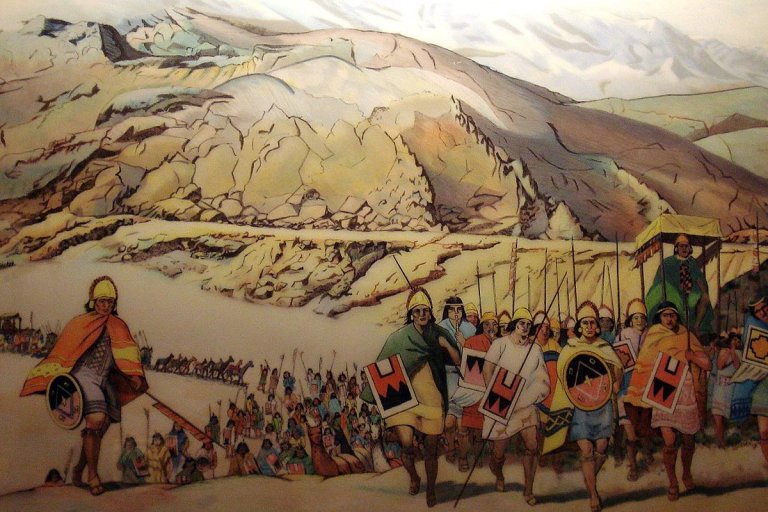
To arm their citizen militias, stores of Mayan weapons were kept by each city in a centralized location. Before heading on campaign or into battle, these weapons were handed out by government officials. These warriors seemed to have been grouped by the town they came from and were probably recruited for service by their local lord. Once the battle started, they followed a standard made by attaching a shield to the top of spears. Similar to how ancient and medieval Europeans used flags, the Maya warriors used these battle standards to coordinate what they could of the battle before all hell broke loose.
The main object of Mayan warfare seems to have been gaining political control over other city-states. By subordinating other polities, Mayan rulers gained power and prestige, and increased the wealth of their own city through tribute payments. Once these wars got underway, a lot of Mayan warriors died. But, killing the enemy was not the main goal of the battlefield. Instead, Mayan warriors hoped to capture opponents for ritual sacrifice.
Mayan Weapons for Hand-to-Hand Combat
Mayan warriors carried some seriously fearsome looking weapons into battle. Tipped with razor sharp obsidian blades, these weapons could do some serious damage in the hands of a skilled fighter.
Spears
One of the most formidable weapons in the arsenal of Mayan warriors during warfare was the spear, a versatile and deadly tool used both for thrusting and throwing. The Mayans were known for their mastery of a variety of weapons, and their spears were no exception. Similar in size to the lances used in other ancient cultures, allowing the warrior to engage in combat from a distance while maintaining a strategic advantage.
The Mayan spear was typically constructed with a long, sturdy wooden shaft tipped with obsidian, a sharp volcanic glass known for its cutting-edge properties. The spearhead could be a single blade or multiple blades, sometimes affixed with resin or other materials to increase its durability. While primarily used as a thrusting weapon in close combat, the Mayan spear could also be thrown with great precision, enabling warriors to strike at enemies from afar.
In battle, these spears were highly effective. Unlike the larger weapons such as the macuahuitl, which required close-range combat, the spear allowed Mayan warriors to keep enemies at bay while dealing deadly blows. The warriors would often employ their spears in combination with shields and other weapons, creating a balanced and adaptable fighting style that made them formidable opponents in the heat of battle.
Macuahuitl
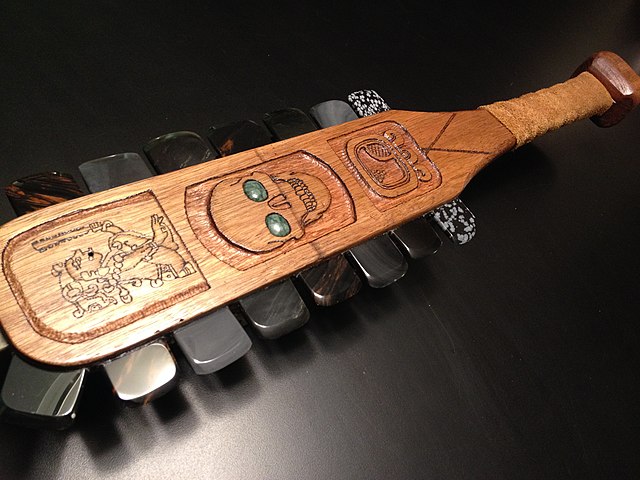
The macuahuitl, a distinctive weapon wielded by the elite warriors of the Maya civilization, was an integral part of their military arsenal. Although it might seem less intimidating compared to the iron blades of the Old World, the macuahuitl was a highly dangerous weapon in its own right.
Like its Aztec counterpart, the Mayan macuahuitl came in two main variants: a one-handed version, approximately 3 to 4 inches wide and about three feet in length, and a larger, two-handed version that stood as tall as a man, with a width of around four inches. This larger variant required extraordinary skill and strength from Mayan warriors to handle it effectively.
Crafted with expertise by skilled artisans, the Mayan macuahuitl featured a sturdy wooden frame, often made from hardwoods like oak. The outer edge of the weapon was intricately carved to hold sharp obsidian blades. These blades were sometimes arranged in a smooth, continuous line, while in other instances, gaps between them created a jagged, serrated edge. The obsidian blades were securely attached to the wooden base using natural adhesives, such as resin and plant-based glues.
In combat, the macuahuitl demonstrated its effectiveness, becoming notorious for its ability to slice through armor and flesh alike. Spanish conquistadors that encountered a warrior wielding a macuahuitl were often left in awe of the weapon’s power. Some stories even claim it could cut a horse’s head clean off.
Spiked Clubs
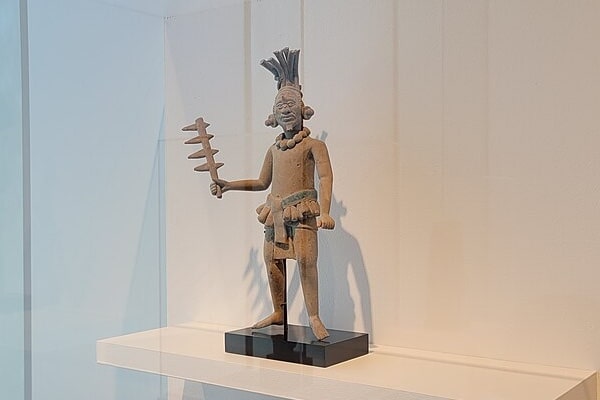
Within the last decade or so, another deadly Mayan weapon has come to light. In 2014, archaeologists released a study in which they studied 116 skulls from 13 different Maya sites. According to this study, “some injuries appear to be from small points hafted in wooden clubs.” While modern authors often refer to macuahuitls as “clubs,” Mayan warriors also seemed to have used spiked clubs akin to what the warrior statute above is holding.
Though these spiked clubs sound cruder in construction than the macuahuitl, they were extremely (and brutally) effective. Remains of Mayan warriors have been found where their skulls have oval-shaped impressions made by these deadly weapons. If this weapon was wielded by a skilled veteran of hand-to-hand combat, it clearly could do some damage (I mean look at that thing!).
Projectile Mayan Weapons
In ancient warfare, having strong hand-to-hand forces often wasn’t enough to win battles. To truly have the advantage, armies needed ways to strike from a distance. Let’s explore the projectile weapons Mayan warriors used to take control of the air.
Atlatl
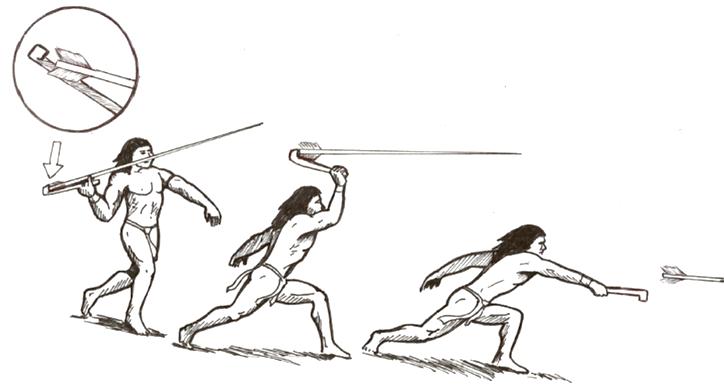
The atlatl was one of the most formidable long-range weapons used by the Maya, and it held a place of great significance in their military history. Dating back to the late Ice Age, the atlatl has been found across every habitable continent. While it was eventually replaced by the bow and arrow in many parts of the world, it remained an essential hunting and warfare tool in both Australia and the Americas.
By the time of the Maya civilization, the atlatl had become a key component of Mesoamerican warfare. But what exactly was an atlatl?
The atlatl was a simple yet effective device that allowed warriors to throw a spear — or “dart” — with greater speed and distance than they could achieve by hand. The effectiveness of the atlatl was well documented by those who encountered it. Spanish invaders reported that the darts launched from atlatls were capable of penetrating the cotton-based armor worn by both Maya warriors and the Spanish themselves. Some accounts even suggested that the atlatl could pierce the heavier metal armor the conquistadors had brought from Europe, though this claim is debated by modern historians and archaeologists.
Bows and Arrows

The bow and arrow were vital weapons in the arsenal of Mayan warriors, appearing frequently in both warfare and hunting. The Mayan bow was relatively straight and the bowstring was commonly made from hemp cord.
Mayan arrows were often constructed from reed or bamboo shafts, meticulously shaped and tipped with sharpened flint or fish teeth. These points were carefully crafted to be incredibly sharp and capable of inflicting serious wounds. The combination of lightweight yet sturdy shafts and razor-sharp tips made the Mayan bow an efficient tool for both long-range attacks and precise strikes in close combat.
Blowguns
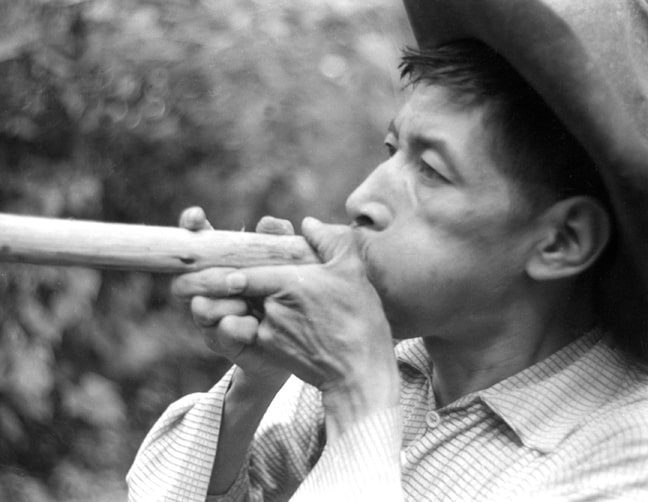
For millennia, blowguns have been an essential weapon for Mayan hunters. Largely used to hunt birds and small mammals, blowguns were used by ancient Mayan warriors to carry out stealth attacks.
Anywhere from 3 feet to 9 feet (1-3 meters) long, blowguns were made from lightweight wood or bamboo and shot small wooden darts or clay pellets. While peoples farther south in the Amazon rainforest are well known for using poison darts, the Maya never did. But that didn’t make these Mayan weapons any less effective. I wasn’t able to find any data on the range of Maya blowguns, but the length of the length of the weapon suggests they could shoot quite far.
Blowguns’ ferocity is also attested in the Mayan language from the Classic Period (c. 250-900 CE). During this period of Mayan history, some Mayan dialects used the word “Ahpu” for the sun. Translated into English, this means “he with the blowgun.” A weapon would have to be pretty awesome to be used by the sun.
Mayan Armor
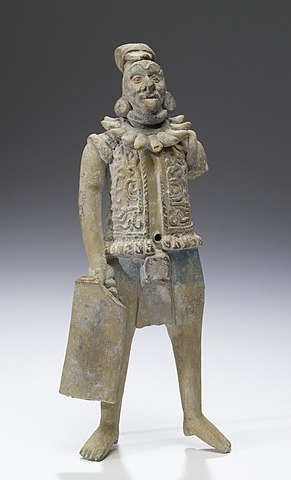
With all these crazy weapons coming at you, you’d want some protection right? So did ancient Mayan warriors. To project themselves in battle, they turned to these two main pieces of armor.
Cotton Armor
At the forefront of Mayan military attire was the ichcahuipilli (a Nahuatl word roughly meaning “cotton shirt”), an essential piece crafted from quilted cotton. Though it may seem light compared to the iron armor of the Old World, this armor, widely used across Mesoamerica, provided significant protection. The armor was made of cotton padding, covered and reinforced with leather. This clever design proved effective in deflecting arrows and spears during combat.
This approach was in sharp contrast to the fully armored European soldiers that eventually showed up on the Maya’s doorstep. While European warriors encased themselves in heavy iron suits, the Maya, whose primary goal in battle was often to capture rather than kill enemies, chose lighter armor that allowed for greater mobility. The fear of death in battle was not as prevalent in Mayan warfare, enabling them to design armor that balanced protection with agility. Plus, the lighter cotton armor was much preferable for the hot and humid conditions of a battle in Central America. The Spanish themselves adopted this armor during their campaigns.
Shields
An essential tool for ancient warriors the world over, shields were crucial defensive Mayan weapons. Held in one hand while the other held a spiked club, spear, or macuahuitl, Mayan warriors used shields to protect their core from opponents’ blows.
Depending on which region of the Mayan world they came from, warriors would have carried different types of shields. Most Mayan warriors seem to have used square wooden shields covered in animal hide to provide extra support and elongate the life of the shield. These wooden shields were also decorated with images of gods.
Warriors from the Usumacinta River region, which stretched across areas of Mexico and Guatemala, got a little more inventive. Mayan warriors from this area used flexible shields that could be folded up and carried over their shoulder to make long treks easier. These shields were made from woven mats to make this folding functionality easier and probably made these shields considerably lighter than their wooden counterparts.
Sources on Mayan Weapons
- David Freidel, “Maya Warfare, Myth and Reality,” maya.csueastbay.edu
- Ibid
- Lynn V. Foster, Handbook to LIfe in the Ancient Maya World (New York, NY: Facts on File, Inc., 2002), 148-149
- Foster, Handbook to LIfe in the Ancient Maya World, 151
- Maup van de Kerkhof, “Mayan Weapons: From Spears to Cotton Armor,” historycooperative.org
- April Holloway, “Traumatic skull injuries reveal Mayans used spiked clubs,” ancient-origins.net
- Stanley Serafin, Carlos Peraza Lope, and Eunice Uc González, “Bioarchaeological investigation of ancient Maya violence and warfare in inland northwest Yucatan, Mexico,” onlinelibrary.wiley.com
- April Holloway, “Traumatic skull injuries reveal Mayans used spiked clubs,” ancient-origins.net
- Beth Bragg, “It came from the ice age, but the atlatl continues to impress,” adn.com
- Foster, Handbook to LIfe in the Ancient Maya World, 151
- Ibid
- Carol Ventura, “The Jakaltek Maya Blowgun in Mythological and Historical Context,” Ancient Mesoamerica, Vol. 14, No. 2 (Fall 2003), via jstor.org
- Ibid
- Ian Mursell, “Ichcahuipilli (quilted cotton armour jacket),” mexicolore.co.uk
- Cara Grace Tremain, “RESOURCE: Ancient Maya Clothing,” mexicolore.co.uk
- Freidel, “Maya Warfare, Myth and Reality,” maya.csueastbay.edu
- Foster, Handbook to LIfe in the Ancient Maya World, 146
- Foster, Handbook to LIfe in the Ancient Maya World, 146