Mayan God of Death: Going Mental in Metnal
The Mayan god of death is actually a pretty difficult god to pin down. In researching this article, I quickly found that the ancient Maya had a complicated relationship with death, and their visions of the afterlife and the god(s) who ruled it was just as complicated.
The Multiple Maya Death Gods
To start, it’s hard to know who the Mayan god of death was or there was even one Mayan god of death. As I’ve discussed elsewhere, the ancient Maya were not unified politically, but rather a collection of city-states with a shared history and culture. As such, regional dialects of the Mayan language evolved over time, leading to different names for the same deities.
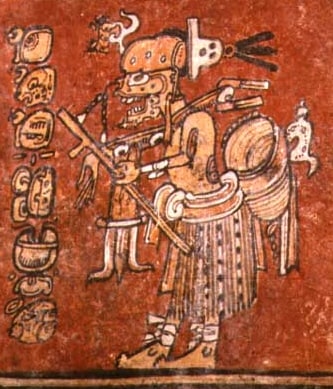
Ah Pukuh (or Ah Puch, as mistranslations have labeled him) and Kisim (meaning “flatulent one”) appear to be the two main names for the Mayan god of death. To make matters even more confusing, before Western scholars could read ancient Mayan hieroglyphics, they labeled the gods using different Latin letters, so the death god is sometimes referred to as God A.
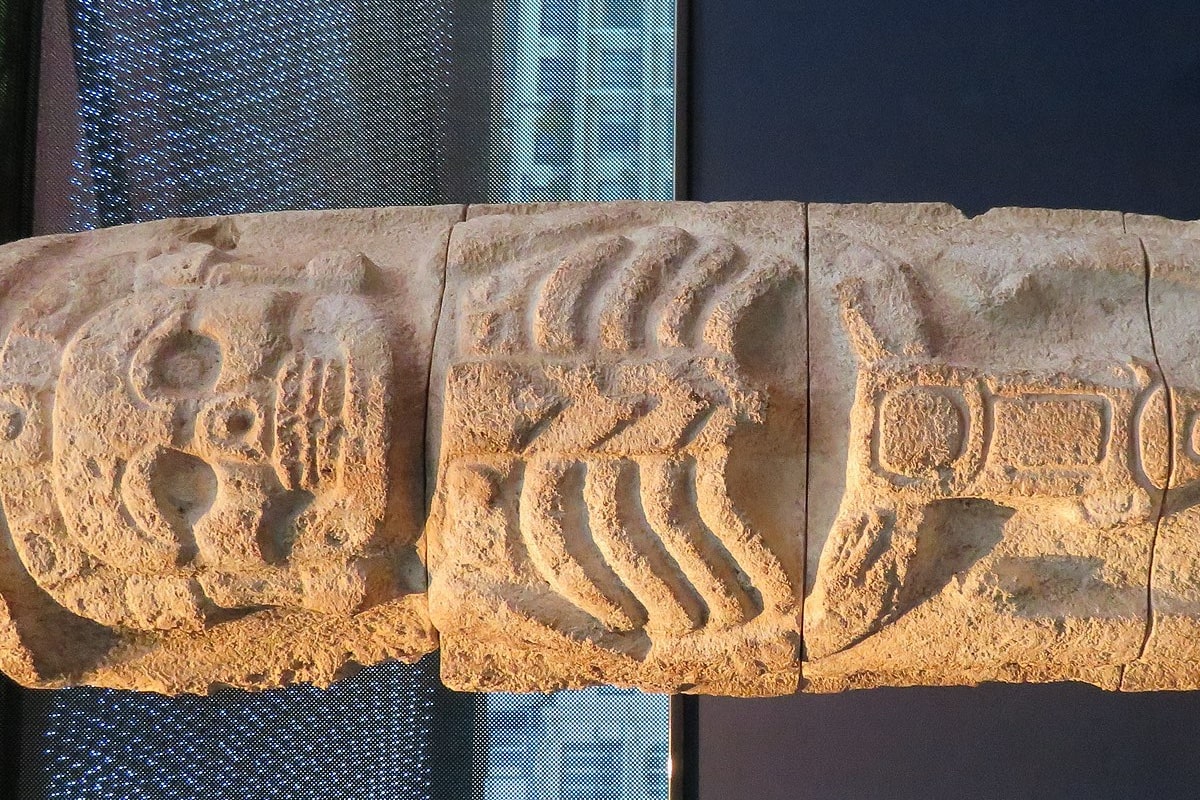
There are some things we can be sure of, though, about this god. For one, he was depicted as having a skeleton, with a necklace or collar made of human eyes. His body was pock-marked and his belly often shown as distended. In essence, he was the personification of death and decay.
The Death God also resided over the Underworld, known as Xibalba or Metnal depending on the Mayan dialect (more on this below). In Mayan belief, most people would have gone to the Underworld after they died, where the God of Death played a role in determining their eternal fate.
The Death Lords
Apart from the main Mayan god death, whatever you want to call him, there were several other “Lords of Death.” Inhabitants of the Underworld, they were responsible for various forms of human suffering. Apparently, though, the Lords of Death enjoyed the buddy system, as they always came in pairs:
- Hun-Kame (“One-Death) and Vucuv-Came (“Seven-Death”): The leaders of the Lords of Death.
- Scab Stripper and Blood Gatherer: Caused blood-born diseases.
- Demon of Pus and Demon of Jaundice: Made people develop inflammation.
- Bone Scepter and Skull Scepter: Responsible for the process of decay that led dead bodies to turn into skeletons.
- Demon of Filth and Demon of Woe: A manifestation of Mayan cleanliness, these two hid in dirty corners of homes and stabbed their inhabitants to death.
- Wing and Packstrap: Caused travelers to die by coughing up blood.
The God of Death and His Place in the Ancient Maya Pantheon
Clearly, the Maya had a rather dire understanding of the Underworld. But there’s more to the Mayan god of death than meets the eye. As we shall see in this section, he wasn’t just an incarnation of ancient fears of mortality, but played a crucial role in the Maya understanding of the universe.
The Yin to the Rain Deity’s Yang
In ancient Mayan cosmology, the history of the world was divided into distinct eras. Each era ended with destruction and then a new one was born from creation. In Mayan religion, as well, there were gods associated with creation and gods associated with death. In this sense, the rain god, Chaac, was the perfect counterbalance to the Mayan god of death.
As the god of rain, Chaac played a crucial role in agriculture. No rain, no crops. As such, it’s important to also view him as a god of cyclical creation.
On the other side of the equation, the god of death is responsible not just for the death of humanity, but for decay more broadly. In the depictions of Ah Puch/Kisim, the god is shown with sores, bloating, and a skeletal figure; he seems to be literally rotting away in front of your eyes. Partner this with the powers of the Death Lords to spread disease and we see a not just terrifying assortment of Underworld dwellers, but a balancing force in the world: the good and the bad.
Battle With the Hero Twins

The Mayan myth of the Hero Twins is rich in twists and intriguing elements, so let’s focus on the key points of their journey.
There are two pairs of Hero Twins in Mayan mythology. The first pair consisted of Hun Hunaphu (“1 Hunter”) and Vuqub Hunahpu (“7 Hunter”). These twins were exceptional at the Mayan ball game, which led to their invitation to play against the Death Lords in the underworld, Xibalba. Unfortunately, during their first night in Xibalba, the Death Lords deceived the twins and killed them. Hun Hunahpu was beheaded, and his head was placed in a tree, where it transformed into a squash. At one point, Xquic, the daughter of one of the Death Lords, visited the tree and spoke with the head. After spitting into her hand, Hun Hunahpu’s head magically impregnated her, and she later gave birth to the second set of Hero Twins—Hunahpu and Xbalanque.
The second pair of twins grew up to be skilled ball players as well, and like their predecessors, they were summoned to Xibalba. Aware of the traps that had previously led to their father and uncle’s deaths, Hunahpu and Xbalanque outsmarted the Death Lords and survived. They played the ball game with the Death Lords the following day, and according to some variations of the myth, the twins eventually chose to sacrifice themselves in order to achieve divinity. After dying, they were reborn—first as catfish, then as human boys, and finally as the adult twins once again. Upon their resurrection, the Hero Twins gained the power to bring others back to life, including their father, who was transformed into the Maize God.
Lord of the Underworld, Metnal aka Xibalba
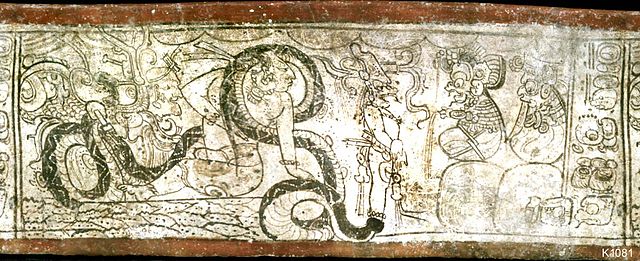
The Mayan god of death ruled over the Underworld. Here he oversaw the souls of the dead. In Mayan religion, only people who had died in a sacrifice or women who died in childbirth automatically went to the “upper world” (sometimes called “the heavens” by modern historians). Everyone else started the afterlife in Xibalba. But this was not a place you really wanted to be. A cold place filled with the souls of the dead, there were nine layers of the Underworld, each presided over by a Death Lord.
Interestingly, the Underworld also seems to have functioned as a trial to determine if a soul would go to the Upper world or stay in Xibalba. Like something from an epic poem, souls would journey out of the Underworld, facing obstacles along the way.
Sources on the Mayan God of Death
- Lynn V. Foster, Handbook to LIfe in the Ancient Maya World (New York, NY: Facts on File, Inc., 2002), 168
- Ibid
- “RESOURCE: Ancient Maya gods – 2) Death God Kimi (‘God A’),” mexicolore.co.uk
- Jim Reed, “Exploring the Maya Underworld,” mexicolore.co.uk
- Nicoletta Maestri, “Hunahpu and Xbalanque — The Maya Hero Twins,” thoughtco.com
- “Maya Hero Twins,” historyonthenet.com
- “Mayan Religion and Cosmology,” historyonthenet.com
- Mark Cartwright, “Xibalba,” worldhistory.org