Mayan Artifacts and What They Tell Us About Mayan Society
Mayan artifacts offer us a fascinating glimpse into the material world that the ancient Maya lived in. The statues, jewelry, calendars, and even cities they left behind give use so much great information on the history of this extraordinary civilization. In this article, I’d like to explore five of the more intriguing Mayan artifacts that have survived and look at what they can tell us about Mayan society. Let’s get into it!
Statue of Chaac the Maya Rain God
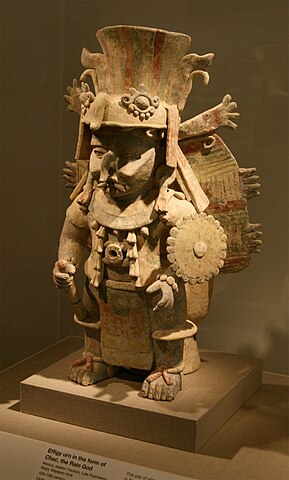
This interesting looking little statue is a Mayan artifact made to look like the rain god, Chaac. Coming in just shy of two feet tall (21.75 in.), this statue of Chaac was originally used as an effigy urn, meant to burn incense in places of religious significance.1 Made some time during the twelfth- to fourteenth-centuries, this interesting artifact can tell us a lot about the Mayan rain god. But first, who was Chaac?
Chaac was one of the most significant gods in the Mayan pantheon. First appearing in the archaeological record during the Preclassic Period (around 2000 BCE – 250 AD), the worship of Chaac has roots that stretch back thousands of years.2
In ancient Mayan society, rainfall was essential for survival. Without sufficient rain, farmers couldn’t grow enough crops, and food shortages would follow. If droughts persisted, the ruling leaders were often seen as being out of favor with Chaac, which could weaken their authority.3 This vital connection between rain and survival made Chaac one of the most important Mayan deities.
As we can tell from the statue above, Chaac was often shown as a human-like figure, though not quite a typical one. He stood on two legs (like a human) and wielded a lightning axe (less like a human), but his features were far from conventional. His skin was covered in scales, his eyes were large and round, and his nose was long and drooping, resembling more of an elephant’s trunk than a human nose.4
Unlike many other ancient religions, it seems the Maya did not expect their important gods to be physically perfect. In fact, between Chaac and the Mayan god of death (who is depicted with rotting skin and boils), the opposite may be true.
Feathered Serpent at Chichen Itza
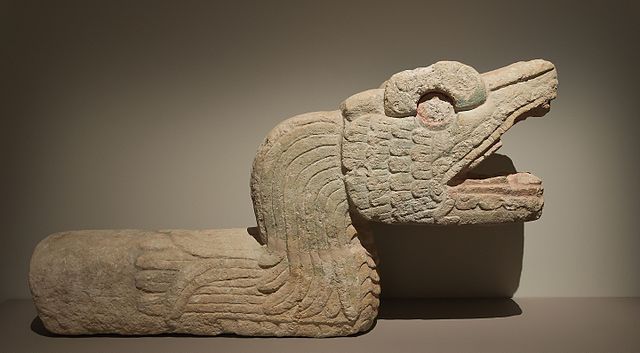
Created between 800-1200 CE, this statue represents one of the most important gods across Mesoamerican religion, not just the Maya. The Feathered Serpent has been represented in Mesoamerican artistic traditions for thousands of years. While many people recognize this deity by his Aztec name, Quetzalcoatl, the Maya referred to him as Kukulkan. The name “Kukulkan” itself is derived from the Yucatec Maya words for “feathered” (k’uk’ul) and “serpent” (kan).5
This particular statue was carved to serve as the edge of a platform or bench in a city in the Yucatan, possibly Chichen Itza. Made to look like it’s poised to strike, the statue would have also originally been painted with bright colors, creating a captivating, if not awe-inspiring, effect on the Maya faithful.6
As one of the supreme gods in the Mayan pantheon, Kukulkan served as the bridge between the divine and human worlds. In Mayan beliefs, snakes were often associated with caves, which were thought to form a spiritual connection between these two realms.7 As seen in the image above, the serpent’s mouth was usually open, symbolizing a link to the divine. Feathers crown the head of the god, and intricate details embellish the jaws of this powerful deity. This magnificent Mayan artifact offers us a glimpse into the spiritual and architectural sophistication of the ancient Maya.
Jade Mask of Pakal

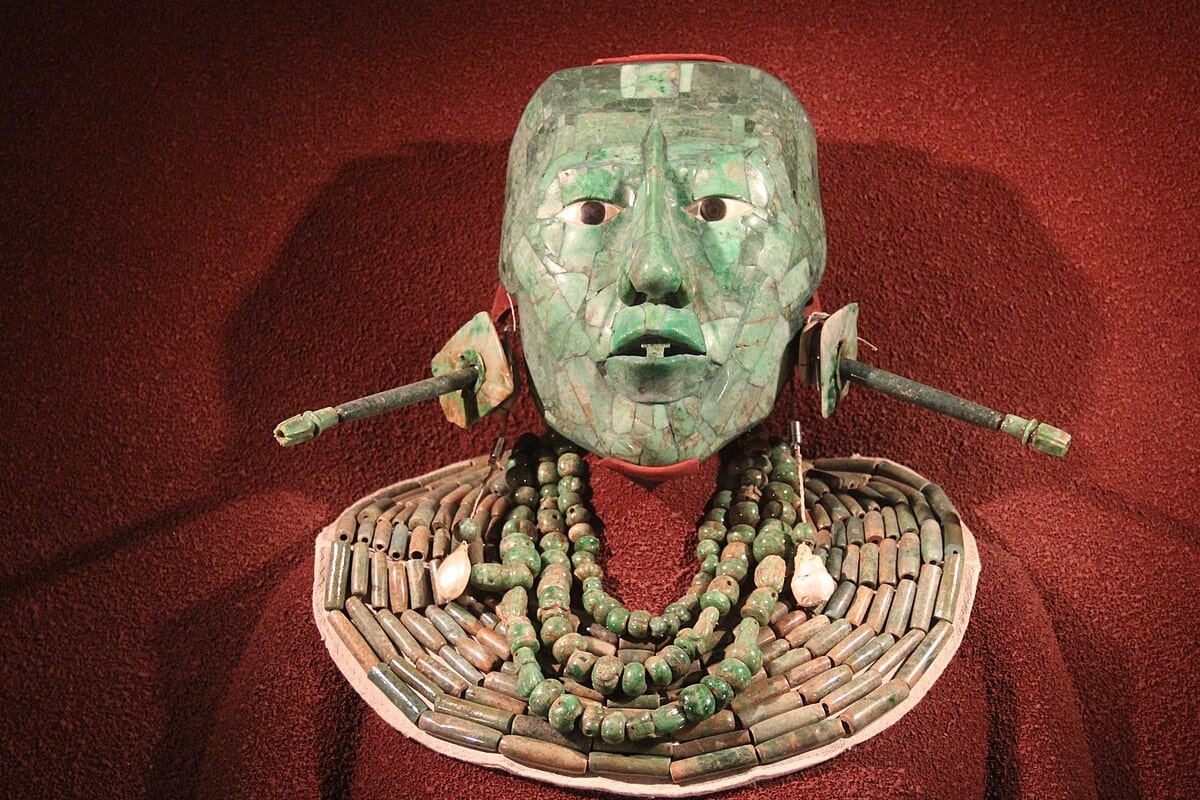
The jade mask of Pakal is one of the most extraordinary Mayan artifacts ever discovered. Made for the king of Palenque, Kinich Janaab Pakal, aka Pakal the Great, around 683 CE8, it was unearthed until 1952.9 Found in Chiapas, Mexico at a site known as Palenque (though the ancient Mayans called it Lakamha, meaning “big water”), this single artifact can tell us so much about Mayan beliefs of the soul, the nature of kingship, and the importance of Jade in Mayan culture.
Who was Pakal?
First up, who was Pakal? One of the most powerful people to ever live, Pakal ascended to the throne of Palenque at age 12. At the time of his ascendence, the city-state he governed was on the decline. Under Pakal’s predecessor, Palenque had suffered devastating military defeats at the hands of their rival, a city called Kaan. After Pakal came into his own (his mother ruled as queen regent for the first three years of his reign), this trend was reversed. Getting wind of another Kaan offensive through his spy network, Pakal sent his army to destroy the closest Kaan military outposts. It was a hard battle, but Pakal’s forces prevailed and captured many of Kaan’s nobles, whom they ultimately sacrificed in a duel display of piety and power. Through the rest of this 68 year reign, Pakal would go on to take Palenque to even greater heights.10
Why a death mask?
Pakal’s greatness in life earned him equal splendor in death. Archaeologists discovered his tomb under the Temple of the Inscriptions, a pyramid-temple built during the reign of Pakal himself. Pakal was laid to rest in an elaborately carved stone sarcophagus, which was surrounded by jade and shell artifacts, two of the more precious materials in Mayan culture (but more on this below). And, finally, there was the death mask that had covered Pakal’s face for some 1,300 years.11
Death masks did not originate with Pakal. They were an important part of Mesoamerican religion for centuries. In the Mayan world, death masks represented their complex beliefs about the transition into the afterlife. The core of Mayan cosmology was an idea of transition, from life to death back to a new form of life. The rising and setting of the sun is a prime example of this. For the human soul, the Mayans believed there was no death, just transformation. The death mask was a rite that could facilitate this transition.
But not everyone in the Mayan world was buried with a death mask. This practice was probably limited to kings or individuals of extreme importance. Researchers have noted how, in Mayan culture, death masks represented a face the person had created over their life, which represented their soul. In other cultures, it was common for the mask to be more of an idealized version of a human face. Either way, experts believe that death masks could also be used to deify a person and thus transition them from person to god.12
The impotence of jade
Lastly, the jade mask of Pakal demonstrates the extreme importance of jade in Maya culture. Whether his death mask was a metaphorical funeral rite of an important ruler or something meant to help him become a god, it was not something to skimp on. The natural place to turn, then, would be jade.
For the Maya, jade was a symbol of wealth and fertility (another type of transition!), and “was associated with the Maize God and evoked his eternal youth and vigor.”13 Here again we see potential repercussions for the soul that wore jade during its transition to the next life – the ability to gain everlasting energy, strength, and vitality.
Here on the mortal coil, jade was reserved for only the wealthiest members of society and rulers across the Mayan civilization were often buried wearing jade.14
Stone Ball Game Yoke
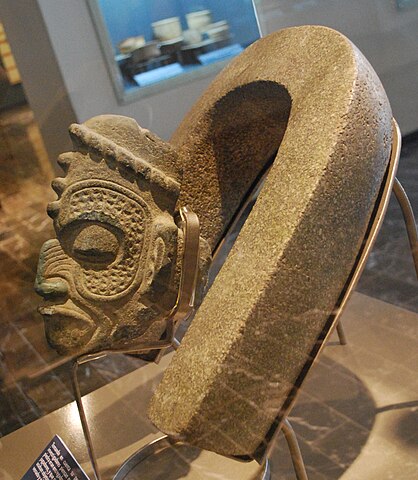
One of the oldest sports in recorded history, the Mesoamerican ball game was a favorite among the Maya. To fully understand what an interesting Mayan artifact this stone ball game yoke is, I’d like to give a quick overview of the ball game.
Played for thousands of years throughout Mesoamerica (and still is), the game was played on a large stone court. The court was made up of two parallel walls, which sometimes were slanted and sometimes not, that had stone hoops part way up which were oriented so that the “rim” was perpendicular to the ground. Unlike modern sports where goal sizes tend to be standardized, it seems different regions of the Mayan world had different ways of setting up their ball courts.15
To score, a team made up of three plates had to get a rubber ball through the stone hoops. To do so, each player could use their thighs, upper arms, shoulders, or head to direct the ball. For protection, they wore a protective belt made from either leather, rubber, or wood.16 Something like a cross between modern day soccer (or football) and basketball, this game would have taken an extreme amount of skill.
Stone carvings were used as prizes for the victorious team. Typically, these took the forms of sculptures or stone yokes meant to resemble the belt work by ball game players. The stone yoke above is from the Chiapas region of Mexico. This yoke was not intended to be worn, but was purely ceremonial.17 They were so prized, in fact, that many people chose to be buried with them. While the stone yoke above is not decorated, it was not uncommon for artisans to create stone ball game yokes that were highly stylized. Archaeologists have found ones shaped like animals, people, and potentially gods.18
Tzolk’in Mayan Calendar Stone

Many people mistakenly believe the Maya only had one calendar system, but in reality, they used four distinct calendars. Each of these calendars held significant importance in both the religious and agricultural aspects of Maya life, no matter which kingdom or city-state they belonged to.
The calendar stone above is the Tzolk’in, a Mayan calendar that tracked a 260-day cycle.19 Unlike other Mayan calendars, which measured time in a linear fashion, the Tzolk’in followed a more circular approach to timekeeping.
That being said, delving into the intricacies of the Tzolk’in can be quite complex. If you wish to explore this fascinating and spiral-like system of time, I recommend consulting expert sources at the end of this article. The Tzolk’in appears to have had a more mystical or supernatural role compared to other Mayan calendars.
The Maya used the Tzolk’in to assign names, predict future events, determine the best times for battle, and every day within the calendar was linked to specific omens. Essentially, the Tzolk’in acted as a kind of spiritual guide for the Maya, allowing them to navigate the uncertainties of life.
Some of the most intriguing Mayan artifacts, like carved stone monuments, feature references to the Tzolk’in, further highlighting its crucial role in their civilization.
Sources on Mayan Artifacts
- “Effigy urn in the form of Chahk (the Rain God),” famsf.org
- N.S. Gill, “Gods and Goddesses of the Maya,” thoughtco.com
- Lynn V. Foster, Handbook to LIfe in the Ancient Maya World (New York, NY: Facts on File, Inc., 2002), 167
- Ibid
- Mark Cartwright, “Kukulcan,” worldhistory.org
- “Plumed Serpent Sculpture,” metmuseum.org
- Mark Cartwright, “Kukulcan,” worldhistory.org
- Gary Todd, “Jade Death Mask of Kinich Janaab Pakal,” worldhistory.org
- “Maya: Pakal the Great’s burial mask,” kids.britannica.com
- “Death Mask of Pakal the Great,” atlasobscura.com
- “The Tomb of Pakal the Great: A Window into Mayan Culture and Beliefs,” thearchaeologist.org
- “The Funerary Mask: Metaphor of Transformation,” publishing.cdlib.org
- “Mayan Jade,” collections.gilcrease.org
- Ibid
- Mark Cartwright, “The Ball Game of Mesoamerica,” worldhistory.org
- “Ball game yoke, 1000–500 B.C.,” artmuseum.princeton.edu
- “Ceremonial Ball Game Yoke,” learn.ncartmuseum.org
- “Ceremonial Ball Game Yoke,” learn.ncartmuseum.org and “Ballgame Yoke,” collections.mfa.org
- “The Calendar System,” maya.nmai.si.edu