Mayan Pottery: That’s Some Dynamic Ceramic!
Mayan pottery constitutes some of the most breathtaking ancient artifacts to survive to the present day. A combination of practical tools and artistic media, these amazing works of ceramics have helped to understand so much about the ancient Mayan world.
How Mayan Potters Created Their Ceramics
To begin, Mayan artisans had to source their clay. Though it’s up for debate how the ancient Maya did this, many of their modern day ancestors harvest the clay they use in their ceramics from river deposits.1
Next, the potters would temper the clay with volcanic ash.2 This process made the clay malleable, allowing Mayan potters to shape it. Unlike modern potters, however, the Maya did not use a potter’s wheel to create the intricate shapes and designs their pottery is known for. Instead, they used two different techniques to form different sections of their ceramics:3
- Coil: Potters created long strips of clay that they coiled or wound upward to create the main form of the ceramic. They then smoothed out the coils in order to give structure to the walls of the piece.
- Slab: Square chunks of clay were used to create lids and feet for vessels or boxes.
If the potter wanted to add decoration to the piece (as much Mayan pottery did, no matter the wealth of the owner), they would next apply paint or slips (a mixture of water and clay). Once decorated, the pottery was placed into a kiln and fired. Unlike today, the ancient Maya kept their kilns outside and used either grass, wood, or charcoal to keep them burning.4
Notable Examples of Mayan Pottery
Creating a pottery classification system for ancient Maya ceramics is difficult because, well, the Mayans loved pottery and made a lot of it. Decades worth of books are dedicated to this subject and so I won’t be able to run through every different type or form of Mayan pottery that we know about. Instead, I’ll concentrate on the types of pottery that are important for understanding Mayan culture and society.
Polychrome pottery
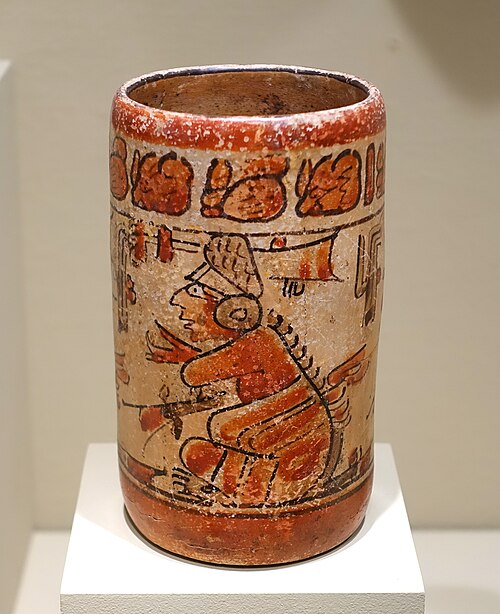
Polychrome pottery evolved during the Classic Period (c. 250-900 CE) throughout the Mayan world.5 Intact, or mostly intact, polychrome pieces have been found in Mayan sites across the Yucatan in Mexico, as well as Guatemala, Belize, and Honduras.
As the name suggests, polychrome pottery was a type of ceramic that artists adorned with multiple colors. They also used these ceramics to flex their artistic muscles, depicting scenes from Mayan mythology or that flattered their patron (that is to say, ruler). Archaeologists have vases, bowls, and plates that adhere to the polychrome style.6
We probably owe much of the surviving examples of polychrome ceramics to the burial rituals of the Mayan elite. Just as the nobility used polychrome pottery in their day-to-day life (more on this later), they were also buried with it. The inclusion of these exquisite pieces of art in the burial of a given area’s most politically important individuals probably meant that they were interred with care.
Codex-Style Vessels
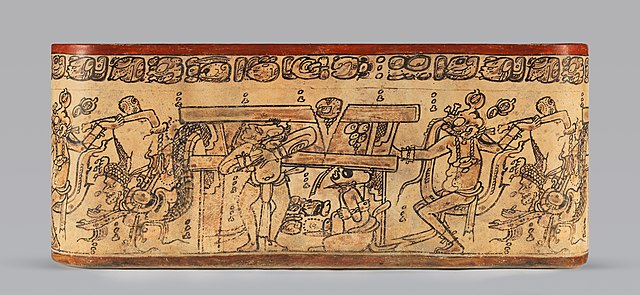
Codex-style vessels have been one the most important types of Mayan pottery for unlocking the secrets of the ancient Maya’s past. Codex-style vessels are ceramic pieces finely adorned with intricate scenes depicting kings, gods, and myths. But what sets them apart from other polychrome pottery pieces is the band of writing that circles the top edge of these vessels.
Written in a style known as the Primary Standard Sequence (PSS), these hieroglyphics follow a distinct pattern that’s made of five parts7:
- The first section acts as an introduction, describing how the piece of pottery was made, was presented to its owner, and how it was blessed.
- The second section tells how the surface of the ceramic vessel was painted, carved, or otherwise treated by the artisan who made it.
- The third section lets the reader know what type of vessel the writing appears on. Some examples of these inscriptions are: “yuch’ab, or ‘his/her drinking vessel’”; “u lak, or ‘his/her plate’”; or “u hawte’, ‘his/her tripod plate.’”
- The fourth section describes what food or drink will be served in the vessel. The most common content for codex-style vessels was chocolate (which the Mayans drank), but other vessels have been found that label their intended contents as corn, atole, tamales, and bread, among others.
- The fifth (and final) section of the sequence gives the name and titles of the person who owns the vessel.
The codex-style vessels seem to have largely been produced at Calakmul in present day Campeche, Mexico and the Petén district of northern Guatemala.8
What Mayan Pottery Can Tell Us About Maya Culture
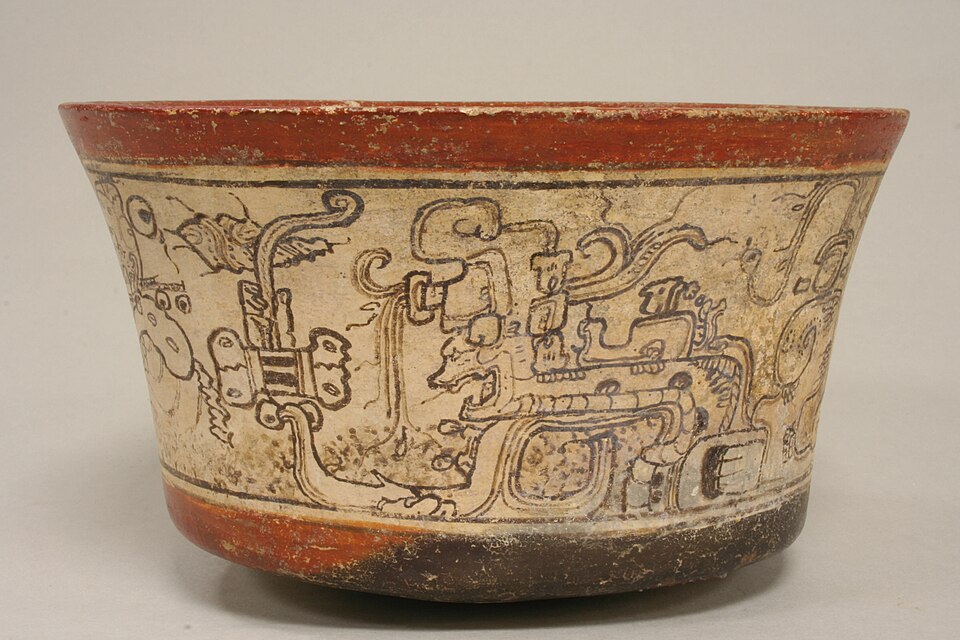
To understand any culture, it’s important to understand the objects created by that culture. The same holds true for the ancient Maya. By examining Mayan pottery, we can better come to terms with how their society functioned, their beliefs about the world around them, and more.
Social Structure
From the Early Classic period through the Postclassic period, the ancient Maya lived in highly stratified societies. The basic structure was nobility and priests on the top, with commoners and slaves on the bottom. While this class system was certainly rigid, Mayan pottery finds have helped us better understand what daily life was like for people throughout the Maya social structure.
For the elite classes, pottery wasn’t just for consuming their daily meals, it also helped them forge political bonds. The Mayan nobility held large celebrations to create alliances, gain prestige, and flaunt their power and wealth. There were also ceremonial feasts held for important events in a person’s life like marriage, the birth of a child, or the death of a loved one. Either way, when a noble hosted a feast they used the finest pottery in the Mayan world, typically polychrome vessels, to serve and consume a wide variety of food and drink.9
The other end of the class system is where things get interesting with Mayan pottery (or at least I think they do!). In such a highly stratified society where the creation of pottery was such a labor intensive effort, you wouldn’t expect Mayan commoners to have access to a lot of pottery. Archaeologists, however, have found just that. At the Mayan site of Cerén, El Salvador, archaeologists have found that every home had around 70 pieces of pottery! While some were simple storage vessels, every household excavated in Cerén had at least some painted pottery.10 This shows that every Mayan had decent access to pottery and that Mayan commoners enjoyed a relatively high standard of living.
Mayan Art
Art was an important part of the ancient Mayans’ world. They left us exquisite architecture, sculpture, and painting. But pottery was the highest form of Maya art. In our modern, industrialized world where machines can crank out bowls and plates en masse, we don’t tend to think of pottery this way. But ancient societies across the world definitely did.
For the ancient Maya specifically, we see pottery that’s been honed into intricate shapes, painted with scenes from mythology and history, or painted with abstract patterns. And that doesn’t even take into account the fascinating world of ceramic sculpture in ancient Maya society! Many of the polychrome pottery pieces that have survived to our present day are true masterpieces of the form and show just how sophisticated Mayan artists were.11
Analysis of highly stylized, painted Mayan pottery has also provided us with insights into the techniques employed by these artists. Depending on the style of pottery a Mayan artists was creating, they would actually use different brushes. To paint an entire piece of pottery one color, artists (much like today) employed a wide brush. Thin brushes made from yucca leaves were used to create fine lines and details like we see in the polychrome pottery image above. And to create the hieroglyphics on codex-style vessels, ceramic artists used a brush made from a hollow tube with human or animal hair attached to one end.12
Beliefs About the Afterlife
Throughout the Mayan world, from the Yucatan peninsula to Guatemala to El Salvador and everywhere in between, archaeologists have uncovered pieces of pottery interred with the dead. Pottery was included in the elaborate tombs of kings and the simple burials of the non-elite. This tells us quite a bit about the beliefs held about death throughout Mayan culture.
One of the core beliefs in Maya cosmology was that death was not an end, but a transition into a new state of being. The cycle of life, death, and rebirth informed how they understood both the universe around them as well as their own lives. This belief fueled one of the ways in which the Maya interacted with pottery.
So, by including works of Mayan pottery in graves, the Maya clearly meant for them to act as grave goods for the deceased. Grave goods of all kinds were buried with the dead to help ease their transition into the afterlife, though pottery was one of the more prominent.13
Sources on Mayan Pottery
- “Maya ceramics facts for kids,” kids.kiddle.co
- Lynn V. Foster, Handbook to Life in the Ancient Maya World (New York, NY: Facts on File, Inc., 2002), 314.
- “Maya ceramics facts for kids,” kids.kiddle.co
- Ibid
- James Doyle, “Ancient Maya Painted Ceramics,” metmuseum.org
- The British Museum, “Maya: The Fenton Vase,” smarthistory.org
- Foster, Handbook to LIfe in the Ancient Maya World, 293-294
- Doyle, “Ancient Maya Painted Ceramics,” metmuseum.org
- Jaclyn Skinner, “The Significance of Classic Maya Ceramic Vessels in Feasting,” minds.wisconsin.edu
- Payson D. Sheets, “What was life like for most of the Ancient Maya?”mexicolore.co.uk
- Foster, Handbook to LIfe in the Ancient Maya World, 314
- Foster, Handbook to LIfe in the Ancient Maya World, 315
- \“Exploring the Mayan Underworld Through Día de Muertos,” yucatandivecrew.com