Exploring the Rich Traditions of Mayan Religion
The Maya world was a complex and multifaceted society with a rich spiritual tradition. Mayan religion was at the center of their culture and life, complex, often confusing, and filled with mystery. The Maya believed in a pantheon of deities, including gods and supernatural beings. The Maya viewed all of nature as sacred, and believed that all things – animals, plants, rocks, rivers, weather systems, human handiwork, and perhaps even words – were alive.
Ancient Maya Society and Culture
Mayan culture and the societies they founded date back 4,000 years. Originally semi-nomadic people, the Maya settled down into fully permanent settlements by 1,000 BCE and began building their now famous cities between 1,000 BCE and 300 BCE. These cities thrived thanks to their economies built on agriculture, trade, and warfare. Known as the Preclassic period, this was the era when Mayan society was gaining strength. Their villages began turning into urban centers, they began creating their unique writing system, and charted the stars to make astounding astronomical insights.
Around 250 CE, the Mayan Classic period began. Lasting until c. 900 CE, the Classic period is when Mayan city-states achieved incredible strength. Led by powerful kings, the Mayan city-states had spread across territories in modern day Mexico, Guatemala, El Salvador, and Honduras. During this period, the Maya perfected their writing system and constructed many of the amazing pyramid temples that have survived till today in Central America. Thanks to these two achievements, in particular, the ancient Maya left a written and architectural record of their religious beliefs.
The development of Mayan society was closely related to their religion, with the two being inextricable. The Maya believed that their gods were closely tied to the natural world and that their rituals and ceremonies were necessary to maintain the balance of nature. Having developed a highly stratified society by this point, it comes as a little surprise that Maya civilization created a priestly class. It was the priests job to understand the will of the gods and manage the elaborate cycle of rituals and religious ceremonies to keep the gods happy.
Now that we have a basic understanding of Mayan society and culture during its heyday, let’s deep dive into their religion.
Maya Cosmology and Mythology

The ancient Maya believed they lived in a multi-layered universe. They divided the universe into three realms:
- Upper world: Also called “the heavens” by some historians, the Maya divided this cosmic realm into 13 additional layers. Each of these 13 heavenly layers was represented by god.
- Earth’s surface: This was the realm of humanity. From earth’s surface, people could interact with the other realms through openings in the earth, known in ancient Mayan as ch’e’en.
- Underworld: Known as Xibalba in Mayan, the underworld was divided into nine layers, each with its own “Death Lord.” This was a cold place inhabited by unhappy souls. When ancient Mayans died (expect for women who died in childbirth or those who died in a sacrifice) their soul was sent the underworld and, overtime, they could work their way through the nine layers and into the heavenly layers above the earth.
Another distinctive aspect of Mayan cosmology was their animistic set of beliefs. In Mayan belief, everything has soul, from people, animals, and plants to trees, mountains, and rocks. But, has one historian explained, “more significant than the person, animal, or thing were the enduring relations among them and their role in maintaining the balance of existence.” The interactions between everything in the world, and their souls, had the power to maintain balance in the universe, or through it out of balance. Essentially, the Mayans came up with “the force” 2,000 years before George Lucas.
Time, too, was cyclical to the Maya. According to Mayan belief, the world was created and destroyed according to a rhythm. This belief in a cyclical creation and destruction led to the creation of the famous long count calendar, which attempted to chart the beginning and end of the human era in world history.
The Most Important Maya Gods and Goddesses
The Maya pantheon is rich and complex, with over 250 gods and goddesses. Like many polytheistic religions, the Maya gods are fluid and have diverse personalities, with some gods morphing with less notable gods and sharing characteristics. Experts have argued that this fluidity among the gods shows an incorporation of the connectivity so important to Maya culture into the myths around the Maya deities.
To get a better understanding of Maya mythology and their belief system, let’s explore the major Maya gods.
Kukulkan
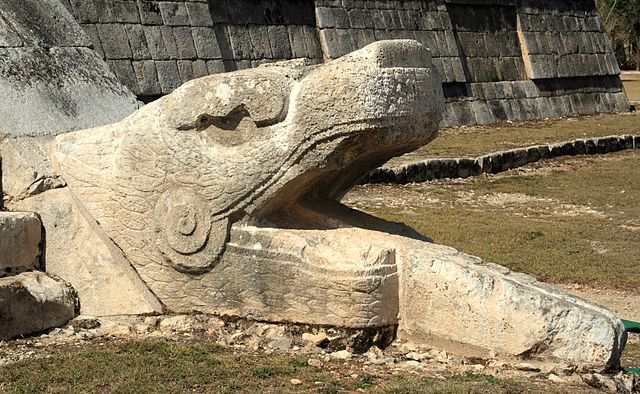
A god by many names, Kukulkan was a super important deity to not just the Maya, but almost every Mesoamerican culture. Known as Kukulkan in Yucatec Mayan, Gucumatz in Quiche Mayan, and Quetzalcoatl in Nahuatl (the language the Aztecs spoke), this god’s name translates to “feathered serpent.”
An ancient god, depictions of the feathered serpent date back to the third-century CE at Teotihuacan, a powerful city-state that inspired many other Mesoamerican civilizations. Originally a god of vegetation in his earliest incarnations at Teotihuacan, among the Maya Kukulan took on a bunch of different roles. In Mayan belief, Kukulkan was the god of:
- Creation
- Life
- Storms
- Wind
- Rain
Fitting with his reputation as a creator god, Kulkuan is also credited with bringing civilization to humanity. This included all Maya daily life that allowed them to create such a thriving civilization including hunting and fishing, agriculture, architecture, writing, law, medicine, artistic expression, and architecture. But hey, all in a day’s work for a creator god, right?
Chaac

Chaac was the Mayan rain god. But he didn’t stop there. Since rain is so often accompanied by thunder, lightning, and cloud cover, Chaac also became associated with these phenomena. For a society that depended upon agriculture for its survival, the importance of the rain god cannot be understated. This is why in the Post-Classic Period of Mayan history, a period of renaissance after a near collapse of Mayan society, Chaac became associated with human sacrifice.
Another key indicator of Chaac’s importance to the Maya is his association with the cardinal directions.

Despite his extreme importance to Maya culture, depictions of Chaac in Maya art were… interesting. Classic Period works show Chaac with large eyes, long, protruding fangs, and a nose like an elephant’s trunk. In the Postclassic Period, sacrificial altars known as chacs depict the god with long arms and legs, in a supine position holding the altar on his stomach (almost like he’s doing a situp).
Tonsured Maize God

Like all other agricultural peoples in the Americas, maize (a.k.a. corn) was a crucial part of the Mayan way of life. The importance of corn is reflected in the Maya belief in the tonsured maize god. In fact, the Maya had two maize gods, one male and one female. The male maize god was the tonsured maize god and the more powerful of the two. He personified maize as well as cacao and jade, two other important natural resources in Mesoamerica.
Mayan artists depicted the maize god with an elongated head, symbolizing a corn cob. They also showed him with long, flowing hair, meat as a metaphor for the long fibers that grow out of the top of a piece of corn. Finally, this body was often covered in jade jewels, a reference to the green leaves that surround a piece of corn on the stalk.
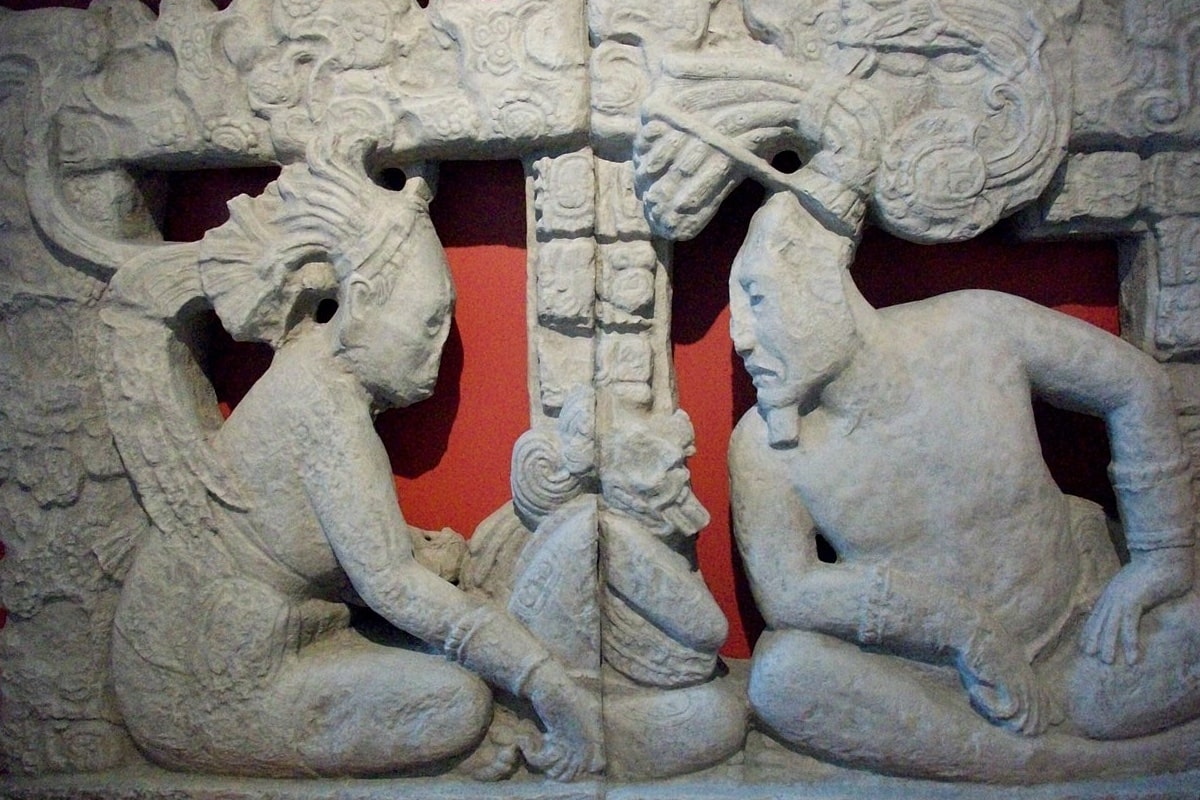
The maize god is also often shown as a scribe or artisan, as in the image above. This could potentially be the Maya acknowledging the role corn cultivation played in the founding of their civilization.
Ix Chel
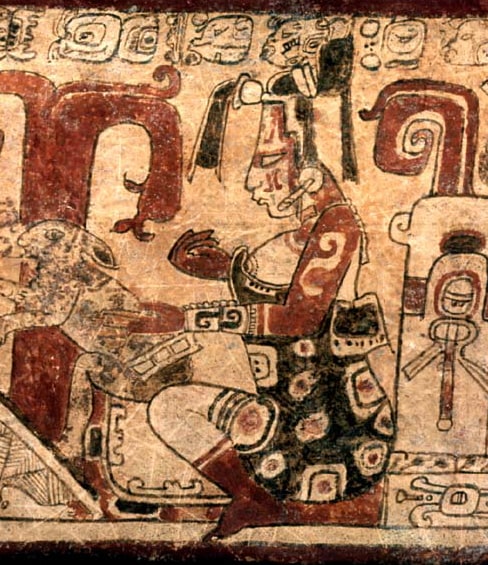
Ix Chel was the goddess of the moon. Her name translates to “Lady Rainbow” or “She of the Pale Face,” the latter clearly a reference to the moon. In Mayan artistic traditions, Ix Chel is depicted as an old, plump woman, often with pointed ears, jaguar claws, and fangs.
Ix Chel is though to have been a goddess that oversaw many of the “female” aspects of life, including pregnancy and textile work. But, she also seems to have had domain over medicine and love, aspects of Mayan society that were also decidedly “male.”
Modern representations of Ix Chel show her as a young, beautiful woman. Some scholars have argued, though, that this younger version is in fact a distinct deity. Though we don’t know this other god’s name, archaeologists have denoted her as “Goddess I.”
Hunab Ku
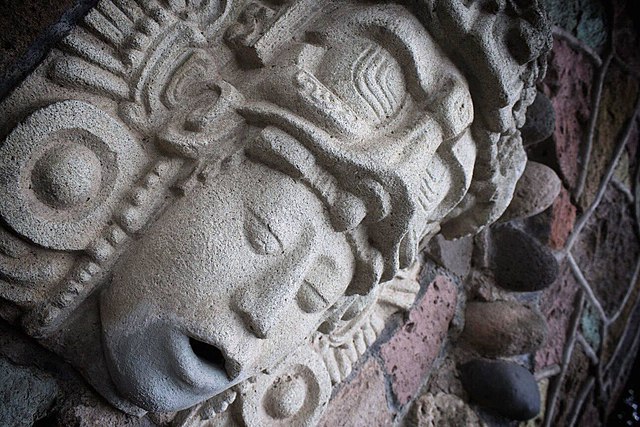
Hunab Ku is a fascinating case study of the effects of the Spanish conquest and colonization on Maya culture.
Some experts claim that Hunab Ku was the chief god of the Maya pantheon. Though Kukulkan was more widely worshipped, Hunab Ku seems to have been an omnipotent and all knowing god. Indeed, his name means “Sole God” or “the one god,” which could be a linguistic nod to Hunab Ku being the only god with such all encompassing powers.
Some scholars argue, however, that the “Sole God” came about as a result of Spanish colonization. Eager to convert the inhabitants of the New World to Christianity, the Spanish sent droves of missionaries to Central America. It could be that Hunab Ku entered the Mayan cosmology during this time of transition from the traditional Mayan religion to Chrisitianity as a Mayan reaction to Spanish missionaries and a way of explaining how to competing belief systems could coexist. Or, as other historians have argued, Spanish missionaries got wind of a “Sole God,” in the Maya pantheon and seized upon this wording as a way of converting the Maya to the European version of the “one god.”
Rituals and Practices in Mayan Religion
The Maya were a highly religious people and rituals were an important part of their spiritual and political life. In Mayan cosmology, the universe was created from the blood of gods. Therefore, blood was required to keep the universe going. While the Maya did practice human sacrifice, it was not as common. Instead, the Maya performed bloodletting ceremonies to appease the gods.
According to Diego de Landa, a Spanish bishop who worked to convert indigenous populations of the Yucatan, bloodletting was a ceremony in which:
“They [the Maya] offered sacrifices of their own blood, sometimes cutting themselves around in pieces and they left them in this way as a sign. Other times they pierced their cheeks, at other times their lower lips. Sometimes they scarify certain parts of their bodies, at others they pierced their tongues in a slanting direction from side to side and passed bits of straw through the holes with horrible suffering, other slit the superfluous part of the virile member leaving it as they did their ears.”
The ancient Maya also commonly held ceremonies to ensure the fertility of both women and their farm land. Some of these include:
- Mak: In this agricultural ritual, four Mayan priests ritualistically light and extinguish a fire in the plaza of their city for two days. After this, they would burn incense and provide offerings and prayers to the gods in charge of agricultural fertility.
- In the Book of the Songs of Dzitbalché, the author described a fertility ritual in which women danced naked during the night while carrying offerings of various kinds.
Temples and Sacred Sites in the Maya World
In Mayan religion, ceremonies and rituals needed a place to be carried out. In order to performed these important rituals, Mayans constructed pyramid-temples (many of which still stand) and used naturally occurring geologic features like caves and cenotes.
Pyramid-temples

If you’re ever lucky enough to visit an ancient Maya site, temples are one of the most striking features you’ll see. Built in the shape of a step pyramid with a large staircase ascending the front of the temple, these structures were hugely important in Mayan religion. Built largely by rulers (though this assertion has come under scrutiny in recent years), temples seem to have been made for several reasons. Temples were only used as sites of religious ceremony and celebration, but they were also built as a way of displaying the power of rulers. Basically, “I’ve made our city so rich we can build this giant awesome pyramid.”
At the top of the pyramid, Maya architects constructed the temple of the so-called “pyramid-temple.” Here, priests conducted religious ceremonies to honor the gods, ancestors, and deceased rulers. It seems like the Maya practiced ritual sacrifice, honoring the gods by giving them crops, goods, and other things important to Maya life. Though it was rare, archaeologists have also found evidence that the Maya practiced human sacrifice. When it happened, it seems that slaves and prisoners of war were the ones sent to the sacrificial altar. Given how rare this was, though, iit probably only happened during very difficult times.
While all this happened on the outside of the pyramids, the inside was reserved as a tomb for rulers, their family, grave goods, and the victims sacrificed at that temple. Excavations of Mayan pyramids have found vaulted tombs, essentially a building within a building, that are just as large as the temple situated on the top of the pyramid. Beautifully constructed, these tombs show the extent to which the Maya sought to honor those who used their life to ensure the continuation of their polity (whether by ruling or dying for it).
Caves and Cenotes
To the modern Western observer (e.g. myself), temples are an easy concept to wrap our mind around. Throughout time and across the globe people have built structures to honor the divine. But another Mayan concept of sacred space that is harder for some moderns to understand (except for, perhaps, the modern Maya themselves), is the Mayan version of animism. For the Maya, the entire world and everything in it was imbued with divinity to some degree. This included people, animals, plants, and (what we would call) inanimate objects. In ancient Mayan religion, some of these places had a greater connection to the supernatural than others and could act as portals for humans to connect with the gods and the dead.
Caves were one of the places in the Mayan world where people could come close to the divine. In Mayan religion, caves were seen as one of the entrances to the underworld, or Xibalba. Due to this association with the underworld, Mayan rulers and priests often left sacrifices in caves. Archaeologists have found pottery, sea shells, animal bones, plants, jewelry, and more. By making these sacrifices, rulers and priests hoped to gain power of nature and thus boost their political standing.
Cenotes were equally powerful places in Mayan cosmology. Like caves, cenotes were seen as an entrance to Xibalba. This association with the underworld made cenotes into a place of pilgrimage, where communities would go to make sacrifices and collect water (which was seen as sacred when it came from a cenote). To get down into the sinkhole, the Maya constructed massive wooden ladders that they placed at the hole’s edge. When they collected the cenote water, they would then have to climb these ladders holding their ceramic jars filled with the holy water. Talk about upper body strength!
Hero Twins

The story of the Hero Twins in Mayan religion is pretty long and has all kinds of twists and turns along the way. So, I’ll just stick to the basics of the twins’ fascinating story.
The first thing to know is that there were two sets of hero twins. The first Hun Hunaphu (“1 Hunter”) and Vuqub Hunahpu (“7 Hunter”). These twins were excellent players of the Mayan ball game and thus summoned to play a game with the Death Lords in Xibalba. During their first night in the underworld, however, the Death Lords trick them and kill them. Hun Hunahpu was decapitated and had his head placed in a tree where it turned into a squash. One day Xquic, a Death Lord’s daughter, came to talk to Hun Hunahpu’s head and, by spitting in her hand, he impregnated her. Xquic would then give birth to the next set of Hero Twins, Hunahpu and Xbalanque.
The younger Hero Twins also grew up to become excellent ball players and, like their father and uncle, were summoned to Xilbalba to play the Death Lords. Aware of the tricks the Death Lords used to kill their predecessors, Hunahpu and Xbalanque outwit them and are not killed and play the Death Lords in the ball game the next day. According to some versions of the story, the twins then realize that to become divine themselves they need to die and so let the Death Lords kill them. The twins were then reborn first as catfish, then became human boys who grew back into the adult twins. Once reborn, the Hero Twins could resurrect others as well, even bringing their father back to life and turning him into the Maize God.
Sources on Mayan Religion
- Lisa J. Lucero, “A Cosmology of Conservation in the Ancient Maya World,” publish.illinois.edu/
- “Mayan Religion and Cosmology,” historyonthenet.com
- Lucero, “A Cosmology of Conservation in the Ancient Maya World.”
- Maria C. Gomez, “Maya Religion,” worldhistory.org
- Joshua J. Mark, “The Mayan Pantheon: The Many Gods of the Maya,” worldhistory.org
- Ibid
- “Quetzalcóatl,” britannica.com
- Joshua J. Mark, “The Mayan Pantheon: The Many Gods of the Maya,” worldhistory.org
- “The Mayan Pantheon: Gods and Goddesses,” historyonthenet.com
- “Chac,” britannica.com
- Ibid
- “The Mayan Pantheon: Gods and Goddesses,” historyonthenet.com
- Karl Taube, “The Classic Maya Maize God: A Reappraisal,” in Fifth Palenque Round Table, 1983 ed. Merle Green Robertson and Virginia M. Fields (San Francisco, CA: The Pre-Columbian Art Research Institute), mesoweb.com
- K. Kris Hirst, “Ix Chel – Mayan Goddess(es) of the Moon, Fertility and Death,” thoughtco.com
- “Ixchel Mayan Goddess,” spanishacademyantiguena.com
- K. Kris Hirst, “Ix Chel – Mayan Goddess(es) of the Moon, Fertility and Death,” thoughtco.com
- “The Mayan Pantheon: Gods and Goddesses,” historyonthenet.com
- Joshua J. Mark, “The Mayan Pantheon: The Many Gods of the Maya,” worldhistory.org
- Maria C. Gomez, “Maya Religion,” worldhistory.org
- Munson J, Amati V, Collard M, Macri MJ, “Classic Maya bloodletting and the cultural evolution of religious rituals: quantifying patterns of variation in hieroglyphic texts,” pmc.ncbi.nlm.nih.gov
- “Mayan Rituals,” chichenitza.com
- Ibid
- Maria C. Gomez, “Maya Religion,” worldhistory.org
- Mark Cartwright, “Maya Architecture,” worldhistory.org
- Michael Edwin Kampen, The Religion of the Maya, accessed via google.com/books
- Holley Moyes, “Rites in the Underworld: Caves as Sacred Space in Mesoamerica,” mexicolore.co.uk
- Andrew Kinkella, “The Importance of Cenotes in pre-Hispanic Mesoamerica,” mexicolore.co.uk
- Nicoletta Maestri, “Hunahpu and Xbalanque — The Maya Hero Twins,” thoughtco.com
- Ibid
- “Maya Hero Twins,” historyonthenet.com