Who Was Chaac, Mayan God of Rain?
Chaac was the Mayan god of rain, clouds, thunder, and lightning. He was one of the most important gods in the ancient Mayan pantheon. The Maya’s belief in Chaac has been memorialized in stone carvings, written records, and artistic representations on pottery, among others. Let’s get to know this important god and what he can tell us about Mayan culture and religion.
Chaac, Mayan Rain Deity
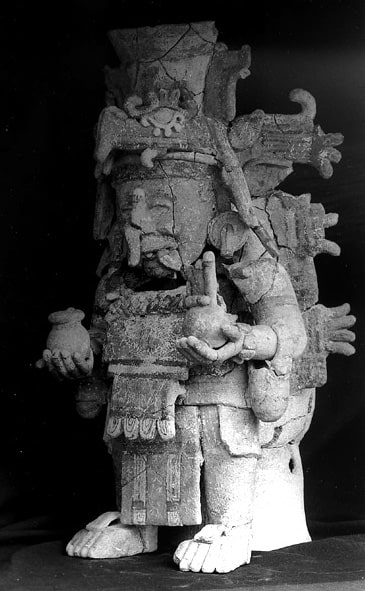
Chaac was one of the most important Mayan gods. First appearing in the archaeological record in the Preclassic Period (c. 2000 BCE – 250 AD), the worship of Chaak is at least a few thousand years old – and odds are much older.
In ancient societies like the Maya city-states, rain was everything. If you didn’t get enough rain, your farmers couldn’t grow enough crops, and people went hungry. If this happened enough, rulers looked weak and unfavored by the rain god. This dependence on rain led to Chaak becoming a highly important Mayan god. The political fallout of a lack of rain could be one reason by Chaak was closely associated with rulership as well.
But what about Chaak himself? The Maya pictured him looking more or less like a human being. Unfortunately for Chaak, they also imagined him as a not altogether attractive human. While he stood one two legs and had two arms that he used to wield a lighting axe – you know, normal human stuff – his skin was also covered in scales, his eyes were large and building, and his nose was long and drooping, looking more akin to a small elephant trunk than a nose. The image below gives us a good ideas as to how the Maya imagined his face in particular.
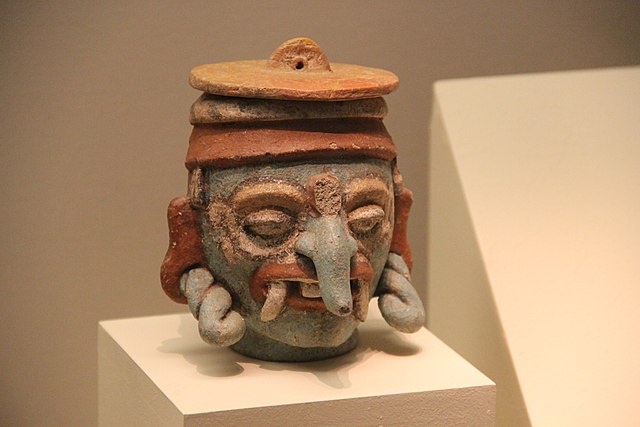
Apart from acting as the god of rain, Chaac had other responsibilities in the Maya conception of the universe. In fact, he took on four distinct roles as the bringer of clouds, thunder, lightning, and rain. He thus was associated with water sources like rivers, springs, and cenotes – the latter of which held special meaning in Mayan religion.
Chaac and the Four Cardinal Directions
An interesting parallel exists between Chaac’s role as the Mayan god of four different weather events and another part of the Mayan world split into four, the cardinal directions.
In Mayan culture, the cardinal directions – east, west, north, and south – held significant symbolic meaning. For the Maya, the east and west held particular importance, primarily because they were the points where the sun rose and set. As scholars have noted:
“‘East’ is the entire section of the horizon where the sun rises throughout the year, from solstice to solstice. This quadrant is symbolized in the layout of Mayan sites by the E-group complexes found at Uaxactun and other places. ‘West’ is the corresponding quadrant where the sun sets.”
North and south were conceptualized as secondary to east and west, derived from the primary celestial directions. The Maya’s view of north and south diverged from modern Western thinking. While we might consider north as “up” and south as “down,” the Maya associated north with the left-hand quadrant of the sky, and south with the right-hand quadrant.
Additionally, each cardinal direction was linked with a specific color in Mayan tradition, reflecting the cultural significance of these points in the natural and spiritual world:
- East was represented by the color red.
- West was associated with black.
- North was symbolized by the color white.
- South was linked to yellow.
To get back to Chaac, in Mayan belief the rain god was made up of four parts:
- Chaak Xib Chaac, Red Chaac of the East
- Sak Xib Chaac, White Chaac of the North
- Ex Xib Chaac, Black Chaac of the West, and
- Kan Xib Chaac, Yellow Chaac of the South
These four parts were known as “the Chaacs” and could be worshipped independently, with different Chaacs holding more sway in different areas of the Mayan world.
Rituals and Ceremonies for Chaac
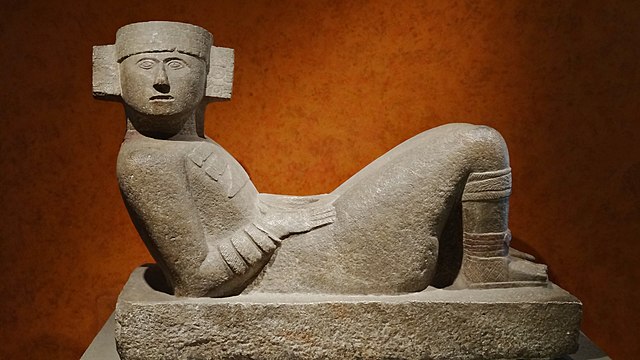
The ancient Maya had many important religious rituals and ceremonies. Several of the ones that involved Chaak incorporated a sacrificial element.
In ceremonies known as Cha’a Chaak, the ancient Maya would prepare a sacrificial altar that represents the center of the world, where they would offered food to gods, including the rain god. This ceremony has proved an enduring part of Mayan culture, so much so that modern Maya still practice this ceremony with the Christian god incorporated into it.
While I’m always hesitant around reports of human sacrifice – as human sacrifice and cannibalism were often reported by Europeans to gain support for imperial efforts back home – modern scholars seem to agree that it was indeed a part of Mayan religious practice.
In Mesoamerican religion, the world was created when demi-gods sacrificed themselves to the full-fledged gods. One of the Mayan creation myths tells us that characters known as the Hero Twins sacrificed themselves while in the Underworld in order to achieve divine status, after which they became the moon and the sun. Because of their sacrifice the world could be created, thus, to keep the world running meant more sacrifice.
The Maya did not practice sacrifice as frequently as the Aztecs would after their rise in the fourteenth-century. When they did, however, it seems Chaak played an important role. Given the rain god’s central role in keeping the Mayan world afloat (no pun intended), it would be natural within the Mayan cosmology to offer him sacrifices.
Using sculptures known as chaac mool (like the one above), Mayan priests would offer the blood and hearts of sacrificial victims (drawn largely from prisoners of war). They did this by collecting the sacrificial offering in a bowl and placing it on the chaac mool during the ceremony in the spot on sculpture where the god’s hands meet this stomach.
Sources on Chaac, Mayan God of Rain
- Lynn V. Foster, Handbook to Life in the Ancient Maya World (New York, NY: Facts on File, Inc., 2002): 167
- “The Mayan Pantheon: Gods and Goddesses,” historyonthenet.com
- Joshua J. Mark, “The Mayan Pantheon: The Many Gods of the Maya,” worldhistory.org
- Nicoletta Maestri, “Chaac, the Ancient Mayan God of Rain, Lightning, and Storms,” thoughtco.com
- Ibid
- Jim Reed, “Maya Spirituality, continued,” mexicolore.co.uk
- “Creation Story of the Maya,” maya.nmai.si.edu
- Carl B. Johnson, “The Chacmool and Ballgame (1),” mexicolore.co.uk