Viking Weapons and Their Role in Warfare
For two centuries, Viking warriors launched successful raids and carved out kingdoms across Europe. Their skills in battle were so renowned that the Byzantine Emperor even employed Norse bodyguards! But, what made them so good? While the full answer may be lost to time, part of the equation is certainly the large array of Viking weapons these warriors carried into battle.
Offensive Viking Weapons
Swords, axes, and spears were the main weapons of the Viking period, with a Viking seax thrown in for good measure from time-to-time. Let’s explore why these weapons became part and parcel with Viking warfare and they were used on the battlefield.
Swords
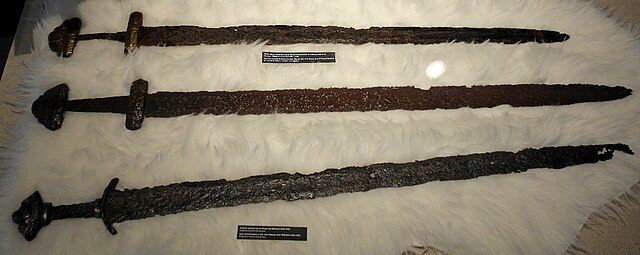
Swords were the crème-de-la-crème of Viking weapons. Coming in at around 90 cm (or three feet) in length, and weighing between two-and-a-half and five-and-a-half pounds, this formidable weapon could do some serious damage. But, not everyone was just walking around with a sword strapped to their waist. Viking swords were weapons of the elite. Expensive to source, swords were either manufactured in Scandinavia or purchased from swordsmiths in the large and powerful Frankish Empire. Since swords were such precious items, they were often passed down through the generations. There were even cases of Vikings who used swords that were over a hundred years old!
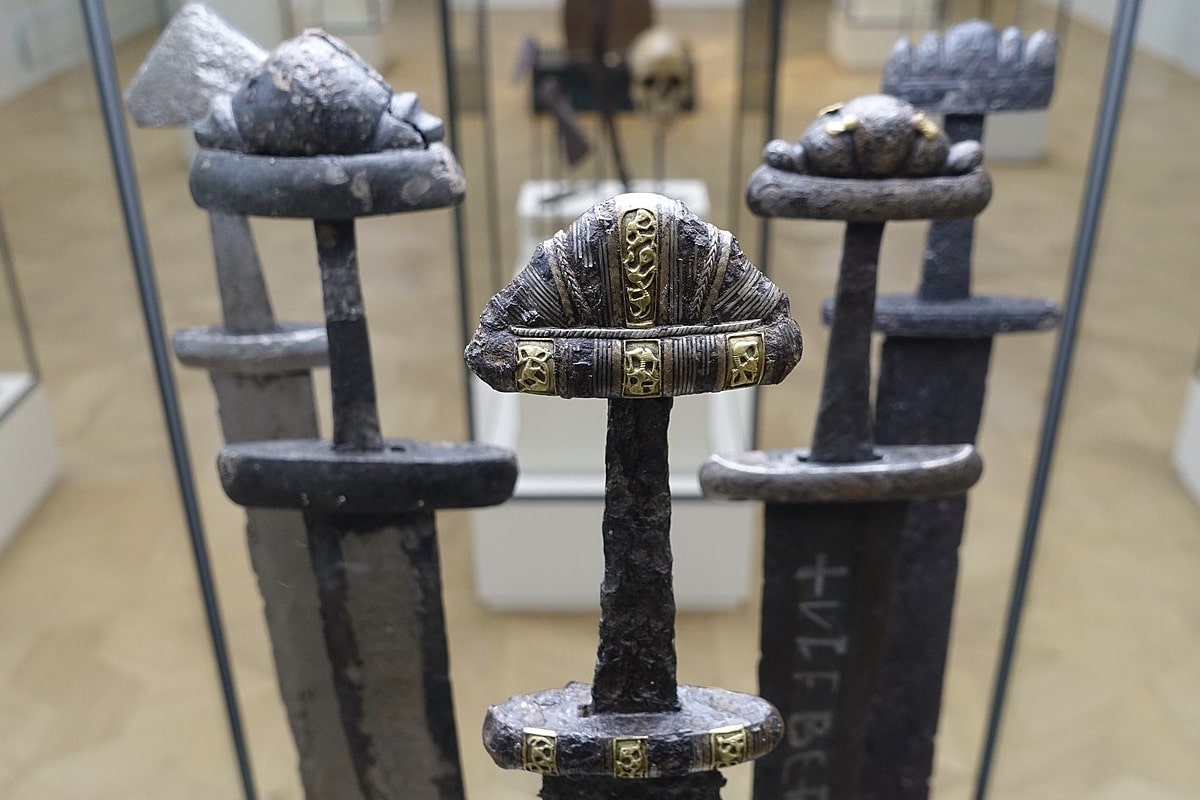
Fortunately, archaeologists have uncovered a lot of Viking swords throughout Scandinavia – and by a lot I mean over 2,000! – so we know exactly what these menacing weapons looked like. Viking swords were made up of four distinct parts: the blade, the fuller (also known as the “blood channel”), the quillon, and the pommel.
- The blade is the main part of the sword that does all the nasty work. Ideally, the sword’s owner kept the blade’s edges sharp, increasing its effectiveness in battle.
- The fuller was a divot carved into the blade in order to reduce the weight of the sword without decreasing its striking power.
- The quillon was a bard that sat between the blade and pommel, thus protecting the swordsman’s fingers.
- Lastly, the pommel was that bulbous looking thing on the bottom of the sword’s hilt. This helped to add balance to the sword’s weight and could serve as a weapon in-and-of-itself.
Given the punishing abilities of their swords, it’s unsurprising that Viking warriors gave them rather menacing names like ‘War Snake,’ ‘Widow Maker,’ ‘Odin’s Flame,’ ‘Torch of the Blood,’ ‘Battle Flasher,’ and ‘Leg-Biter.’
Axes
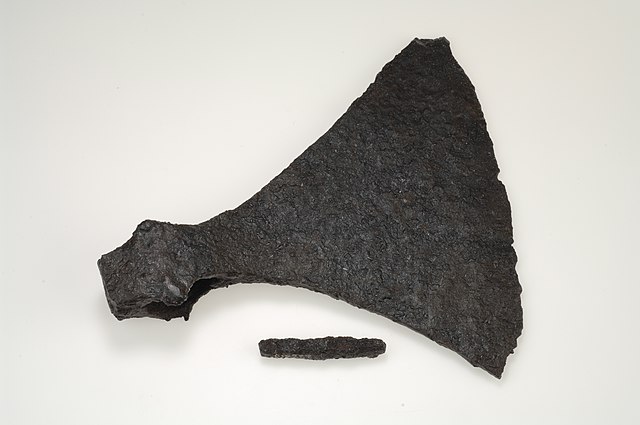
Unlike swords, most Norse people in the Viking Age would have had an axe. This could have been because the Norse used a lot of wood: their homes and ships were built from it; they used it to make the fires that warmed their halls and cooked their food; they even (spoiler alert) used it to fashion most of their weaponry, from shield and spears to bow-and-arrows. And, they needed axes to chop all that wood.
Many Norse people would probably have used these wood cutting axes in battle as well, especially if they had to defend their village or town from a raid. But the Vikings loved their axes and didn’t stop at dreaming up just one type of axe. When it came to warfare, the Vikings also employed different battle axes which were fashioned specifically for fighting.
The most famous of these Viking axes is the Danish axe. This battle axe had a large, but very thin blade, meaning it dealt serious damage while not weighing down the weapon. This blade was then placed on a wooden pole so large (probably over 3 feet) that warriors had to wield these axes with two hands.
Another type of battle axe had a “bearded” blade. This meant that the bottom of the axe blade had a slight curve to it, allowing a Viking warrior to hook an enemy’s shield or, if they were skilled enough, hook the opposing combatant’s own weapons or limbs. Any of these scenarios would lead to a serious disadvantage, making the bearded blade a real menace on the Medieval battlefield.
Battle axes did have their downsides, though. The effectiveness of the axe was dependent upon how much force the warrior could put behind a large, arching swing. So, if they missed their target, the axe’s wielder would either get their weapon stuck in the ground or lose their footing – neither of which are good on in the heat of battle.
Spears
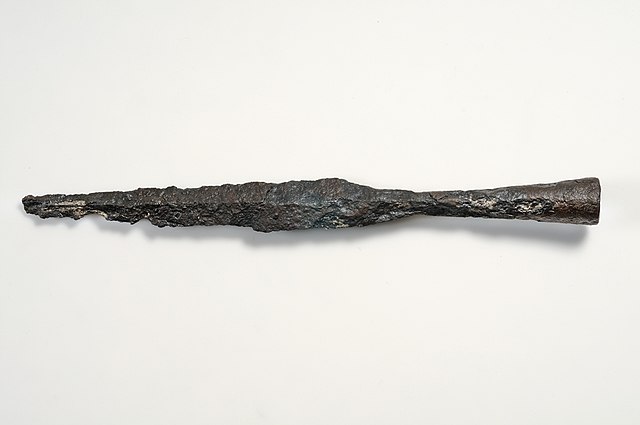
Perhaps the most common weapon in the Viking world, spears were as versatile and lethal as any Viking weapon. Used to repel attackers from a distance, spears could be thrown at oncoming combatants or wielded in close-quarter fighting. Since their shafts were made of wood, few have survived to the present, but due to written sources historians estimate that spear shafts were 7- to 10-feet long. These large, but light, weapons would have taken serious skill to use effectively in battle.
Unlike swords or finely crafted axes, the ability to have a spear was not determined by one’s wealth. The small amount of iron needed to construct the spearhead meant that people from every free level of Norse society. Their relative affordability also meant that many Viking warriors went into battle carrying multiple spears – one for throwing and one for fighting.
What sets spears apart from other Vikings weapons, however, is the symbolism that links them to the chief Norse god, Odin. In Norse mythology, Odin carried a magical spear into battle. Named Gungnir, the spear never missed its target, making it the most dangerous weapon among the Norse gods. While the exact reason the Norse believed that Odin carried a spear into battle rather than a sword or axe has been lost, the fact that they did shows their high level of reverence for this seemingly basic weapon.
Seaxs
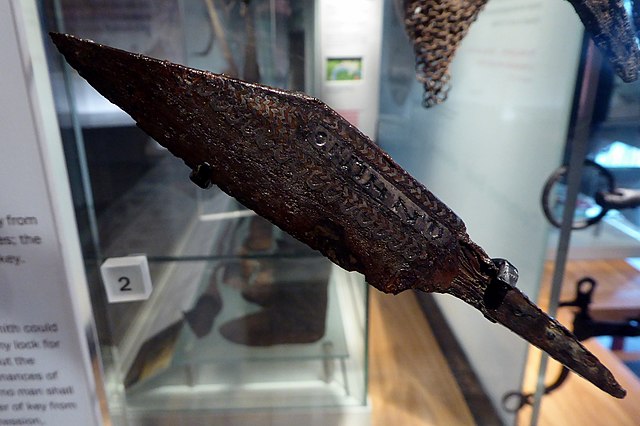
The Viking Age was a dangerous time in Europe. As such, it was not uncommon for people, particularly men of fighting age, to carry weapons with them wherever they went. The Viking seax proved a popular option for many. Interestingly, despite its popularity among the Norse, the various types of seaxs are remembered by their Old English names, “seax” itself being an Old English word to denote this particular type of knife.
Essentially a large knife fashioned to look more like a sword, seaxs were especially dangerous in very close-quarter combat. There were two different types of saxes available: the injury knife (or scraem seax in Old English) and the long knife (or lang seax). Though both versions of this Viking weapon could prove dangerous in the hands of an expert, historians typically categorize seaxs as a last resort type weapon given how close one would have to be to their attacker for it to prove useful.
Whether in battle or just out-and-about, seaxs were generally carried in a small, leather sheath that hung from a belt around the bearer’s waist. A Viking never wanted to reach far for their weapon, after all!
Defensive Viking Weapons
Viking weapons weren’t all offense, though. Shields and armor were an important part of their wartime regalia, because, like any good coach will tell you, defense wins championships (or, you know, plunder).
Shields
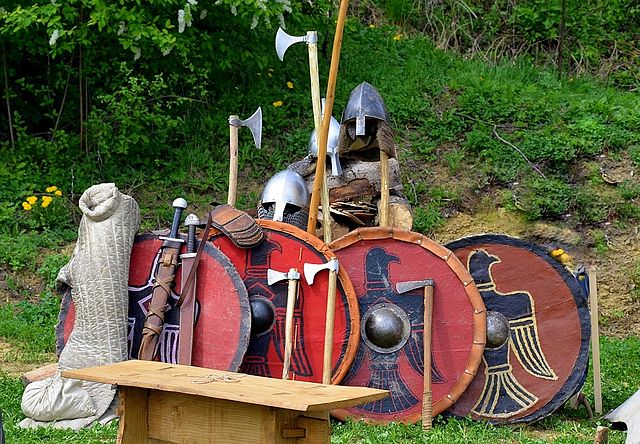
Viking shields were an indispensable part of battle. Measuring a meter (a little over three feet) in diameter, shields covered most of a warrior’s body. Made by strapping parallel wooden boards together, a Viking shield had a remarkable ability to absorb blows (at least, you know, for wood). Additionally, shields had an iron grip Vikings warriors held onto, which was covered by an iron semi-circle known as the “boss.” Though these iron bosses were meant to protect the shield holder’s hand, they could also serve as an offensive weapon in a pinch.
Thanks to some important archaeological finds, we’ve been able to piece together some of the more aesthetic details about Viking shields as well. In a large burial site in Norway, archaeologists unearthed 64 shields, each covered in blue and yellow paint. A few of the shields also had a thin layer of animal skin, which scholars believe helped to add an additional layer of protection. Due to this find, in conjunction with written evidence from the Viking Age, we know that Vikings added decorative elements to their shields, potentially as a way to identify themselves in the heat of battle.
Viking Armor

The armor that a Viking warrior wore into battle depended largely on their wealth and standing in society. The average person would have access to only a leather jerkin (basically jacket) and a leather helmet. Can you imagine going to a medieval battlefield with less protection than a 1920s football player? No thanks…
More well off Vikings had access to more sophisticated armor, such as the image above. The well-to-do Norsemen would have had metal, conical helmet (sadly horned helmets did not actually exist) and a shirt of chain mail that extended below the knees. Since these Viking warriors would have protected their torso with a shield, the main job of this chain mail was to protect their legs from sword or spear slashes.
How Battles Went Down
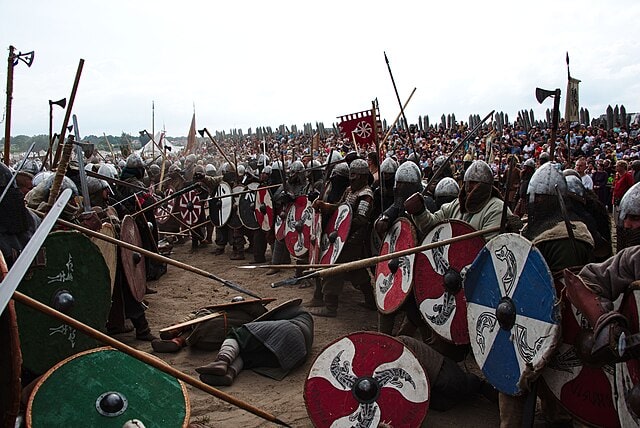
But, how did these Viking weapons get employed in battle? Whether it was a land-based war against other Scandinavians or an amphibious attack elsewhere in Europe, Vikings had the same general battleplan.
First, archers would kick off the festivities by launching volleys of arrows against the opposing force. Once they had weakened the enemy as much as they could with their arrows, which could hit their target from 600 feet away, it was time for the spears. Since nobody can throw a spear 600 feet, Viking warriors drew closer to their before letting their spears fly.
Finally, when Vikings reached the enemy lines, it was time for close-quarter combat with swords, axes, spears, and seaxes. The main tactic with these weapons was to use them in a slashing motion. This general melee would continue until one side won.
Sources on Viking Weapons
- Martin Arnold, The Vikings: Culture and Conquest (New York: Hambledon Continuum, 2006), 59 and “Viking Weapons,” jorvikvikingcentre.co.uk
- “Viking swords,”en.natmus.dk
- Arnold, The Vikings, 59
- “Viking Weapons,” jorvikvikingcentre.co.uk
- Arnold, The Vikings, 59
- “Viking axe,” en.natmus.dk
- “Viking Weapons,” jorvikvikingcentre.co.uk
- Alex Bond, “Viking Spears,” virtualvikings.sites.grinnell.edu
- Ibid
- Michael Haskew, “The Spear, Axe & Sword: Viking Weapons,” warfarehistorynetwork.com
- “Viking Weapons,” jorvikvikingcentre.co.uk
- Ibid
- Richard Hall, The World of the Vikings (New York: Thames and Hudson, 2007), 68
- Ibid
- Hall, The World of the Vikings, 68
- Ibid
- “Viking shields,” en.natmus.dk
- “Viking Weapons,” jorvikvikingcentre.co.uk
- Arnold, The Vikings, 60
- “Viking combat techniques,” en.natmus.dk
- Ibid
- James Graham-Campbell, The Viking World (London: Frances Lincoln, 2013)