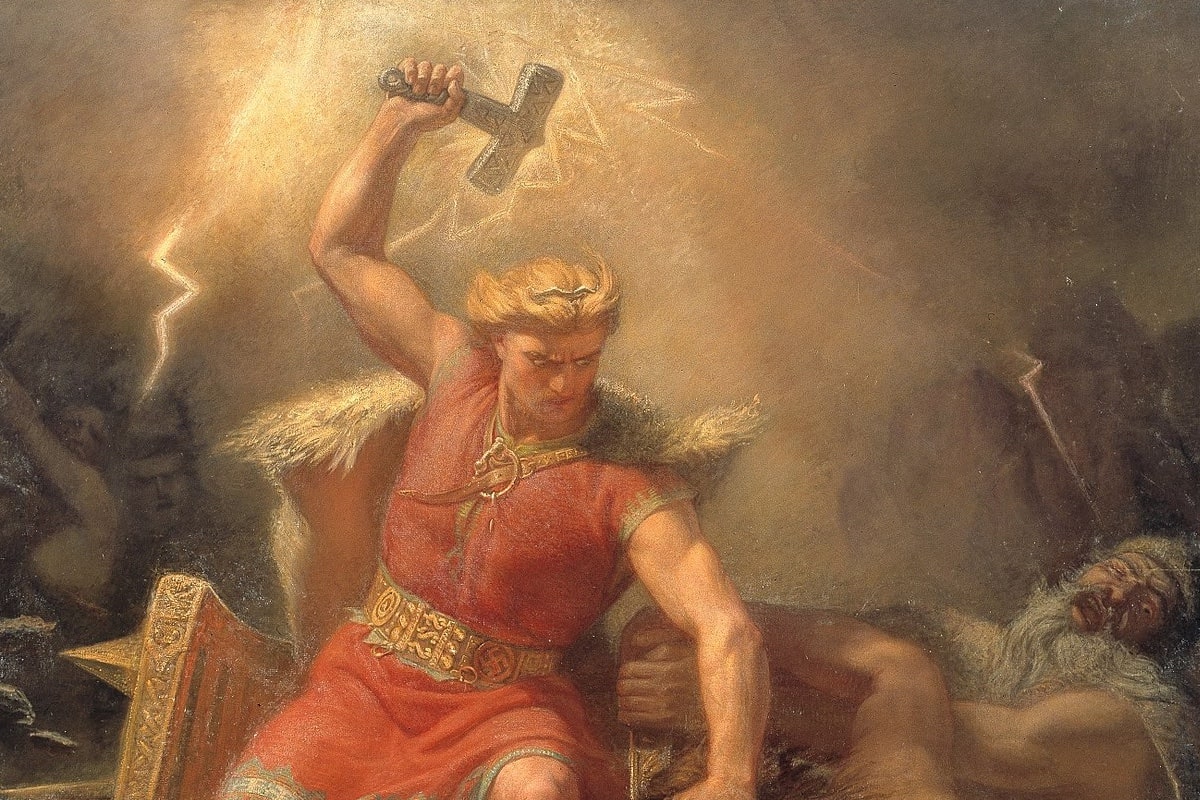
Mjolnir Symbol and Its Meaning Explained: It’s Hammer Time!
Thor’s hammer, known as Mjolnir in Old Norse, has been a powerful symbol for millenia. From its origins among the Germanic people of ancient northern Europe, it was carried far and wide by Viking explorers. Then, thanks to their, let’s call them escapades, in England, Francia, and eventually Iceland, they carried the Mjolnir symbol into legend.
Getting to Know the God Thor
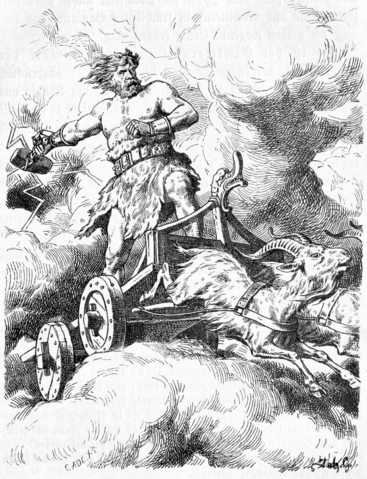
Thanks to the magic of Hollywood, Thor is perhaps the most recognizable name from the Norse pantheon. Unfortunately, the Thor of Norse mythology probably wasn’t as hunky as Chris Hemsworth. Often portrayed as temperamental and somewhat dumb, he also had bushy eyebrows and red hair.1 Far from the perfectly preened Aussie we all know and love.
Thor played several key roles in the Norse pantheon. The son of Odin, Thor was the god of thunder, the sky, and agriculture, as well as a skilled warrior and one of the principle guardians of Asgard, the realm of the gods.2 To protect Asgard from the various supernatural ne’er-do-wells of the Norse mythological universe, Thor equipped himself with four main pieces of weaponry: his hammer, Mjolnir (more on this later); magic gauntlet (basically metal glove) that gave him to hold Mjolnir; a belt called Megingjörð that improved his already considerable strength; and (my personal favorite) a goat-drawn chariot.3
An ancient god, the worship of Thor occurred across all pre-Christian Germanic cultures in the Bronze Age (c. 2,000-500 BCE) and Iron Age (c. 500 BCE – 100 CE). By the time of the VIking Age (800-1,050 CE), Thor’s strength meant that, among his other godly duties, he was viewed as a protector god. This evolution made Thor a popular god among all social classes of Norse society. But he was also so much more! The Norse would have asked Thor to bless marriages, provide good harvests, protect sailors on long voyages, and for victory in battle.4
Turns out, Thor was quite the polymath!
Thor’s Hammer in Norse Mythology
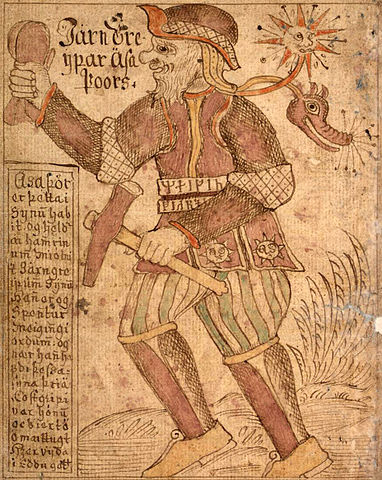
The Mjolnir symbol has a long, storied history in Norse mythology. As the principal weapon for one of the Vikings’ most powerful gods, this hammer got into quite a few adventures.
Mjolnir’s Origin Story
According to Norse legend, Mjolnir – the mightiest weapon among the gods – was created as a result of some shenanigans. Loki, the god of fire and trickster par excellence, decided one day to steal a lock of hair from Thor’s wife, Sif. Unhappy with this, Thor gave Loki an ultimatum – fix the situation or die. So, Loki made his way to the land of the dwarves, the finest craftsmen in Norse mythology.
Originally, Loki had gone to persuade them to make Sif a new lock of hair out of gold. Once he arrived, though, Loki did Loki things and tricked the dwarves into making a suit of weapons for the gods by asking them to prove which one was the best craftsman. But, pain in the ass that he was, Loki turned himself into a fly and buzzed around the dwarf who made Mjolnir, which caused the annoyed dwarf to slip up and make the hammer’s handle too short.
After all was said and done, Loki returned to Asgard with Thor’s hammer, Odin’s spear (Gungnir), and a few other prized weapons of the gods.
Mjolnir’s Functions and Abilities
Mjolnir was more than just a weapon, however. It possessed magical properties. When Thor threw Mjolnir, the hammer would always return to him, like a boomerang. And, though Thor was already a god, Mjolnir made him invincible in battle, as it killed all of Thor’s enemies with a single blow.
As a result of Mjolnir’s strength, the Vikings believed that lightning bolts were Mjolnir streaking to earth and that thunder was the sound of the mighty hammer making contact with an enemy combatant.
That Time Thor’s Hammer Was Stolen…
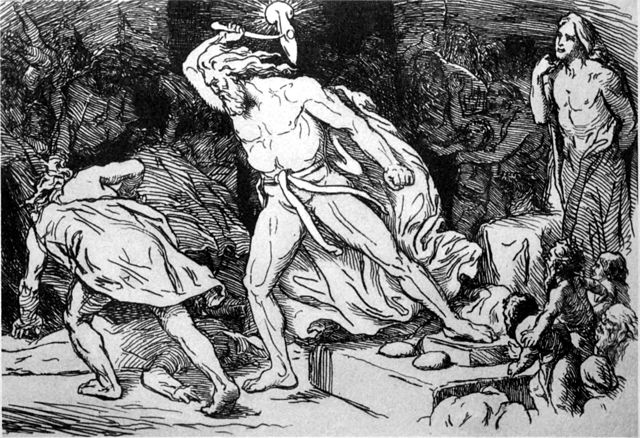
Mjolnir was so powerful that some scholars have argued that Thor was essentially powerless without it. In a tale that comes to us from the Prose Edda, Mjolnir was stolen by a giant named Thrym while Thor slept and held it ransom in exchange for the goddess Freyja’s hand in marriage. Frejya, in turn, gave such an emphatic “no” that Asgard itself shook. So, to get Mjolnir back, Thor had to team up with Loki to play a trick on the giants.
Dressing up as Freyja, Thor traveled with Loki to the land of the giants, Jotunheim. When they arrived, they joined a feast where Thor apparently pigged out, eating an entire ox and a handful of salmon, while drinking a full barrel of mead. Thrym got suspicious, but Loki played it off by telling the giant Freyja had been starving herself for several days to prepare for meeting him.
By the end of the night, Thyrm was convinced that fake-Freyja wanted to marry him. So, he placed Mjolnir in Thor’s lap as a wedding gift. With his hammer back, though, Thor went into full Thor mode and killed all the giants in attendance.5
Aside from all the interesting questions it brings up about gender in Norse society, this story also shows that Thor was no match for the giants he was tasked with guarding Asgard from without his hammer. Otherwise, why trick them to get the hammer back rather than just taking it by force?
Viking Age History of the Mjolnir Symbol

As long as people have believed in Thor, there were probably always people who used the Mjolnir symbol to display their veneration. The Viking Age, though, is where we see a real explosion of hammer symbols throughout Viking lands.
Especially popular were hammer pendants that people wore as necklaces. Excavations across Scandinavia have turned up Mjolnir pendants of varying degrees of intricacy, from ornate ones like the image above to more simple necklaces most likely work by the commoners of Norse society. Around the same time that Thor’s hammer became a vogue fashion choice, Christianity started to penetrate into Viking territories and belief systems.6 While we can’t know exactly why the explosion of Mjolnirs and the appearance of Christian crosses coincide in the archaeological record, scholars have proposed a few compelling theories.
For one, it’s possible that Vikings who stuck to the traditional beliefs of the Norse people began displaying their beliefs more openly in reaction to their neighbors’ conversion to Christianity. Other theories suggest that, as in many polytheistic societies, it was possible to believe in both Christ and Thor, and thus wear both a cross and a hammer (or a pendant that looks like a mashup of the two symbols).7
No matter the reason for the widespread use of Mjolnir as a necklace, it shows how important Thor was to Norse society. In the eleventh-century, an English author named AElfric recorded that the Roman equivalent of Thor was Jupiter, the Roman’s chief god.8 This direct observation of Viking practices, along with the sheer amount of hammer pendants found from Iceland to England to Norway and Sweden, suggest that, on the ground, Thor was the most important Norse god.
Modern Uses of Mjolnir

The modern uses of the Mjolnir symbol range from fun and irreverent to hateful. Since I like to got out on a high note, let’s cover the bad stuff first.
Similar to other ancient Germanic and Viking symbols, like the swastika and valknut, the Mjolnir symbol has been adopted by white supremacists. These racist versions of Mjolnir are often used by those who follow a white supremacist version of neo-Norse beliefs called Odinism.9 But, because I’m unwilling to down this internet rabbit hole, that’s all the research I’ve done on this topic.
On to cheerier examples!
Believers in the neo-Norse religion Asatru incorporate the hammer of Thor into their worship. In this practice, Mjolnir represents the power of Thor, much like it did for Viking Age believers, and they use it to connect with these ancient traditions.10
And, lastly, Marvel! From Mjolnir’s short handle and its boomerang ability to anyone else’s inability to pick it up, it turns out the movies got a lot right.
Sources on the Mjolnir Symbol
- “Thor – a temperamental thunder god,” historiska.se
- Joshua J. Mark, “Thor,” worldhistory.org
- Ibid
- Ibid
- “Thor – a temperamental thunder god,” historiska.se
- Daniel McCoy, “Thor’s Hammer,” norse-mythology.org
- Ibid
- The Viking World, 157
- “Thor’s Hammer,” adl.org
- Prof. Geller, “Mjölnir,” mythology.net