Mayan Art: Depicting the Ancient Maya World
Mayan art was one of the richest artistic traditions in the entire ancient world. Over centuries, ancient Maya artists created works from clay, stone, paint, and more that have survived to our day. Through their creations, we can learn quite a lot about their world.
Important Forms of Mayan Art
The ancient Maya created art across a variety of media. From pottery that could fit on your shelf to towering works of architecture that still rise about the Mesoamerican jungle, Maya artists were constantly creating. Let’s take a look at some of the most prominent forms of Mayan art to see what they have to tell us.
Pottery

Some of the most compelling insights into Mayan art come from their ceramics. Far beyond mere utility, Maya pottery served as a medium for artistic expression, political messaging, and ritual significance. Because the ancient Maya produced such a vast array of ceramics, scholars have long debated how to categorize them. Here, we’ll focus on two key styles that highlight the artistic and cultural sophistication of Maya society.
Polychrome pottery, developed during the Classic Period (c. 250–900 CE), is one of the most recognizable forms of Mayan ceramic art. These multicolored vessels, found in sites across the Yucatán, Guatemala, Belize, and Honduras, often depict scenes from mythology and royal life.1 Vases, plates, and bowls were painted with vibrant pigments, showcasing the skill of Maya artisans. Many of these pieces have survived thanks to their use in elite burials, where they were interred with nobles as symbols of status and identity.2
Equally important are codex-style vessels — fine ceramics that combine vivid imagery with hieroglyphic texts. Written in the Primary Standard Sequence (PSS), these inscriptions reveal how the vessel was made, what it contained (often chocolate), and who it belonged to. This fusion of visual storytelling and written language offers rare insights into Maya belief systems and royal lineages.3
Codex-style vessels were primarily produced in Calakmul (modern Campeche) and Guatemala’s Petén region.4 They stand as masterpieces of Mayan art, blending craftsmanship with intellectual depth. Whether through colorful polychrome scenes or glyph-laden codex vessels, Maya pottery remains a vital key to understanding this ancient civilization’s art, society, and spiritual life.
Sculpture and Statues
Maya civilization produced a lot of great sculptors who carved their works from a variety of materials, including stone, wood, bone, clay, shells, and stucco.5 Maya sculpting traditions began taking shape (pun intended) during the first millennium BCE – about 3,000 years ago. In this early stages of Maya sculpture, Maya artists took great inspiration from the Olmec civilization which boarded them to the north on Mexico’s gulf coast.
As Maya civilization evolved and great kingdoms began to dominate the Mayan homelands of southern Mexico, Guatemala, El Salvador, and Belize during an age known as the Class Period, their statues and sculpture became distinctively Mayan. From small figurines made out of ceramic to large, imposing stone sculptures that adorned royal palaces, these works of Mayan art showed what was most important to the Maya conception’s of their world. While we’ll get into this more below, many of the statues that survive depict the life and accomplishments of kings and nobles or the nature of gods.
Because of the importance of sculpture within the Maya artistic lexicon, the great sculptors often signed their work. One such artist was named Chakalte’. Even though he lived in the eighth-century CE, we can still pinpoint this sculptor’s works and, subsequently, their artistic style.6 Something about someone’s name and work surviving for over 1,000 years just blows my mind.
Architecture

The ancient Maya were incredible architects and builders. To this day their pyramid-temples tower above the Mesoamerican treeline. Originally built as temples, these massive pyramids were constructed in the step-pyramid style – a series of progressively smaller squares stacked on top of one another to create the pyramidal shape. At the front of these pyramids, a large staircase led to the top level. Some Maya pyramids were built so that priests could access this top layer to conduct ceremonies (and apparently get a great workout in too). Other pyramids, however, were off limits to all humans once their construction was complete, a sign that the Maya believed their gods were able to walk among them.7 Interestingly, archaeologists have found pyramids that contain several smaller pyramids within them, almost like a nesting doll of ancient stone. Even crazier, each of these levels had their own murals and decorations.8 While modern day observers probably know the Maya best for these immense pyramids (and why not!), their palaces were equally impressive.
Massive in scale, Maya palaces were the residences of kings, their family, and their court. Multi-story buildings, the king conducted the everyday business of his realm within its walls, from conducting trade and collecting tributes, to dealing with legal disputes and more.9 The size and scale of a palace was thus a direct indication of kings’ abilities to control the resources of their area. Over time, kings in powerful cities like Tikal, Tulum, and Palenque added to the palaces they inherited from their predecessors. In this way, important city-states came to house massive palace complexes, complete with courtyards, intricately painted walls, towers, and homes for the non-royal residents.10 Palace construction also echoed Maya belief about the afterlife, with upper levels containing thirteen doors (the number of strata in heaven) and the lower levels having nine windows (the number of levels of the underworld).11
Murals

Murals are one of the big parts of ancient Mayan art that archaeologists and historians are still uncovering and working to understand. To get a better understanding of Maya murals and what they can tell us, let’s explore the most well known and preserved example: the murals at Bonampak.
Discovered by archaeologists in 1946, Bonampak is an ancient Maya site in the Chiapas state of southern Mexico. Experts have been busy excavating and preserving this incredible find in the decades since. Painted at some point during the Late Classic Period (600-900 CE), the murals at Bonampak are the most intact yet found from the ancient Mayan world. The fact that these murals sat relatively undisturbed for 1,000ish years means they have a lot they can tell us about life and art in ancient Bonampak and the Maya world more generally.
What murals tells about Mayan art
Since this is an article about Mayan art, let’s start with the artsy stuff! The artists who created the murals at Bonampak used every inch of available space. The walls of the formerly great palace are covered in scenes of Maya courtly life, war, and more. Even some of the benches where the visitors or royal residents would have sat have scenes on them. Talk about making the world your canvas! To make these stunning works of art, Maya artists employed over thirty different pigments, giving us a true sense of what clothes, weapons, instruments, and other accouterments of daily life would have actually looked like.12 WIth such a rich combination of colors, the artists were able to bring multiple scenes from the Mayan past (or I guess their present) vividly into life.
What murals tell us about Maya life
From Bonampak, we also get glimpses into Maya celebrations, kingship, and war. The excavated part of the complex is divided into three rooms (creatively dubbed Room 1, Room 2, and Room 3) and each room’s murals address different themes of the ancient Maya world.
In Room 1, the murals depict celebrations and dancing. More specifically, they depict a royal celebration, potentially marking the complement of the Bonampak palace as one inscription in this room is a record of the dedication of this building in 792 CE. But whatever the reasons for the season, we get a pretty good idea of how Maya nobility would have turned out for a celebratory bash. In one panel, we see royal children decked out in quetzal feathers (highly prized among all Mesoamerican peoples) performing a “quetzal dance.” On all sides of the dancing youths, processions of musicians and performers make their way toward Bonampak from every direction. Finally, a group of messengers (ebeets in Maya) stand apart from the festivities, apparently uninterested in the general frivolity of the day.13
In Room 2, the artists recorded a military victory for Bonampak’s most famous king, Yajaw Chen Muwaan – who noticeably stands apart from the action on top of a pyramid. In the Room 2 mural, we see the forces of Yajaw Chen Muwaan well clad in Mayan armor, while their defeated foes are shown without armor or weapons.14 The defeated warriors are then ritually tortured and sacrificed. These scenes give us an idea of what elite Maya warriors would have worn into battle, the role of kings in warfare, and the potential fate of captured enemy combatants.
Finally, in Room 3, we find what appears to be a celebration following a ritual sacrifice. An image of a dead man with his heart removed lies over the door. On the surrounding walls, we see dancers dressed in different regalia performing on the steps of a pyramid, messengers looking on over the festivities, and royal women seated on a throne taking it all in.15
Common Motifs in Mayan Art
The ancient Maya were prolific artists. Through their work they left us a window into their world and their minds. When we peer through this window into the past, some common motifs from Mayan art stand out, namely the power of their religion and their rulers.
Religious Scenes
Ancient Maya society was highly religious and Mayan art reflects this piety. From depictions of the gods to scenes taken from the tales of their lives and exploits, Maya artists drew a lot of inspiration from their pantheon of deities.
When it came to the materials used and size of the art created to depict these religious scenes, Maya artists weren’t picky. Artists used jade, stone, ceramics, paint (and probably other forms, like wood, lost to time) to create representations of the gods that varied from massive sculptures to items of jewelry meant to be worn by the rich and powerful.16
One of the most famous pieces of Mayan art are the Kukulkan heads that adorn the base of the pyramid at Chichen Itza. The size of these heads and the detail the artists included demonstrate both the skill of Maya stone masons as well as the reverence they felt for the Feathered Serpent god. After all, artists throughout history haven’t tended to take on religious themes without some kind of deeply held belief or philosophy underpinning it.
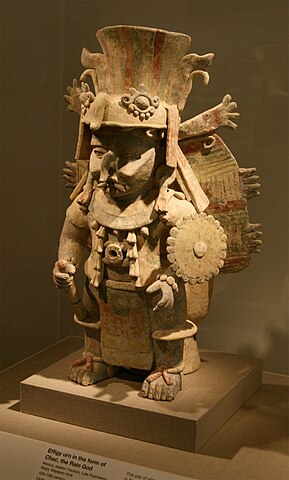
Maya ceramics also have much to tell us about their religious beliefs. One great example of this is a ceramic sculpture of the rain god, Chaac. A highly important god in the Maya pantheon, Chaac’s ability to provide or withhold rain meant he held the fate of Maya crops, and thus their survival, in his hands. As such he cropped up (see what I did there?) in a lot of Mayan art, which lets us see what the Maya thought this important deity looked like. He was a strange looking dude. Chaac had a long, trunk-like nose, scaly flesh, and fangs for teeth. Why we don’t know why the Maya thought Chaac looked this way, it’s still fascinating to get this intimate glimpse inside their minds.
Images of Power
Outside of religious motifs, kings were perhaps the most commonly depicted images in Mayan art. These powerful rulers dominated the political, social, and economic life of their city-states, giving them the ability to patronize the great artists of their time. But like monarchs from all ages of history, when they commissioned a piece of art, it was usually to make them look good. Two prominent examples come to my mind: Yajaw Chan Muwaan and Pakal the Great.
As we talked about earlier, Yajaw Chan Muwaan was the king of Bonampak, the city where archaeologists have found the most intact Maya murals. The murals at Bonampak show Yajaw Chan Muwaan as a victorious martial king. Standing atop Bonampak’s pyramid, he looks on while the prisoners of war taken from a battle he won are sacrificed. While the artistic merits discussed above are plain to see, the subtext (or sub-painting?) of this work is the power and war-time prowess of the king.17
Next up: Kinich Janaab Pakal, aka Pakal the Great. Pakal was the king of Palenque in southern Mexico from 603-683.18 Upon his death, Maya artists created a death mask made of jade. This stunning and surprisingly intact piece of Maya jade work can tell us a lot about how the people of Palenque saw Pakal (and perhaps how he saw himself). Jade was one of the most prized natural resources among the Maya and symbolized wealth, fertility, youth, and vigor within their art. It was also associated with the Maize God, one of the gods associated with life, death, and rebirth.19 By choosing jade for Pakal’s death mask, its creators sought to portray the king’s ability to control the world around him in life and their hope for his ascent to the heavens in the afterlife.
Sources on Mayan Art
- James Doyle, “Ancient Maya Painted Ceramics,” metmuseum.org
- Trustees of the British Museum, “Maya: The Fenton Vase,” smarthistory.org
- Lynn V. Foster, Handbook to LIfe in the Ancient Maya World (New York, NY: Facts on File, Inc.), 2002, 293-294
- Doyle, “Ancient Maya Painted Ceramics,” metmuseum.org
- Ibid
- James Doyle and Steven Zucker, “Chakalte’, Relief with Enthroned Ruler,” smarthistory.org
- “Maya Civilization: Pyramids and Architecture,” ducksters.com
- Mark Cartwright, “Maya Architecture,” worldhistory.org
- Christopher Minster, “Ancient Mayan Architecture.” thoughtco.com
- Ibid
- Cartwright, “Maya Architecture,” worldhistory.org
- Claudia Brittenham, “The Bonampak Murals,” mexicolore.co.uk
- Ibid
- Ibid
- Ibid
- Doyle, “Ancient Maya Painted Ceramics,” metmuseum.org
- Brittenham, “The Bonampak Murals,” mexicolore.co.uk
- Joshua J. Mark, “K’inich Janaab’ Pakal,” worldhistory.org
- “The Tomb of Pakal the Great: A Window into Mayan Culture and Beliefs,” thearchaeologist.org